The Hiace vs Coaster question for a visiting delegation is rarely settled by seats. It is settled by bags, by the last 500 metres to the hotel door, and by whether you can live with the group arriving in two halves. Here is the working rule: a single Hiace carries a group of up to about ten people who each have a checked case; a group of 11 to 15 with hand luggage only can still fit in one van; from roughly 14 people with full luggage, you are choosing between two vans and one Coaster; and once you pass about 16 travellers with bags on a motorway programme, one Coaster normally wins on cost, coordination and arrival time. Above about 24 with checked bags, even a 29-seat Coaster needs help, either a luggage van or a second vehicle.
Hill routes move that switch point upwards. On a Murree, Galiyat or Naran programme with narrow hotel approaches, two vans can beat one Coaster at 18 or 20 people, because a van can reach the door and a bus sometimes cannot. The rest of this guide shows how to test your own group against those thresholds before you ask anyone for a price.
The switch point in one view
Treat the numbers above as a starting position, then adjust for three things in this order:
- Luggage per head. A full-size checked case per person pulls every threshold down by three to five seats in a van. Hand luggage only pushes it back up.
- Route type. Motorway and city work favours the Coaster once the group is large. Hill stations, old-city hotels and tight gated compounds favour vans.
- Tolerance for a split group. If the delegation must walk into a meeting together, or the principal cannot be left waiting for a second vehicle, the case for one Coaster gets stronger.
If you only remember one thing: count bags first, then seats, then the road.
Hiace bus seats vs Coaster seats: what the listings actually say
People searching “hiace bus seats” usually find a figure and stop. The trouble is that “Hiace” covers several bodies and roof heights, and a Pakistani hire fleet can contain more than one generation.
Toyota Hiace
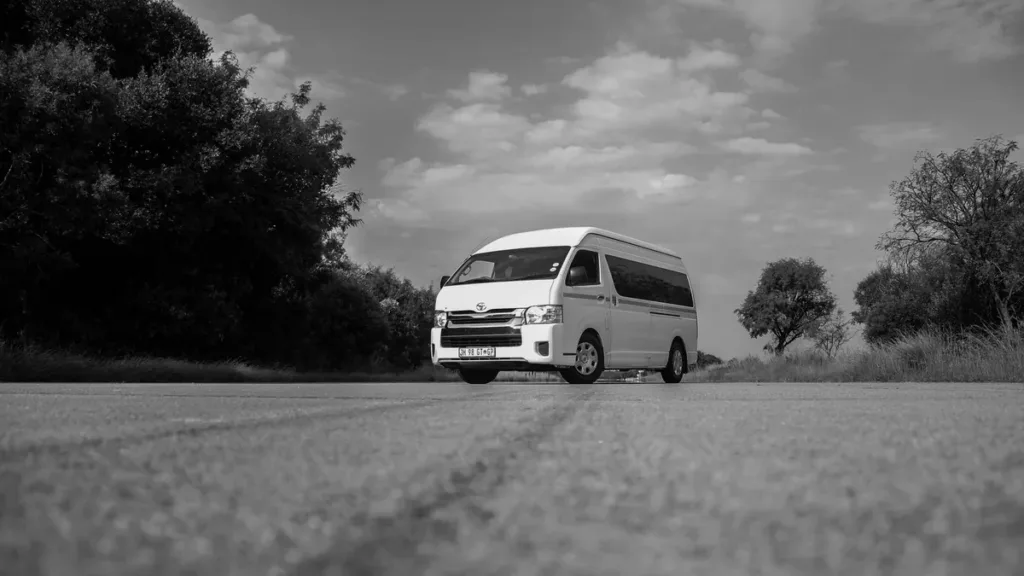
Indus Motor, Toyota’s assembler in Pakistan, sells the Hiace in standard-, mid- and high-roof versions, with a 2.5-litre 2KD-FTV diesel or a 2.7-litre 2TR-FE petrol engine and what it calls a wide, super-long body. Roof height matters more than the badge: a high-roof body is seated and loaded differently from a standard one. Our own listing for the Hiace H200 shows 15 passengers and six large cases, and is candid that the real range is 13 to 15 seats depending on body and bench layout. Across our group-van class the luggage ceiling rises to about 12 large cases, but only in the vans that give up seats for it, such as the Grand Cabin. Fewer seats, far more luggage: that trade is the whole story of van choice.
Toyota Coaster
Indus Motor lists a single Coaster High Roof as a 29-seater, and our Toyota Coaster minibus page uses the same figure. You will also see Coasters advertised in the low twenties. The same body is sold abroad with 22 or 23 seats, and saloon-trim buses with reclining two-plus-two seating come in well under 29: the difference is seat pitch, not size. A 22-seat Coaster with proper legroom is a different vehicle for a delegation than a 29-seat unit set up for staff shuttles, even if both carry the same badge.
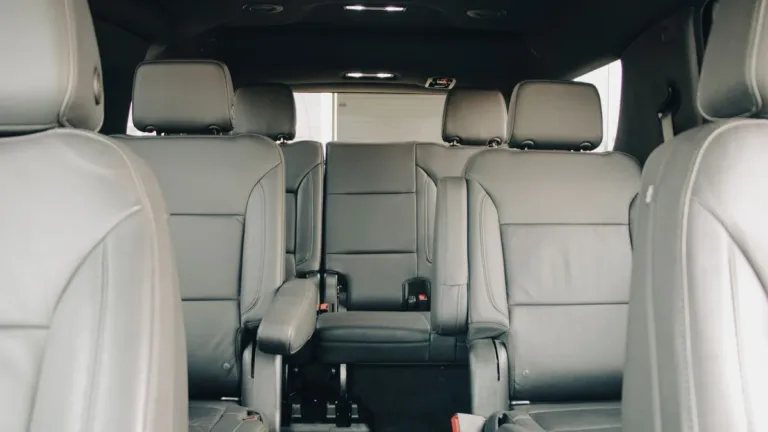
So when a quote says “Coaster”, ask for the seat count and a photo of the cabin. When it says “Hiace”, ask which body: H200, H300 or Grand Cabin. The seat figure alone does not tell you whether a group of 12 in business dress will be comfortable for four hours.
Luggage decides more bookings than seats do
A delegation of 14 flying into Islamabad for a two-day programme will usually bring 14 suitcases, some garment bags and at least one box of printed material or gifts. That load changes the arithmetic completely.
In a van
A Hiace’s luggage lives behind the last row, and every passenger added to that row eats into it. A van running at its full seat count has room for soft bags and little else. In practice a 15-seat Hiace is a comfortable airport vehicle for somewhere around eight to ten adults with one large case each, which is why the Grand Cabin, with fewer seats and a deep rear space, exists at all. Our comparison of how many people and suitcases fit in each vehicle class sets out the loads we plan around.
In a Coaster
Coaster luggage space varies more than people expect. Depending on the body and how the operator has fitted it out, bags may go into a rear luggage area, behind a shortened last row, or onto a roof carrier. There is no under-floor hold of the kind a full-size coach has. A 29-seat Coaster filled to every seat with every passenger carrying a checked case is not a realistic combination; around 20 to 24 people with cases is where it sits comfortably.
Roof carriers are a weather decision
Bags on a roof rack are fine on a dry motorway day. They are a poor choice in monsoon rain, in dust on the approaches to the Salt Range, or on a winter hill run where the bags will be loaded and unloaded in the cold. If the plan relies on the roof, ask for tarpaulin and straps to be confirmed, and keep laptops, documents and anything for the first meeting inside the cabin.
Motorway speed and tolls: what changes when you step up to a Coaster
On the motorway network the practical gap between a van and a Coaster is smaller than most planners expect, but it is not zero.
Speed limits by vehicle class
In June 2026 the Motorway Police confirmed that the speed limits on motorways and highways had been restored to 120 km/h for cars and light transport vehicles and 110 km/h for public service vehicles and heavy transport vehicles. A Coaster carrying a hired group sits in the public service class. A commercially registered Hiace carrying paying passengers may be treated the same way, so do not build a van schedule on the assumption of 120 km/h cruising. Limits are revised from time to time; National Highways and Motorway Police announcements are the reference.
Worked example, for illustration only: over a 300 km motorway stretch, a steady 110 km/h against a steady 120 km/h costs about 14 minutes. Real journeys include service-area stops, interchange queues and the city legs at either end, so the gap is usually swallowed by everything else. The speed difference is rarely a reason to split a group into vans.
Tolls
Tolls, by contrast, favour the Coaster once you need two vans. From 5 July 2026 the revised Lahore-Islamabad M-2 toll was reported at Rs 2,390 for a wagon and Rs 3,350 for a coaster. Two wagons therefore pay Rs 4,780 against one coaster’s Rs 3,350 on that single road. The figures change with each NHA revision and differ on every motorway, so check the current rate before you rely on it. The pattern holds, though: tolls are charged per vehicle, and two vans always pay two tolls.
Fuel and driver costs follow the same logic. Every extra vehicle adds a driver, a driver allowance if the trip is overnight, a second fuel bill and a second set of tolls. That is why the second van, not the first, is where the cost curve bends.
Hill roads, old-city lanes and hotel gates
This is the part a spec sheet never shows. A Coaster is a longer, taller vehicle with a wider turning circle than a Hiace, and Pakistan has plenty of places where that matters.
Hill stations
The Expressway up to Murree is a good road for a bus. The trouble begins after it: steep hotel driveways in the Galiyat, parking that is full by mid-morning in season, and single-lane stretches where a bus meeting an oncoming truck has to reverse. Further north, the Kaghan road to Naran is seasonal. The Naran road reopened on 21 April 2026 after about five months of closure caused by snow and glaciers. The UK government’s travel advice for Pakistan notes that landslides frequently block roads in the north and recommends experienced local drivers. For group logistics on that route, see our guide to Islamabad to Naran and Kaghan by road.
Hotels and compounds
In the cities, the constraint is usually the last few hundred metres. Hotels in older parts of Lahore and Rawalpindi can sit on lanes a bus struggles with. Some hotels and office compounds in Islamabad and Karachi run security gates with barriers, bollards and inspection bays sized for cars. A Coaster may be asked to set down on the road outside, which is exactly what you do not want with a senior guest, a queue of traffic and 20 suitcases.
Before committing to a Coaster, ask each venue two questions in writing: can a Coaster enter and turn inside the gate, and where does it wait. If the answer is “outside”, decide whether a short walk is acceptable or whether vans make more sense for that leg alone.
A mixed plan is often right
For many delegations the sensible answer is not one or the other. Use a Coaster for the airport arrival and the motorway leg, then switch to two vans for a hill day or a city programme with tight venues. You pay for more vehicles on the days that need them, and fewer on the days that do not.
Coaster or Hiace for group travel: one bus against two vans
Once a group reaches the size where two vans and one Coaster are both viable, the decision stops being about vehicles and becomes about operations. These are the trade-offs a careful planner should weigh.
Timing
One vehicle means one departure. Two vans mean two departures that rarely leave together: one van waits for a late guest, the other waits for the first. At an airport, two vans can help if arrivals are spread across flights; at a hotel, they usually add ten minutes to every move. Over a four-stop day that adds up.
Drivers
Two vans means two drivers, each of whom needs the itinerary, the contact list, the venue instructions and the same understanding of timing. The chance of one of them taking a different interchange, stopping for fuel at a different service area or misreading a pickup point is real. One Coaster driver, briefed once, removes that variable. If you do go with two vans, name a lead vehicle and give both drivers the same written schedule.
Split-group risk
The biggest hidden cost of two vans is that the delegation stops being one unit. The host sees half the group arrive, then waits. A document or gift is in the wrong van. The interpreter is in van one while the guest who needs them is in van two. For protocol-sensitive visits this alone can decide it.
Resilience
Two vans do have one real advantage: if one breaks down, half the group still arrives, and the other half can often be reloaded into a replacement quickly because vans are easier to source at short notice than Coasters. For a long hill programme, that redundancy has value.
Comfort
A Coaster gives more headroom and an aisle, which matters on journeys of three hours and more. A full Hiace is fine for an airport run but tiring on a long drive, especially for the middle seats of each row.
Decision table: delegation transport in Pakistan by group size
This table assumes adults travelling with one checked case each, a mix of motorway and city driving, and no unusual equipment. Adjust down for heavier luggage and up for hand-luggage-only groups.
| Group size | Motorway or city programme | Hill or tight-access programme | Watch for |
|---|---|---|---|
| 10 | One Hiace, or a Grand Cabin if bags are large | One Hiace | Rear luggage space at full load |
| 11-13 | Grand Cabin, or Hiace plus a car for luggage | Hiace plus a car | Seat count in the quoted body |
| 14-16 | Two vans or one Coaster: compare total cost | Two vans | Split arrivals at venues |
| 17-20 | One Coaster | Two vans, or Coaster if hotels confirm access | Gate and turning space |
| 21-24 | One Coaster with luggage confirmed in writing | Two or three vans | Roof carrier in bad weather |
| 25-30 | Coaster plus a luggage van, or two Coasters | Three vans, or a Coaster on the motorway leg only | Whether a larger coach is simpler |
At the top end of that range, the comparison is no longer between a van and a minibus. It becomes a question of whether a full-size coach suits the programme, which is a separate decision covered on our minibus and coach hire page.
For smaller parties still weighing a van against a string of saloons, our sister service Pakistan Taxi has a guide on choosing a group van or several cars, which starts where this page leaves off.
How to test your own group before asking for a quote
Most mismatches between vehicle and group happen because the request said “15 people” and nothing else. Work through these steps and the right answer usually becomes obvious.
- Count heads, including your own staff. Liaison officers, interpreters, photographers and security personnel all take seats. A “12-person delegation” is often 15 on the day.
- Count bags by type. Large checked cases, cabin bags, garment bags, and anything unusual such as display stands, camera cases or boxed gifts. Write the numbers down.
- List every stop. Airport, hotels, offices, venues, restaurants. For each, note whether you know a Coaster can enter.
- Mark each leg by road type. Motorway, city, or hill. A programme that is 80 percent motorway behaves differently from one with two hill days.
- Decide how much a split group costs you. For a trade visit with fixed meeting times, a lot. For a relaxed family or study group, very little.
- Run the table above. If two options survive, ask for both to be priced and compare the total, including tolls, driver allowances and any overnight costs.
If some of the delegation are flying on to Saudi Arabia for Umrah or a business programme, the same thinking applies there. Our sister company Saudi Cab Co covers Coaster minibus transfers in Saudi Arabia, and the handover is simpler if both legs are planned with the same head and bag count.
What to send when you request a Coaster or Hiace
A good request lets the dispatcher check fit before anyone commits a vehicle. Include:
- Total passengers and the number of large and small bags.
- Date, flight number and terminal for any airport pickup.
- Every address on the programme, with any known access restrictions.
- Whether you need one vehicle for the whole group or will accept a split.
- Any protocol requirements, such as a lead car or a named contact at each venue.
You can enter the journey on the iDrive booking page. Vehicle availability and the final price depend on the dates, the route and supply, and we confirm which vehicle is suitable for the party, the luggage and the road before anything is booked.
Questions people ask
How many seats does a Toyota Coaster have in Pakistan?
Indus Motor lists the Coaster High Roof as a 29-seater. Hire fleets also run 22 to 26-seat versions, often older or refitted with wider seats, so always confirm the seat count of the specific bus.
Is a Hiace coach the same as a Coaster?
No. “Hiace coach” is a loose term for a high-roof Hiace van, which seats roughly 13 to 15 depending on body and bench layout. The Coaster is a separate, larger Toyota minibus with an aisle and up to 29 seats.
At what group size should I switch from a Hiace to a Coaster?
With a checked case each, from about 14 people you are comparing two vans with one Coaster, and from about 16 to 17 a Coaster usually wins on a motorway programme. On hill roads with tight hotel access, two vans can remain the better choice up to around 20.
Is a Coaster slower than a Hiace on the motorway?
Public service vehicles are limited to 110 km/h against 120 km/h for cars and light vehicles, but a hired van may fall in the same class. On most trips the difference is a few minutes and is outweighed by stops and city driving.