An event shuttle bus plan fails at one moment: the fifteen or twenty minutes when most delegates want to arrive at once. Size the fleet for that peak arrival wave, not for the total headcount, and work out a realistic loop time that includes the hotel gate search, boarding and turnaround as well as the drive. Divide the peak wave by the seats each vehicle can deliver inside the wave window, then add a spare-seat margin of roughly 15 to 25 per cent before anything goes into the contract. In Pakistani cities that usually means a mix of 29-seat Toyota Coasters and full-size coaches on the main loop, with Hiace vans for overflow and VIP runs. The rest of this guide shows the arithmetic, the local friction that American shuttle templates ignore, and what a commission document should promise.
Decision summary for an event shuttle bus loop
If you only have five minutes before a planning call, these are the numbers and decisions that matter:
- Size for the wave, not the register. A 1,200-person conference does not need 1,200 seats. It needs enough seats to move the share of delegates who turn up in the busiest window.
- Measure the loop, do not guess it. Drive time is often less than half the cycle once a hotel gate check, kerbside loading and a venue drop-off queue are counted.
- Use seat counts you can verify. Toyota Indus lists its locally sold Coaster as a 29-seater High Roof. Coaches sold as 45-seaters vary by body builder, so ask for the seat plan.
- Hold a margin. Plan to fill no more than about 80 per cent of nominal seats at the peak. Luggage, lanyard bags and people who will not squeeze into the last seat eat the rest.
- Change the demand as well as the supply. Staggered registration and session times often do more than an extra vehicle.
- Contract for capacity per hour, not for “unlimited shuttles”. Vague promises are where disputes start.
Step one: find the peak arrival wave
The headline delegate number is the wrong input. What you need is the largest group that wants to board within a single loop cycle, and that depends on three things: how many people actually use the shuttle, how their arrival times cluster, and how wide the window is before the first session.
Shuttle take-up
Not every registered delegate rides. Locally based attendees often drive themselves or come by their own car and driver; delegates who flew in and are staying at partner hotels are the core riders. Split your registration list into three columns: staying at a partner hotel, staying elsewhere, and local. Only the first column is reliable shuttle demand. The second may use the shuttle if a stop is close. The third mostly will not, unless parking at the venue is restricted.
If there is no past data, ask on the registration form whether delegates will use the shuttle and from which hotel. It turns a guess into a count.
Clustering
Morning arrivals bunch. For a 09:30 opening keynote, most riders will want to arrive between about 08:45 and 09:20. That 35-minute window is your peak arrival wave. Evening returns bunch even harder, because a closing session ends at a fixed minute and everyone walks out together.
A useful working rule: assume that a large share of the day’s shuttle riders, often somewhere between half and two thirds, want to travel inside the busiest 30 to 45 minutes of the morning. Treat that as a planning assumption to test against your own data, not a measured statistic.
Worked example (hypothetical)
Take a two-day conference with 1,200 registrations. 700 are staying at three partner hotels. You expect 85 per cent of them to use the shuttle on day one, which gives about 595 riders. You assume 60 per cent of those will try to travel in the 40 minutes before the keynote. Your peak arrival wave is therefore about 357 people in 40 minutes. That is the number the fleet must clear; the other 843 registrations barely matter to the morning plan.
Step two: measure the shuttle loop frequency you can really run
Shuttle loop frequency is set by the full cycle time of one vehicle, from leaving the hotel to being back at the hotel kerb ready to load. Broken down, a loop has six parts:
- Boarding at the hotel. Delegates with bags and phones in hand take longer than you think. A 29-seat vehicle rarely fills in under four or five minutes, even with a marshal at the door.
- Exit through the hotel gate. Large hotels in Islamabad, Lahore and Karachi commonly run a vehicle barrier and may check under the vehicle or open the luggage hold; ask each hotel what its gate procedure is for coaches. Outbound is usually quick; inbound is where the queue builds.
- The drive. Time it at the hour you will run it, on a working weekday, not on a Sunday recce.
- Venue drop-off. Convention venues often funnel all vehicles through one security point. A coach behind ten other coaches waits its turn.
- The empty return. Faster than the outbound leg in the morning, slower in the evening, when the direction of heavy traffic flips.
- Hotel re-entry. The inbound gate check, plus finding the loading bay again.
Add a buffer of five to ten minutes per cycle for the things that always happen: a delegate who left a laptop on the bus, a VIP convoy that stops traffic, a driver who takes a wrong exit.
The local friction that imported templates miss
Most shuttle calculators published online assume free-flowing suburban roads and a drop-off lane that belongs to you. Pakistani city events rarely work like that. Three things change the loop:
- Security layers. Venues used for government and diplomatic events carry heavier screening. Islamabad’s Jinnah Convention Centre, on Club Road, is managed by the Capital Development Authority, seats about 2,200 and has hosted national ceremonies, an OIC summit and the April 2026 Islamabad peace talks. When a state event is on nearby, expect road closures that are announced at short notice.
- Route diversions. Protests, rallies and official movements can close roads in the capital and Rawalpindi. The UK Foreign Office currently warns that protests and marches are planned in Islamabad, Rawalpindi, Peshawar and other cities and advises visitors to stay away from demonstrations and large public gatherings. Build an alternate route into the plan and brief every driver on it.
- Traffic enforcement and parking. Coaches cannot simply wait at a kerb near a busy junction. Agree a holding area with the venue, and keep the Islamabad Traffic Police helpline, 1915, or the equivalent city traffic police number, on the dispatcher’s sheet.
Worked example continued (hypothetical)
From the partner hotel to the venue is a 20-minute drive at 08:30. Boarding takes 6 minutes, the outbound gate 2, venue drop-off 6, the empty return 16, the inbound gate check 5, and you add a 7-minute buffer. The loop is 62 minutes. In a 40-minute wave, each vehicle makes one delivery, not two. That single finding is why so many conference shuttles collapse at 09:15: the plan assumed each bus would come back for a second load, and it never did.
Real seated capacity: Coaster, Hiace and 45-seat coach
Nominal seat counts are the start of the calculation, not the end. Below is what the manufacturer or listing states, and what you should plan to put on board at the peak.
| Vehicle | Stated capacity | Where the figure comes from | Planning load at peak | Best use on an event loop |
|---|---|---|---|---|
| Toyota Hiace (standard, mid or high roof) | 15 persons (standard roof) or 16 (mid and high roof) | Toyota Indus Hiace specifications; confirm whether the figure includes the driver | About 11 to 12 delegates with day bags | Overflow runs, small hotels, speaker and VIP transfers, late-evening sweeps |
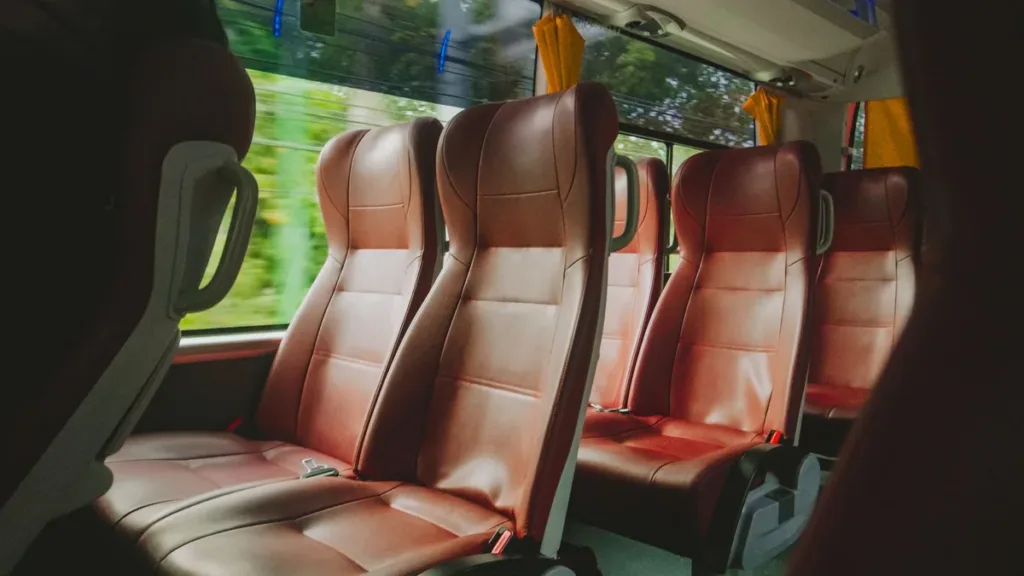
| Toyota Coaster High Roof | 29-seater | Toyota Indus Coaster page; international versions are also built with 24 or 25 seats | About 23 to 24 delegates | Core loop from mid-sized hotels; narrower streets and tighter hotel porches |
| Full-size coach sold as 45-seat | Around 45, varies by body builder | Operator seat plan; ask for it in writing | About 36 delegates | Trunk loop from the largest partner hotel; airport arrivals with luggage in the hold |
The planning load assumes roughly 80 per cent of nominal seats. Bags, banner tubes and colleagues who will not split up account for the rest.
International Coaster configurations vary. The current-generation Coaster is built in standard and long-wheelbase layouts with between 24 and 29 passenger seats depending on market, which is another reason to confirm the actual vehicle rather than the model name. You can see how we describe the Toyota Coaster with driver and the full-size 45-seat coach on their own pages, and compare the whole minibus and coach range side by side.
Step three: turn the wave into a fleet count
With the wave, the loop time and the planning load in hand, the formula is short:
Vehicles needed = peak wave ÷ (planning load per vehicle × deliveries per vehicle inside the wave window)
Deliveries per vehicle is the part people get wrong. If the loop is longer than the wave window, the answer is one.
Worked example finished (hypothetical)
Peak wave: 357 people in 40 minutes. Loop: 62 minutes, so one delivery per vehicle. Planning loads: 36 per coach, 23 per Coaster, 11 per Hiace.
- All coaches: 357 ÷ 36 = 9.9, so 10 coaches.
- All Coasters: 357 ÷ 23 = 15.5, so 16 Coasters.
- A mixed fleet: 6 coaches (216) plus 6 Coasters (138) gives 354, plus one Hiace (11) to reach 365.
The mixed option usually wins: coaches work the biggest hotel, Coasters the smaller ones, and the Hiace waits at the largest pick-up so no one is left on the kerb. After 09:30, most vehicles can switch to a lighter off-peak loop.
Then check the answer against the kerb: ask each hotel how many large vehicles its porch and gate can take at once, and stagger depot departures so vehicles arrive two or three minutes apart.
Shuttle capacity for large events: the spare-seat margin
A spare-seat margin is not waste. It is the difference between a plan that works on paper and one that survives a late plenary, a rain shower or a second hotel filling up at the last minute. For shuttle capacity for large events, three layers of margin do most of the work:
- The load factor. Planning at around 80 per cent of nominal seats, as above, already gives roughly 20 per cent headroom inside each vehicle.
- A standby vehicle per loop. One Coaster or Hiace on standby at the busiest hotel for every six to eight working vehicles covers a breakdown, a late driver or an unexpected surge.
- A second-wave reserve. For events with a gala dinner or a closing ceremony, the evening return is the harder test. Keep the peak fleet available until the last session has cleared, even if the morning fleet was trimmed.
When to add a vehicle
Add capacity when any of these is true on the day before or the morning of the event:
- Hotel rooming lists show more than about 10 per cent more partner-hotel guests than your plan assumed.
- The loop recce took more than 15 per cent longer than your planned loop time.
- A road closure or diversion has been announced on or near your route.
- The programme has moved the opening session earlier, which compresses the wave.
- More than one bag per delegate is expected on the loop, for example on a departure day when people check out and come straight to the venue.
Shape the demand: registration timing and staggered starts
The cheapest seat is the one nobody needs at 09:15. Organisers have more control over the wave than they usually use.
Open registration earlier and wider
If badge collection opens at 08:00 and the keynote is at 09:30, the wave is spread across 90 minutes rather than 40. Put coffee and the exhibition floor at the front of the day, so there is a reason to arrive early.
Split the programme
Two parallel tracks that start 20 minutes apart cut the peak wave almost in half. A pre-conference breakfast briefing for sponsors or speakers moves another group out of the wave entirely.
Tell people which shuttle is theirs
Assigning hotel groups to departure slots in the joining email, for example Hotel A at 08:30 and 08:50, Hotel B at 08:40 and 09:00, spreads the load and makes empty seats visible early.
What an event shuttle rental brief should promise, and what it should not
Most shuttle disputes come from words, not vehicles. An event shuttle rental brief that says “continuous shuttle service throughout the event” invites two different readings, and both sides will be sure theirs is correct. A good commission document states capacity in terms that can be checked on the day.
Put in writing
- Vehicles by type and seat plan. “Six 45-seat coaches, seat plan attached; six 29-seat Coasters; one Hiace standby.” Not “buses as required”.
- Service windows. Peak loop 08:15 to 09:45, off-peak loop 09:45 to 16:30 at a stated frequency, evening return from the end of the last session until a stated cut-off.
- Stops and order. Every hotel, the exact pick-up point at each, and the venue drop-off and holding area.
- Driver and vehicle standards. Uniform or identification, working air conditioning, no smoking, how driver hours are covered across a long day.
- Dispatcher and escalation. One named dispatcher on the operator side, one on yours, and the phone numbers both will answer.
- Changes and cut-off dates. When numbers can go up or down without penalty, and what happens after that date.
- Contingency. What the operator does if a vehicle breaks down or a route closes, and how quickly a replacement is expected.
Leave out
- “Zero waiting.” No honest operator can guarantee it at a peak, and no organiser can hold anyone to it.
- Unlimited capacity. Capacity is always a number; write the number.
- Fixed journey times. Give planned loop times and agree how a delay will be communicated, rather than promising a time that traffic will decide.
- Promises to delegates that the operator has not agreed. If the joining email says “shuttles every ten minutes”, make sure the contract says the same, or change the email.
Pricing for a managed shuttle depends on vehicle mix, hours, dates and demand in the city at that time, so any figure you receive is a quote to review rather than a published fare. When you share your brief through our events and group transport booking page, we reply with vehicle options and a quote to review; availability for specific vehicles is confirmed separately, not assumed.
City and venue notes before you finalise the conference shuttle service
Every venue changes the loop. A few points to check for common locations:
- Islamabad. Security at government-linked venues is heavier, and the Jinnah Convention Centre is recorded as having parking for more than 1,000 vehicles across three areas. Confirm which lot your coaches use and where they queue, because the hotel-to-venue distance is short but the security leg can be long.
- Lahore. Expo Centre Lahore sits in Johar Town, at the corner of Abdul Haque Road and Shahrah Nazaria-e-Pakistan. Hotels near Gulberg, Mall Road or the cantonment are a cross-town run, so time the recce at the event hour.
For delegates arriving from abroad, safety guidance matters as much as seat counts. The FCDO advises against all travel to Balochistan and most of Khyber Pakhtunkhwa, including Peshawar, and against all but essential travel to further areas; check the current advice before planning any delegate excursion outside the host city, and do not add leisure trips to those areas to a conference programme.
Beyond the loop: arrivals, departures and other markets
The shuttle is one part of delegate transport. Airport arrivals, speaker pick-ups and departure-day runs follow different rules, with luggage, flight delays and meet-and-greet in play. Our sister service Pakistan Taxi, which runs on the iDrive network, has a family-friendly walkthrough of conference delegate transport from arrival to departure that pairs well with this loop plan.
If your organisation also runs exhibitions in the Gulf, the same wave-and-loop logic applies there with different vehicles and venues; our sister company Saudi Cab Co covers it in its guide to conference and exhibition transfers for delegates in Saudi Arabia.
When your wave, loop and fleet mix are drafted, send them to us through the iDrive journey request form with your dates, hotels and venue. We review the plan, point out where the loop or margin looks thin, and come back with vehicle options to consider.
Questions people ask
How many shuttle buses do I need for 1,000 delegates?
It depends on how many of them ride and how tightly they arrive, not on the 1,000. Estimate the peak arrival wave, measure the loop, and divide the wave by the planning load per vehicle times the number of deliveries each vehicle can make inside the wave window.
What loop frequency should a conference shuttle run?
At the peak, vehicles should leave each major hotel every few minutes, which usually means several vehicles on the same stop. Off-peak, a loop every 30 to 40 minutes is often enough. The loop time, including security gates and boarding, sets the limit.
Is a Coaster or a 45-seat coach better for an event shuttle bus?
A coach moves more people per driver and suits the largest hotel. A 29-seat Coaster copes better with smaller porches and narrower streets. Most larger events use both, with a Hiace on standby.