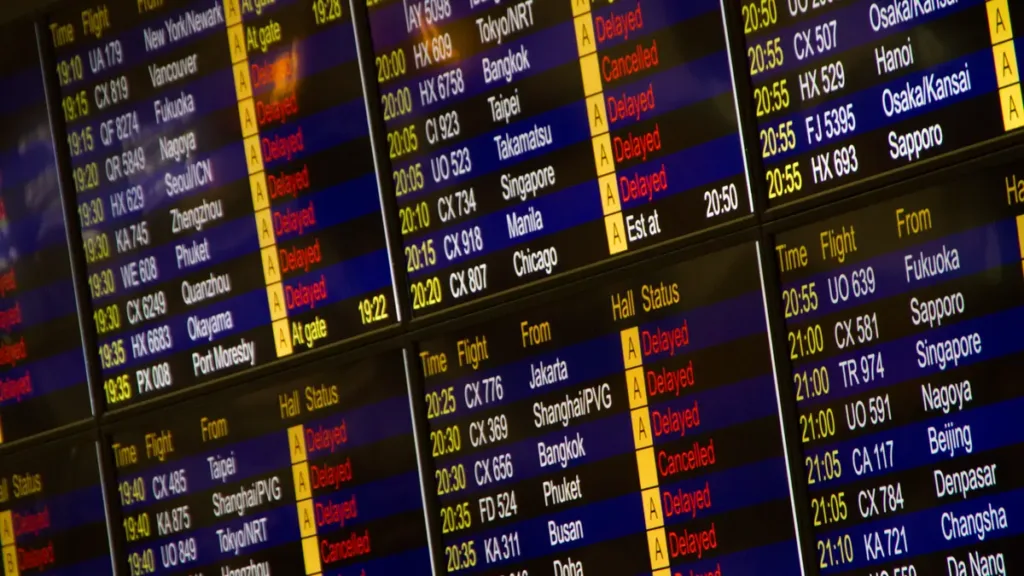
The Islamabad airport arrival schedule gives you two clock times and a one-word status for each flight: the scheduled time the airline sold, the estimated time the airport currently expects, and a status such as Expected, On Time, Delayed, Advanced or Arrived. Neither clock time is the moment your passenger walks out of the terminal. A pickup should be planned from the scheduled time, re-timed from the estimated time on the day, and any free waiting period in a transfer agreement should start from the actual arrival recorded for the flight, not from the time printed on the ticket. Everything after that (immigration, the baggage belt, customs) happens inside the building, and the driver’s clock should allow for it rather than run against it.
That is the short version. The longer version matters because the difference between “landed” and “at the kerb” at Islamabad International Airport varies widely from one flight and one passenger to the next, and plenty of disagreements about late drivers, long waits and extra charges come down to two people quietly reading different timestamps.
Decision summary: which time does what
If you only read one section, read this one. Each time you will see on a board, an airline app or a booking confirmation has a job. Using it for the wrong job is where plans go wrong.
| Timestamp | What it actually records | Use it for | Do not use it for |
|---|---|---|---|
| Scheduled arrival | The time in the airline’s timetable, usually the planned arrival at the parking stand | Making the booking; naming the flight and date | Deciding when the driver should be standing in arrivals |
| Estimated arrival | The current expectation, updated as the flight progresses | Re-timing the driver’s departure to the airport on the day | Starting a waiting clock; it is a forecast |
| Actual landing | Wheels on the runway | Knowing the flight is on the ground | Assuming passengers are free; the aircraft still has to taxi and park |
| On-blocks (in-block) | The aircraft stops at its stand and the doors can open | The fairest trigger for a free-waiting period | Expecting the passenger to appear at once |
| Passenger exit | The traveller clears immigration, baggage and customs and reaches the arrivals hall | The real meeting moment | Contracts; no board records it and it varies by person |
The practical rule: book on scheduled, drive on estimated, wait from actual arrival, meet on exit.
Reading the official Islamabad airport arrival schedule
Searches for the arrival flight schedule Islamabad airport passengers rely on often end on third-party sites; the one worth bookmarking is the airport’s own. The Pakistan Airports Authority runs the official arrivals page for Islamabad International Airport. When we checked it on 25 September 2026 it listed, for each flight, the airline, flight number, origin, a Schedule Time, an Estimated Time and a Status, with filters for airline, origin and flight number and tabs for Yesterday, Today and Tomorrow. It also printed a “Last Updated” stamp at the top, which is worth glancing at before you trust anything below it.
The statuses seen on that snapshot were plain: Expected for flights not yet due, On Time, Delayed, Advanced for a flight running early, and Arrived once it was down. That simplicity is useful but has limits. The board does not say whether its estimated time means touchdown on the runway or arrival at the stand, and it does not tell you when the doors opened or when passengers reached the hall. Treat it as the authority on whether a flight is coming and roughly when, not as a stopwatch.
What a single morning looked like
The same snapshot shows why a pickup should follow the estimated time rather than the timetable. These are rows from the board as published that morning, quoted as an illustration and not as a pattern you should expect on any given day:
- EY 302 from Abu Dhabi: scheduled 03:25, estimated 04:44, status Arrived.
- 9P 767 from Bahrain: scheduled 03:50, estimated 07:09, status Arrived.
- KU 205 from Kuwait: scheduled 04:35, estimated 04:10, status Arrived.
- BA 2161 from London Gatwick: scheduled 22:20, estimated 21:24, status Advanced.
A driver sent for 03:25 on the first flight would have waited well over an hour before a single passenger was even on the ground. A driver sent for 04:35 on the Kuwait flight would have arrived after the aircraft. Both mistakes come from reading the same column. The estimated column exists precisely so you do not have to guess.
Scheduled vs estimated arrival time, and why the gap moves
The distinction between scheduled vs estimated arrival time sounds obvious, but it is worth being exact about what each number is built from.
The scheduled time is commercial. The airline published it long before the day, and it cannot know the winds, the routing or the queue for the runway. Aviation planners describe this time as the moment the aircraft is due at its first parking position; EUROCONTROL’s Airport CDM manual calls it the Scheduled In-Block Time, not a landing time. That point catches people out: the timetable is aiming at the stand, not the runway.
The estimated time is operational. It is recalculated once the aircraft pushes back at the origin, then again en route as winds, routings and holding patterns change it. The closer the flight is to landing, the more the estimate is worth. The morning above had estimates both earlier and much later than schedule within the same hour.
How this changes the driver’s plan
In practice, the dispatch decision is made from the estimate, checked at least twice:
- When the flight departs its origin, check the estimate and confirm the pickup still stands.
- Before the driver leaves for the airport, check again and set the departure time from the latest estimate plus the drive.
- If the status moves to Advanced or the estimate jumps, tell the operator straight away rather than assuming they have seen it.
Asking for the flight number is what makes this possible. iDrive asks for the flight number and scheduled arrival time with every Islamabad airport transfer request so the pickup can be planned against the flight’s actual progress rather than a best guess.
Landing time vs gate arrival: the minutes nobody sees
Landing time vs gate arrival is the gap that most passengers never think about and most drivers experience directly. EUROCONTROL’s manual gives the precise vocabulary. The Actual Landing Time is “the time that an aircraft lands on a runway”. The Actual In-Block Time is “the time that an aircraft arrives in-blocks”, which the same glossary notes is what airlines and handlers normally mean by the actual time of arrival. Between the two sits the taxi-in, which the manual lists as its own estimated component.
Three consequences follow for anyone setting up a pickup:
- “Arrived” on a flight-tracking app may mean touchdown. Some consumer trackers flip to “landed” at wheels-down. The passengers are still strapped in, the aircraft may still be rolling, and at a remote stand there is a bus ride before the terminal.
- “Actual arrival” means different things to different people. The same EUROCONTROL glossary notes that air traffic control uses actual time of arrival to mean landing, while airlines and handlers use it to mean in-block. Two parties can both quote “the actual arrival” and be a whole taxi-in apart.
- Punctuality is measured against the schedule, and the schedule is a stand time. The US Bureau of Transportation Statistics, for instance, counts a flight as delayed when it arrives 15 or more minutes after schedule. Airlines think in in-block terms, and a transfer contract that thinks in the same terms avoids a mismatch.
On-blocks is also, in plain language, doors-open time: the engines are off, the stand is connected, and the cabin crew can release passengers. It is the first moment at which the passenger can do anything to speed up the pickup. That is why it is the most defensible moment for any free-waiting period to begin.
From doors-open to the arrivals hall at Islamabad
Once the doors open, the passenger’s time is governed by the airport’s process, not the driver’s. The Pakistan Airports Authority sets out the international arrival process at Islamabad in three stages.
- Immigration. Lanes are marked separately for Overseas Pakistanis, Foreigners, Taxpayers and Special Persons (older citizens, women and children). The airport notes that Overseas Pakistani Card holders are exempt from disembarkation forms, and asks passengers to remove hats and sunglasses, wait behind the red line and stay off their phones.
- Baggage claim. Passengers find their flight number on the LCD monitors and collect bags from the belt. The airport states that claims for damaged baggage must be made within 7 days.
- Customs. Clearance is mandatory, through the Green Channel with nothing to declare or the Red Channel for dutiable or restricted goods.
Domestic arrivals skip the first and third stages: passengers collect bags and walk into the concourse hall.
How long does it take?
No official figure is published for Islamabad, and any single number would be misleading. What changes the time is predictable, though: how many wide-bodies land in the same window, which immigration lane the passenger joins, whether the bags are checked through or the passenger travels with hand luggage only, and whether anything goes through the Red Channel. On the morning snapshot above, several Gulf and Turkish flights were due within about ninety minutes of each other before dawn. That is the kind of cluster that lengthens queues.
A worked example, labelled as an example rather than a promise: a family of four on a long-haul flight, with two checked cases each, travelling on foreign passports. The board shows the flight Arrived. Allow for taxi-in and disembarkation, a queue at the foreigners’ lane, a wait at the belt for eight cases, and a trip through customs with a trolley. Planning for the family to reach the hall roughly an hour after the flight is shown as arrived, and being pleasantly surprised if it is quicker, is a far calmer plan than expecting them fifteen minutes after touchdown.
A single business traveller on a domestic flight from Karachi with hand luggage is a different case entirely: no immigration, no customs, no belt. The pickup window for that passenger is short, which is exactly why a single rule for “how long to wait” does not work.
Which timestamp should start free waiting in a transfer agreement
This is where the arrival board becomes a commercial question. If a transfer includes a period of waiting at no extra charge, the agreement has to say when that period starts. There are four candidates, and only one survives scrutiny.
| Trigger | Who it favours | The problem |
|---|---|---|
| Scheduled arrival | The operator | A flight 80 minutes late burns the whole allowance before the aircraft lands |
| Actual landing | Mostly the operator | Taxi-in and remote-stand buses eat into waiting the passenger cannot use |
| Actual arrival at stand (on-blocks) | Balanced | Needs a trustworthy source for the actual time; the official board or airline status usually suffices |
| Passenger exit | The passenger | Unmeasurable and open-ended; no operator can price it |
The balanced answer is the flight’s actual arrival as recorded by the airport or the airline, with a clearly stated number of minutes of waiting from that point. If the source only shows “Arrived” without a time, the practical fallback is the estimated time shown once the status changed, which is what the PAA board displays for flights that have landed.
What to check in your own confirmation
Whoever you book with, read the confirmation for these points before you fly:
- Is a free-waiting period stated, and in minutes?
- Does it start from scheduled arrival, from landing, or from the actual arrival of the flight?
- What happens after it ends: a stated rate, a call to agree extra time, or release of the driver?
- Does the operator track the flight, or does it rely on you to report changes?
- What happens if the flight is cancelled or diverted to Lahore or Peshawar?
iDrive states any waiting period that forms part of a journey in the quote itself, alongside tolls, so it is visible before you accept. The general conditions of carriage are in our terms of hire. If a waiting period is not in the quote, ask for it to be added in writing; an unwritten assumption about waiting is an easy way to end up disagreeing at the kerb.
The official PAA board vs airline apps
You will usually have three sources open on the day: the airport’s board, the airline’s flight status page or app, and perhaps a third-party tracker. They do not always agree, and each has a strength.
| Source | Strength | Weakness |
|---|---|---|
| PAA board and the PAA Flight Inquiry app | The airport’s own view of arrivals, all airlines in one list, Yesterday/Today/Tomorrow tabs | Shows clock times without saying whether estimates are landing or stand times; refresh lag is possible |
| Airline status page (PIA, Emirates, Qatar Airways and others) | Most authoritative on delays, cancellations and retimings the airline has made | One airline only; time zones and date formats vary by app |
| Third-party tracker | Live position; useful for spotting a diversion or a hold | May mark touchdown as “landed”; not an official record |
A sensible hierarchy: trust the airline on whether and when the flight is operating, trust the airport on when it arrived, and use a tracker only to see the aircraft’s progress. The PAA board’s own footer links to its Flight Inquiry app on Google Play, which is the same data on a phone.
Overnight arrivals and the date error
Much of the Gulf traffic into Islamabad lands in the small hours: on the 25 September snapshot, flights from Jeddah, Doha, Riyadh, Dammam, Muscat, Abu Dhabi, Bahrain, Istanbul and Kuwait were all scheduled before 05:00. That sets up the costliest avoidable mistake in an airport pickup: booking the wrong date.
The error usually happens in one of three ways:
- Departure date booked as arrival date. A passenger leaves Manchester or Toronto on the evening of the 14th and lands in Islamabad on the 15th. The pickup is requested for the 14th because that is the date on the first line of the itinerary.
- “Midnight” misunderstood. A 00:15 arrival on the 25th is the first minutes of the 25th, but it is the night of the 24th in everyone’s head.
- An early landing crosses midnight backwards. On that same morning, PK 842 was scheduled for 00:15 on 25 September and showed an estimated time of 23:51, which can only mean the evening of the 24th. A board that prints only a clock time next to a date column needs to be read with that possibility in mind.
The fix is to state arrivals in a form that cannot be misread: the flight number, the arrival date in Pakistan time, and the scheduled time in 24-hour format, for example “PK 000, arriving Islamabad Tuesday 14 October, 00:40 PKT” (an invented flight used as an illustration). Then read it back and confirm. The same discipline applies on pilgrimage journeys; our sister company Pilgrim Taxi explains how to read back arrival dates between Saudi and UK time for Umrah bookings, and the method transfers directly to overnight flights into Pakistan.
A pickup plan that uses the right time at each stage
Put together, a pickup that follows the arrival schedule properly looks like this:
- At booking: give the flight number, the arrival date in Pakistan time and the scheduled time. Ask for the waiting terms to be stated. A journey request on iDrive takes these details and returns a quote with the vehicle class it assumes.
- On departure day at origin: check the airline status once the flight has left; send any retiming to the operator.
- Before the driver sets off: use the latest estimated time on the PAA board, plus the drive to the airport.
- On arrival: the flight’s actual arrival starts any stated free waiting. The passenger messages when bags are collected, if they have a working connection.
- At the meeting point: check the driver’s photograph and vehicle registration against the details sent in advance before getting in.
If you are arranging the car for relatives rather than yourself, the family-focused guide from our sister service Pakistan Taxi on Islamabad airport journeys covers meeting points and onward plans from the passenger’s side. Our Pakistan airport transfers page covers the other gateways, from Lahore and Karachi to Peshawar, Multan and Sialkot.
Questions people ask
Where can I see Islamabad airport arrivals today?
On the Pakistan Airports Authority’s arrivals page for Islamabad International Airport, or its PAA Flight Inquiry app. It shows scheduled time, estimated time and status, with tabs for yesterday, today and tomorrow.
Does “Arrived” mean passengers are coming out?
No. It means the flight is down. Passengers still have to disembark and, on international flights, clear immigration, baggage claim and customs before reaching the hall.
Should my driver come for the scheduled or the estimated time?
The estimated time, checked shortly before the driver leaves. The scheduled time is for making the booking and naming the flight.
When should free waiting start?
From the flight’s actual arrival as recorded by the airport or airline, for a stated number of minutes. Starting it at the scheduled time penalises the passenger for delays they cannot control.