A “Hiace luxury van” is not a Toyota model. In Pakistan, Toyota Indus sells the Hiace under two showroom names, Hiace and Hiace Deluxe, and the factory spec sheets behind them list trims called Standard Roof, Hi-Roof, ACE Tourer and ACE Luxury Wagon. “Luxury”, “Grand Cabin” and “Commuter Deluxe” in a hire listing are usually a supplier’s description, sometimes of a factory trim and often of a locally re-trimmed cabin. The label tells you almost nothing on its own. What matters is which body the van is built on, how many seats it carries, what those seats are bolted to, and whether every passenger gets a proper belt.
So the short answer: treat any luxury label as a claim to verify. Ask which Toyota trim the van left the factory as, ask for a photo of the actual cabin, and match the registration number against the provincial record before the day of travel. The rest of this guide explains how to read the labels, what a catalogue entry can and cannot prove, and what to request when a specific van is assigned.
Decision summary
- Up to 9 or 10 adults on a long drive, comfort first: ask for a factory luxury trim (the ACE Luxury Wagon layout, or a comparable wagon such as a Granvia) rather than a converted commuter.
- 11 to 14 passengers with luggage: a high-roof 2.8-litre body is the practical choice; confirm the rear belt type and where the bags go.
- Short airport or city runs for 12 to 15 people: a standard commuter-style Hiace is fine, provided seat count matches passenger count and no one sits on a jump seat.
- Any listing that says “luxury” without a trim name, a year or a real cabin photo: treat it as unconfirmed until a named van is assigned.
Toyota’s actual Hiace trims in Pakistan
Start with what the manufacturer itself publishes, because that is the only fixed reference point. Every other label in the market is measured against it.
The older-platform Hiace
The page Toyota Indus simply calls Hiace describes a “Wide and Super Long Body” option and two engines: the 2TR-FE 2.7-litre petrol (2,694cc) and the 2KD-FTV 2.5-litre diesel (2,494cc). Its published specification sheet covers two body sizes: a 4,695 mm long, 1,695 mm wide, 1,980 mm tall van with 15 seats, and a longer, wider, taller body at 5,380 mm by 1,880 mm by 2,285 mm, listed with 14 seats in diesel form. The shorter body is trimmed in vinyl leather, the long body in fabric. Toyota’s page lists driver and front passenger SRS airbags.
This is the van most people in Pakistan picture when they hear “Hiace”: the flat-nosed shape that has carried families, office staff and wedding guests for years. Suppliers often call it the H200, which is the name our catalogue uses for its Toyota Hiace H200 listing.
The 2.8-litre semi-bonneted Hiace
The Hiace Deluxe page describes a semi-bonneted front end, with the engine moved forward of the cabin, and rear seats in “a combination of synthetic leather & fabric”. The 2.8-litre spec sheet linked from that page covers four versions, all with the 1GD-FTV 2,755cc diesel:
- Hiace Standard Roof 2.8 MT: 5,915 mm long, 1,990 mm tall, 15 seats, fabric trim, manual gearbox.
- Hiace Hi-Roof 2.8 MT: 5,915 mm long, 2,280 mm tall, 16 seats in four rows behind the front.
- ACE Tourer: high-roof body at 2,280 mm, automatic, 14 seats, fabric and vinyl-leather trim, rear cooler with independent vents.
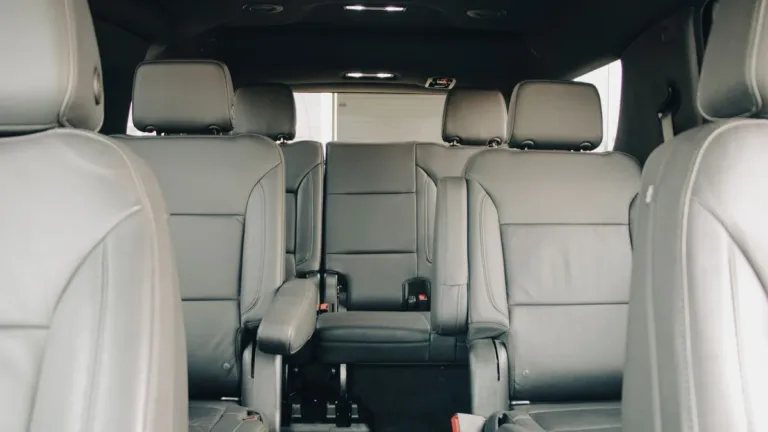
- ACE Luxury Wagon: 5,300 mm long, 1,990 mm tall, automatic, 10 seats, with two rows of individual seats and ottoman rests, a tip-up three-seat rear row, partial leather with quilting, auto air conditioning and two power sliding doors.
This generation is what the market tends to call the H300 or “new model Hiace”. Our catalogue groups it under the Toyota Hiace H300 wide body entry.
Notice what the factory list does not contain: no “Grand Cabin”, no “Commuter Deluxe”, no trim called “Luxury” on its own. Those words arrive later, on the resale and hire market.
Commuter, Deluxe, Grand Cabin and H300 compared
Here is how the common hire-market labels usually map onto real vehicles. “Usually” is doing honest work in that sentence: suppliers are not consistent, and two companies can use the same word for different vans.
| Label you see | What it usually refers to | What the label proves | What you still need to confirm |
|---|---|---|---|
| Commuter / standard Hiace | A bench-seat Hiace, typically the older standard-roof body with around 15 seats | Almost nothing beyond “a Hiace-type van” | Body, year, seat count, rear belt type, air conditioning in the rear |
| Commuter deluxe Hiace | A commuter body with upgraded seat covers, curtains or extra trim; sometimes the factory Hiace Deluxe | That the supplier believes the interior is above basic | Whether “deluxe” means Toyota’s 2.8-litre Hiace Deluxe or a cosmetic refresh of an older van |
| Hiace grand cabin | A high-roof, long-body Hiace with more headroom and a larger cabin; the name is not used on Toyota Indus’s current spec sheets | Probably a taller, longer body | Hiace grand cabin seats: how many, what layout, and whether any were added after the factory |
| H300 / new model | The semi-bonneted 2.8-litre generation | A newer platform, if the photo shows the bonneted nose | Which of the four factory versions, and whether the cabin has been modified |
| Hiace luxury / VIP | Either the factory ACE Luxury Wagon layout or a locally converted cabin with captain chairs, sofas, lights and screens | Nothing on its own | Factory trim versus conversion, seat mounting, belts on every seat, registration record |
The practical lesson from the table: a Hiace deluxe listing and a Hiace luxury listing can describe the same factory van, or two very different vehicles. The only way to know is to go below the label.
Why the H200 vs H300 distinction matters more than the word “luxury”
The body generation sets the ceiling. Toyota’s own figures put the shorter older Hiace at 4,695 mm and its long body at 5,380 mm, while the 2.8-litre Standard Roof and Hi-Roof versions run to 5,915 mm. That extra length goes into legroom and space behind the last row. A beautifully re-trimmed older van is still working inside its original shell; a plain 2.8-litre commuter already has more room to begin with.
For long days on the M-2 between Islamabad and Lahore or on the climb from Islamabad towards the Galiyat, the body and the seat pitch will shape how people feel at the end of the journey far more than chrome trim or ceiling lights will.
Local “luxury” conversions: comfort and safety caveats
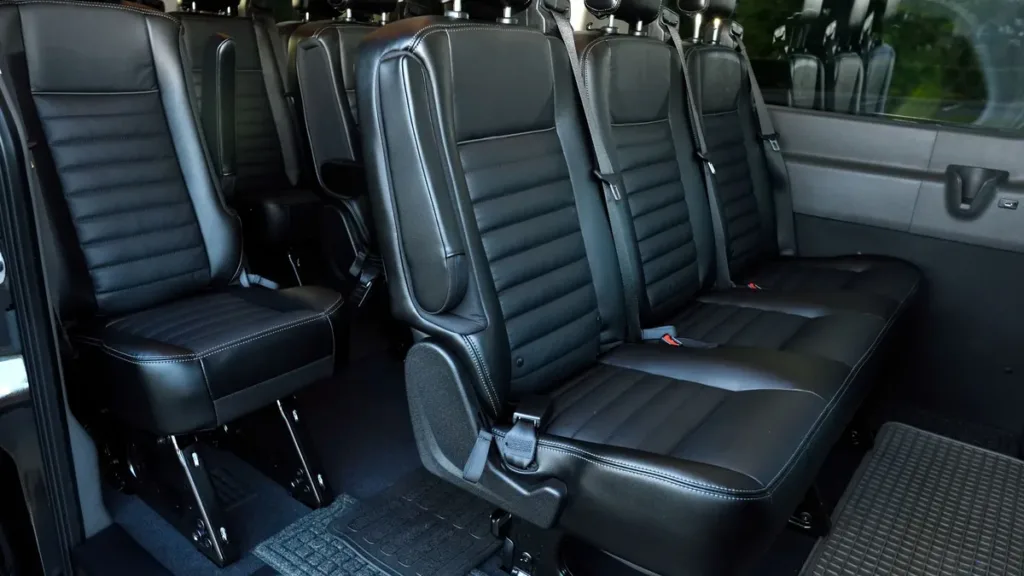
Pakistan has an active market in re-trimming vans. A converted cabin might remove the factory benches and fit reclining captain chairs, a rear sofa, wood-effect panels, ambient lighting, curtains, a screen and a fridge. Some conversions are excellent. The issue is not taste; it is what happens to the parts you cannot see.
What a conversion can change
- Seat mountings. Factory seats are bolted to engineered points in the floor. Aftermarket chairs may be fitted to new brackets or rails. Ask who fitted them and whether they sit on the original anchorages.
- Seat belts. Toyota Indus’s own sheets show that the manual 2.8-litre Standard Roof and Hi-Roof versions list two-point (lap) belts for the rear seats, while the ACE Tourer and ACE Luxury Wagon list three-point belts on all seats. Once seats are replaced, belts may be missing, moved or anchored to the new seat frame rather than the body.
- Seat count. Conversions usually reduce seats: a 15-seat commuter might become a 9- or 10-seat “VIP” layout. That is fine, as long as the supplier quotes the real number, not the original one.
- Luggage space. A rear sofa often takes the space where bags used to go. The more lavish the cabin, the more likely that suitcases need a roof rack or a second vehicle.
- Air conditioning. The factory rear cooler is listed on several trims. Added ceiling panels can reroute vents; confirm the rear rows actually receive cold air, especially on summer runs through Punjab and Sindh.
What a conversion does not change
The engine, suspension and body length stay the same. A converted older van still has the older platform’s ride and space. That is not a flaw; it is simply the honest baseline to compare against a factory wagon.
A fair rule for a group with elderly relatives or children: prefer a van where each occupied seat has its own belt and the rear rows face forward. Side-facing sofas look generous in photographs and are the least useful seats on a motorway.
What a catalogue entry can prove before a van is assigned
An online fleet catalogue, ours included, describes a class of vehicle. It is useful, but it is not a promise about the specific van that turns up. Being clear about that line saves arguments later.
What a catalogue entry does establish
- The model family and body. An entry such as our Toyota Hiace Grand Cabin page tells you which body style is being offered: high roof, long body, commuter-style cabin.
- A realistic passenger and luggage envelope. Catalogue capacity figures are planning numbers for comparing classes. Our guide to how many people and suitcases actually fit in Pakistani fleet vehicles is a sensible cross-check before you pick a class.
- The class you are asking the supplier to match. It sets the minimum standard the assigned van should meet or exceed.
What a catalogue entry cannot prove
- The year, mileage or condition of the van you will actually get.
- Whether that particular van has been re-trimmed, and how.
- The exact seat layout and belt fit in that van.
- That a van of that class is free on your date. Availability is only known once a supplier accepts the job.
- That a stock photograph shows the vehicle you will ride in. Catalogue images illustrate the class.
In other words, a catalogue narrows the field. The assignment is where proof arrives. If a listing anywhere implies that its glossy “luxury” photograph is the van you are guaranteed, be sceptical.
What to request when a specific van is assigned
Once a supplier has named a vehicle for your job, you are entitled to ask sensible questions about it. A professional operator will not mind. Here is the checklist we would use for any group van, and especially for anything sold as a Hiace luxury upgrade.
- Registration number. Ask for it in writing. It lets you check the vehicle against the official record for the province where it is registered.
- A recent cabin photograph of that van. Not a brochure image. You want the seats, the floor and the rear of the cabin, with the rear door open if luggage matters.
- An exterior photo that shows the front. The flat-nosed older Hiace and the semi-bonneted 2.8-litre generation look different at a glance. This one photo settles most “H300” claims.
- The factory trim, if known. Standard Roof, Hi-Roof, ACE Tourer, ACE Luxury Wagon, or the older standard-roof or high-roof Hiace.
- Seat count and layout as fitted today. Number of rows, seats per row, any side-facing or folding seats.
- Belt type per seat. Three-point or lap belt, and whether every seat has one.
- Where the luggage goes. Behind the last row, on a roof rack, or in a second vehicle. Roof racks need covers in rain and dust.
- Rear air conditioning. Confirm it works in the back rows, not only up front.
- For commercial use, fitness paperwork. In Punjab, the Transport Department states that public service and goods transport vehicles registered and operating in the province must hold a Vehicle Fitness Certificate, and that commercial vehicles must be tested every six months. It is reasonable to ask whether the van’s fitness certificate is current.
Checking the registration against the official record
Provincial excise departments run the motor vehicle registers. Sindh’s department offers an online vehicle verification service where you choose the vehicle category and enter the number exactly as it appears on the plate. Punjab’s Excise & Taxation department sets out its registration and transfer requirements online. Services and screens change, so use the relevant department’s current site for the province on the plate.
What you are looking for is simple consistency: whatever vehicle details the record returns should match the van in the photograph. If the record says one thing and the photo shows another, ask before you travel, not at the kerb.
Red flags in Hiace van listings
None of these prove a listing is wrong. Each one is a reason to ask a follow-up question before you commit a family or a delegation to the van.
- “Luxury” with no trim, year or body. The word is doing all the selling. Ask which Toyota version it started as.
- Seat count that matches the factory figure after an obvious re-trim. If the photos show captain chairs and a sofa but the listing still says 15 seats, one of those two things is not current.
- Only interior photos, never the front. The nose tells you the generation. A listing that hides it may be selling an older body as “new model”.
- Photos that look like brochure or showroom shots. Fine for illustrating a class; not evidence of a specific van.
- Side-facing sofas counted as full seats. They may be comfortable in a car park and awkward on a four-hour motorway run.
- No answer on belts. “All seats have belts” is an easy sentence to write. If the supplier cannot say which type, assume you need to check in person.
- Luggage never mentioned. A cabin full of chairs leaves little behind the last row. If there are ten of you and twelve suitcases, the plan needs to say where the cases ride.
- Pressure to confirm without a registration number. A named van has a number. If the supplier will not share it even after assignment, that is worth noticing.
When a factory wagon beats a converted Hiace
For some groups, the better question is not “which Hiace?” but “does this need to be a Hiace at all?”. The ACE Luxury Wagon layout on Toyota Indus’s 2.8-litre sheet shows what a factory-built premium van looks like: ten seats, individual chairs in the middle rows, three-point belts on every seat and powered sliding doors. Premium people-carriers of a similar type, such as the Toyota Granvia, sit in the same bracket.
The trade-offs are predictable:
| Priority | Converted commuter Hiace | Factory luxury wagon |
|---|---|---|
| Maximum heads per vehicle | Stronger, if the conversion keeps enough seats | Weaker; fewer seats by design |
| Consistency of seat mounting and belts | Depends on the workshop | Engineered and documented by the manufacturer |
| Headroom | Excellent in a high-roof body | Lower roof on the ACE Luxury Wagon (1,990 mm overall height) |
| Luggage with a full cabin | Often poor after a sofa is fitted | Limited; check the space behind the rear row |
| Supply across cities | Wider | Narrower; more likely to need notice |
A useful compromise for larger parties: a factory wagon for the elders and a standard high-roof Hiace for everyone else and the bags. Two well-matched vehicles often beat one over-promised one.
Choosing a label-proof brief for your journey
The fastest way to avoid a mismatch is to describe the job, not the label. When you send a request, include:
- Total passengers, including children, and how many are elderly or need an easy step-in.
- Large and small bags, counted separately.
- The route and the longest single leg, for example an airport pickup followed by a drive to another city.
- Whether you need every seat forward-facing with its own belt.
- Whether the “luxury” part is essential (a wedding, a VIP guest) or simply nice to have.
With that brief, a supplier can propose the right body first and the trim second. Browse the full group van class to see the options side by side, then plan your van journey on iDrive. You will see the vehicle class and journey details together, and the assigned vehicle’s details are confirmed by the supplier before travel rather than assumed from a listing.
If you prefer a calmer, family-focused planning flow, our sister service Pakistan Taxi, which runs on the iDrive network, has a guide to van journeys for families and groups in Pakistan. Travelling on to Saudi Arabia for Umrah afterwards? Our sister company Saudi Cab Co explains its VIP van transfers in Saudi Arabia, where the same questions about seats, belts and luggage apply.
Questions people ask
Is the Hiace Deluxe the same as a Hiace luxury van?
Not necessarily. Hiace Deluxe is Toyota Indus’s showroom name for the 2.8-litre semi-bonneted range. “Hiace luxury” in a hire listing may mean that range, its factory ACE Luxury Wagon version, or an older van with a re-trimmed cabin. Ask which one.
How many Hiace grand cabin seats should I expect?
It depends on the van. Toyota Indus’s current sheets do not use the Grand Cabin name; its high-roof versions are listed with 14 to 16 seats from the factory. A converted cabin can have far fewer. Ask for the count as fitted today.
What is a commuter deluxe Hiace?
It is a market label, usually for a bench-seat commuter body with upgraded trim. It may be the factory Hiace Deluxe or a refreshed older van. The front-end photo and the registration record will tell you which.
Can I choose the exact van when I book?
You choose the class and describe the job. A specific van is assigned by the supplier once the booking is accepted, and you can then ask for its registration number and photographs before travel.