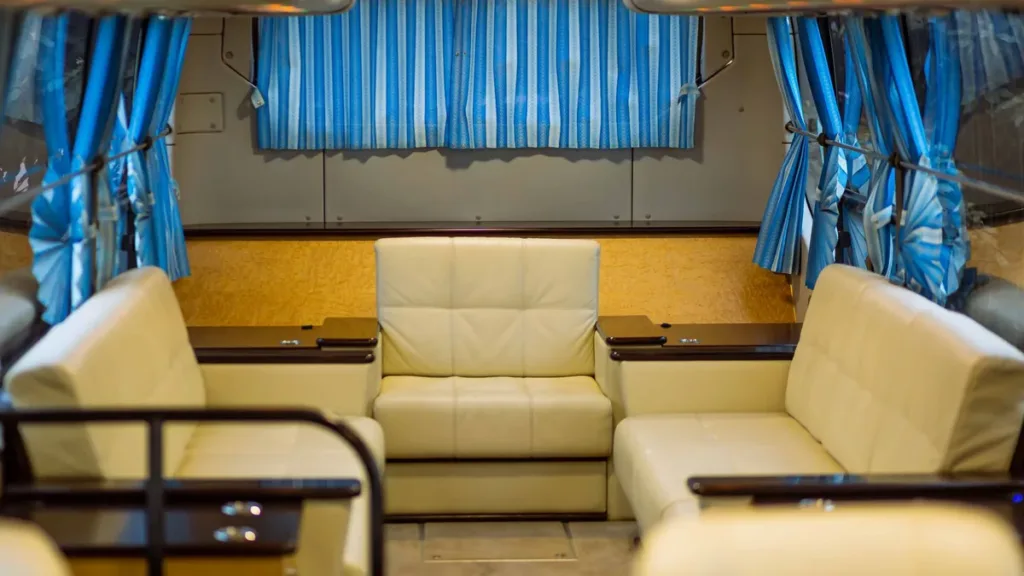
Good corporate event transportation from several pickup points comes down to four decisions made before any vehicle is requested: how many stops you really need, the order they run in, how long each stop is allowed to take, and the point at which one long loop becomes two short routes. Get those right and the vehicle choice mostly follows. Get them wrong and even a well-driven coach arrives late, with the first people collected sitting on board for longer than the event’s opening session.
The practical rule of thumb is simple. Keep each route to a handful of stops, give every stop a fixed window that the vehicle will not extend, and cap the ride time of the first person collected. If the stop list cannot meet that cap, split the route. What follows is the working method, with the geography of Lahore, Karachi and Islamabad used as a reality check rather than decoration.
Decision summary for corporate event transportation
The calls that matter, in order:
- Stops: cluster people to a small number of pickup points you can name precisely (a hotel porch, an office gate, a car park entrance), not to home addresses.
- Order: run stops so the route travels towards the venue, not across the city and back.
- Ride-time cap: set the longest acceptable time on board for the first passenger, then work backwards.
- Window: each stop gets a fixed window. Whoever is not there when it closes makes their own way.
- Headcount: one named person per stop confirms numbers to one coordinator before the vehicle leaves.
- Split test: if the loop breaks the ride-time cap or crosses the city’s main corridor twice, run two vehicles instead.
A company offsite, an annual dinner, a product launch or a training day at a hotel outside town all fit this pattern. The same thinking applies to staff pickup route planning for a regular shuttle, but this guide is written for the one-off event where nobody has a chance to learn the route by trial and error.
Clustering staff into pickup points
Start with a list, not a map. Export your attendee list with one column that matters more than any other: where each person can realistically be at the departure time. For most companies that answer falls into three groups.
- Office-based staff who can gather at one or two company premises.
- Hotel-based visitors from other cities or abroad, who are already concentrated in a few hotels.
- Home-based staff, who are the group most likely to generate a request for “just one more stop”.
The first two groups form natural clusters. The third is where routes go wrong. A multi-point group pickup works when every stop serves several people. A stop that serves one person costs the same few minutes of kerb time as a stop that serves fifteen, and it adds one more chance of a phone call that starts with “two minutes away”.
How to decide what counts as a stop
A pickup point should pass three tests:
- A vehicle can stop there legally and safely. A 45-seat coach cannot pull into many residential streets, gated societies or narrow market lanes. Hotel forecourts and office compounds usually can take a van; check with the property for a coach.
- It can be described in one line. “Main gate, car park B” beats a dropped pin. Drivers and passengers both need to picture the same spot.
- It serves enough people to justify the time. Set a minimum in advance, for example three or more. People below that threshold are asked to reach the nearest cluster point.
Home-based staff can be routed to an office, a hotel on the way, or a well-known landmark with safe standing room. Many companies simply offer a fuel or ride allowance to reach the nearest point. Either way, the decision is made once, by the organiser, and not negotiated per person on the day.
Stop order and maximum ride time
Once you have clusters, put them in an order that moves steadily towards the venue. That sounds obvious, yet the most common mistake is ordering stops by seniority or by who asked first. The vehicle does not care who the managing director is. It cares about direction of travel.
Then set a ride-time cap. This is the longest time you are prepared to have the first person collected sitting on board before arrival. For a formal dinner or conference, people arriving creased and irritated after a long loop is a visible cost. Pick a figure that suits the event and hold to it. The cap is the single number that tells you whether a route works.
Why city geography sets the cap for you
The three major cities make the point in different ways:
- Karachi runs along a long spine. Shahrah-e-Faisal alone runs about 18 km from the Bhutto Underpass near Hotel Metropole to Star Gate by Jinnah International Airport, carries roughly a quarter of a million vehicles a day and is described in the research Wikipedia cites as the city’s most fatal road. A route that collects in Clifton, then Saddar, then Gulistan-e-Jauhar before heading to a venue near the airport is travelling most of that corridor. A route that also detours north is doing it twice.
- Lahore spreads outwards, with the orbital Lahore Ring Road passing DHA and Allama Iqbal International Airport on its way round much of the city (one southern section is still unfinished, so it is not yet a full loop). The airport sits about 15 km from the city centre. Stops on opposite sides of the city, joined through the centre, are usually slower than two vehicles each using the ring road from their own side.
- Islamabad and Rawalpindi behave like two cities. The Islamabad Expressway runs roughly 28 km from Zero Point to T Chowk at Rawat, and Islamabad International Airport is about 25 km from both Zero Point and Rawalpindi’s Saddar, according to published airport data. A single vehicle collecting in F-sectors, then Saddar, then heading to an airport-side hotel is covering a triangle, not a line.
None of these distances tell you a drive time. Traffic in each city varies by hour, day and season, and events such as rallies or VIP movement can close roads at short notice. Use distance to shape the route and a local operator’s current timing to price it.
Pickup windows and the no-wait rule
Every stop gets a window: an opening time and a closing time. The vehicle arrives at the opening, loads, and departs at the closing time whoever is missing. That is the no-wait rule, and it is the difference between a timetable and a wish.
Without the rule, each late passenger pushes every later stop back. Five stops with a few minutes of drift each add up, and the last stop’s group ends up waiting at the kerb while the first stop’s group is already irritable on board.
Setting sensible windows
- Short at hotels. Hotel guests can be asked to be in the lobby before the vehicle arrives. A tight window is fair.
- A little longer at offices. People leaving meetings and lifts take time. Allow for it, but do not let the window absorb a meeting that runs over.
- Buffer at the end, not in the middle. Put your contingency time between the last stop and the event start, so drift at one stop does not ripple through the rest.
Publish the windows in writing to every passenger at least a day ahead, with the line-one description of the stop and a contact number for the stop lead. State the no-wait rule in the same message, and say what latecomers should do instead: take their own transport, claim it back under the event policy, or join a named later vehicle if you have one.
The UK Health and Safety Executive’s advice on planning and managing work journeys is useful framing here even for a Pakistan event: it tells employers to calculate journey times that allow safe driving within the speed limit and not to set schedules that pressure drivers into unsafe speeds to hit agreed arrival times. A no-wait rule protects the driver as much as the timetable. The lost minutes come out of a late passenger’s plans, not out of the driver’s speed.
Headcount at each stop and who confirms it
Drivers drive. They should not be asked to run a registration desk at the kerb, compare faces against a spreadsheet or decide whether to wait for someone’s colleague. Give that job to people.
The two roles you need
- A stop lead at every pickup point. Usually a staff member who is travelling from that stop anyway. They hold the list for their stop, tick people on, and send one message when the vehicle leaves: stop name, number boarded, names missing.
- One transport coordinator. Not at any stop, ideally at the venue or at a desk. They receive every stop lead’s message, keep a running total per vehicle, and are the only person who talks to the operator about changes on the day.
What the list should hold
- Name and mobile number of each passenger.
- Assigned stop and assigned vehicle.
- Any mobility or luggage needs, flagged in advance rather than at the door.
- Return arrangement: same vehicle, a later vehicle, or own transport.
Our sister service Pakistan Taxi has a detailed walk-through on building a pickup manifest for an event with several vehicles, which is a sensible template to adapt for a staff list.
Splitting a route vs one long loop
Here is the decision most organisers get wrong: they book one large vehicle because it looks cheaper and simpler, then force it round every stop. Sometimes that is right. Often two smaller vehicles, each on a tight route, deliver everyone sooner and with fewer knock-on problems.
| Factor | One long loop | Two or more split routes |
|---|---|---|
| First passenger’s ride time | Longest possible; grows with every stop | Shorter; each route has fewer stops |
| Effect of one late stop | Delays everyone after it | Contained to one vehicle |
| Arrival at venue | Everyone arrives together | Staggered unless timed carefully |
| Vehicle size | Large coach; access limits at some stops | Vans or minibuses; easier kerb access |
| Coordination load | One driver, one stream of updates | More vehicles to track; needs a coordinator |
| Resilience | A breakdown strands the whole group | A breakdown affects part of the group |
| Best fit | Stops close together on one axis | Stops on opposite sides of the city or in two cities |
The split test
Split the route if any of these is true:
- The planned loop breaks your ride-time cap for the first stop.
- The route crosses the city’s main corridor twice (for example, running the length of Shahrah-e-Faisal out and back in Karachi).
- Stops sit in two different cities or city halves, such as Islamabad sectors and Rawalpindi Saddar.
- One stop cannot take the large vehicle and would need a separate shuttle anyway.
- More than about a third of the group would be collected at a single stop. That stop can justify its own vehicle.
As an illustrative example only: a Lahore company with 60 attendees, split between a Gulberg office, a DHA office and two hotels near the Mall Road area, heading to a venue outside the city. One coach through all four would cross the city centre. A Coaster-class minibus from the DHA side via the ring road, and a second minibus collecting Gulberg and the two hotels, is likely to deliver both groups sooner. Whether it is cheaper depends on current rates for each vehicle size, which is exactly what a quote should show.
Matching vehicles to each route
Choose vehicle size per route, after the route is fixed. Working the other way round, starting from company event bus hire and fitting stops to the bus, is how loops get too long.
- Cars suit senior guests, VIP speakers or a stop with one or two people you have decided to serve anyway.
- Group vans such as the Hiace, Staria or Grand Starex handle small clusters and tight hotel forecourts well. See the group van range on iDrive for the models typically requested.
- Minibuses are the workhorse of mid-sized events. The fourth-generation Toyota Coaster is built in standard and long-wheelbase versions with different seat counts, so ask for the exact seating of the vehicle offered rather than assuming. The Toyota Coaster page shows how iDrive lists it.
- Full-size coaches make sense when a single stop, such as a head office, holds most of the group and the venue has room to turn a large vehicle.
Two practical checks apply to every size. First, count luggage and equipment as well as people: a team carrying exhibition stands or laptops in cases needs space that a seat count does not show. Second, confirm the venue’s drop-off arrangements. Some hotels and marquee venues have a single gate with security checks, which turns simultaneous arrivals into a queue.
Costing multi-stop routes
Comparing corporate event transportation services is easier once you know what you are actually buying. A multi-stop quote is not the same as a point-to-point fare with extra addresses. The cost drivers are different, and a good quote shows them.
What pushes the cost
- Vehicle time, not just distance. Stops, windows and city traffic consume hours. Many operators price groups by time block rather than kilometre alone.
- Positioning. The vehicle has to reach the first stop from wherever it is based. A first stop on the far side of the city from the operator’s yard adds cost.
- Waiting at the venue. If the same vehicle takes people home, you are paying for the hours in between unless it is released and recalled.
- Tolls and parking. Motorway and some urban tolls, and paid parking at venues or airports, are separate line items. Rates change, so check current figures rather than assuming last year’s.
- Late finishes. An evening event that overruns pushes into overtime. Agree in advance how that is charged.
How to compare quotes fairly
- Send every operator the same stop list, windows, headcount per stop and return plan.
- Ask for each vehicle priced separately, so you can see what a split costs against a single loop.
- Ask what is included: fuel, driver, tolls, parking, waiting time, overtime.
- Ask what happens if a vehicle develops a fault on the day.
Treat any figure you receive before details are confirmed as an estimate. Final prices depend on vehicle availability for your date, the confirmed route and the agreed timings. iDrive works the same way: a request is reviewed and priced, not automatically accepted.
Constraints that break good plans
A route that works on paper can still fail on the day. The recurring causes in Pakistan’s big cities are predictable enough to plan around.
- Short-notice closures. The UK Foreign Office’s Pakistan travel advice warns that rallies and protests can start with little warning and that major roads in and around cities may be shut or blocked, and it tells travellers to have alternative routes for planned journeys. Visiting colleagues from abroad should read it. Islamabad, Lahore and Karachi are not among the areas it advises against, but it does advise against all or all-but-essential travel to Balochistan, much of Khyber Pakhtunkhwa, northern Sindh and several border areas. Do not plan an event route into those areas without specialist advice.
- Mobile data gaps. The same advice notes that mobile data and internet can be cut without warning during protests or unrest. Give every stop lead the coordinator’s number and a written plan that does not depend on a live map link.
- Event-day security. Large venues, hotels hosting dignitaries and government districts may add checks at the gate. Build that time in at the venue end.
- Driver hours. An early start, a long event and a late return can make one driver’s day too long. The HSE’s work-related road safety guidance lists fatigue among the main hazards of driving for work, and its journey-planning page repeats the Highway Code advice of a 15-minute break every two hours. For a long day, ask whether the operator will change drivers.
Next steps for your event
For regular business travel around the event, such as airport collections for visiting speakers or car-and-driver days for executives, the business travel car service page sets out how those requests are handled. City-specific options sit on the Lahore taxi and car hire page and its Karachi and Islamabad equivalents.
If your company also runs events in the Gulf, our sister company Saudi Cab Co covers the same questions for coach and minibus options for large corporate offsites in Saudi Arabia.
When your stop list, windows and headcount are ready, send them through the iDrive journey request form. The team will review the routes, suggest where a split would help and come back with vehicle options and pricing, subject to availability on your date.
Questions people ask
How many pickup points should one vehicle serve?
As few as the ride-time cap allows. In practice that is usually a handful of well-populated stops on one direction of travel. If the list keeps growing, that is the signal to split the route.
Should we wait for late staff?
No. Set a window per stop, publish it, and leave on time. Tell latecomers in advance how they should reach the venue instead.
Is one coach cheaper than two minibuses?
Sometimes, but not always. Two vehicles on short routes can use less total time than one long loop. Ask for per-vehicle prices so you can compare both plans on the same details.
Who should talk to the drivers on the day?
One transport coordinator. Stop leads report to the coordinator; the coordinator alone speaks to the operator. That keeps instructions consistent.