The best car for a family of 6 in Pakistan depends on two numbers most people skip: how many of the six are adults, and whether a driver is coming with the car. Hire with a chauffeur and a seven-seat MPV such as the Honda BR-V or Changan Karvaan is full to the last belt, with room for little more than cabin bags. Drive yourself and the same car has one spare seat, which is usually where the luggage ends up. Six adults, or any group landing with airport-sized cases, should skip the compact MPV entirely and look at a people carrier such as the Kia Carnival, or a Hiace-class van.
Decision summary: which vehicle suits which six
Start with the make-up of the group, not the brochure seat count. A “seven-seater” is a statement about belts, not about comfort, and the gap between the two is widest in the third row.
- Four adults and two children under about ten, light luggage, with a driver: a seven-seat MPV works. The children take the third row, the adults take rows one and two, and the boot holds cabin bags.
- Four adults and two children, self-drive: a seven-seat MPV works better, because the empty seat can be folded or used for bags. This is the one case where a compact MPV is clearly the right buy.
- Five or six adults (teenagers count as adults here), with a driver: a compact MPV is technically legal and practically miserable on anything longer than a city hop. Book a larger people carrier.
- Any six arriving from abroad with full-size cases: the luggage decides it, not the passengers. With every seat in use, a compact MPV or seven-seat SUV cannot take four large cases. Go up a class or send the bags separately.
- Rough roads north of Islamabad with six aboard: ground clearance and drive matter more than rows. An SUV earns its place here; a low people carrier does not.
Why every child counts as a seat
The most common booking error is quietly subtracting children. “Four of us and the kids” becomes “four passengers” on the form, and then a vehicle arrives that is correct for four and hopeless for six. A child, however small, needs a belted position. A toddler on a lap is not a passenger count the vehicle was designed around, and in a collision an adult cannot hold a child against the forces involved.
The only honest way to count is by bodies and belts:
- Count every person who will be in the vehicle, including infants.
- If you are hiring with a driver, add one. A seven-seat car with a chauffeur carries six passengers, not seven.
- Mark who needs a child seat or booster, and where it can physically go (more on this below).
- Mark which passengers are adults or teenagers of adult size. They need rows one and two unless the journey is short.
- Only then compare the total against the vehicle’s registered seating.
A useful planning rule: when a child seat is fitted, count it as one seat for the child plus a penalty on the seat next to it. A bulky rear-facing or high-back seat often stops the neighbouring seat from sliding or folding, which is how most MPVs give access to the third row. In practice a family of six with one fitted child seat can behave like a family of seven when people are climbing in and out.
Legal passenger limits and seat belts in Pakistan
“How many passengers in a car” has a legal answer and a safe answer. The law is the smaller hurdle.
What the law says
On national highways and motorways, the National Highways Safety Ordinance 2000, enforced by the National Highways & Motorway Police, requires a driver not to drive a vehicle without seat belts and working lights and indicators. The same ordinance lists overloading of passengers beyond permissible limits as an offence, and its schedule attaches penalty points to overloading. Penalty amounts under Pakistani traffic law have been revised over the years, so treat any figure you read secondhand as dated and check the current position with the NHMP before relying on it.
The ordinance does not print a seat count for each vehicle, so the sensible working ceiling is the vehicle’s registered seating capacity. A seven-seater carrying eight because “the little one can sit on a lap” is past that ceiling, and it is the driver who faces the officer.
Where Pakistan’s rules are looser than you might expect
The World Health Organization’s 2023 road safety country profile for Pakistan records a national seat-belt law, but notes that it does not apply to all front and rear occupants. It also records no national child-restraint law and no national restriction on children sitting in the front seat. The same profile puts reported road deaths at 5,816 for 2021.
For a family used to UK rules this is a real shift. In Britain, GOV.UK guidance on child car seats says children must normally use a child car seat until they are 12 years old or 135 centimetres tall, whichever comes first, and that front airbags must be deactivated before a rear-facing baby seat is fitted in a front seat. None of that is required on a Pakistani road, but it is still sound physics, so plan as if the UK rules applied.
Third-row seats: adults vs children
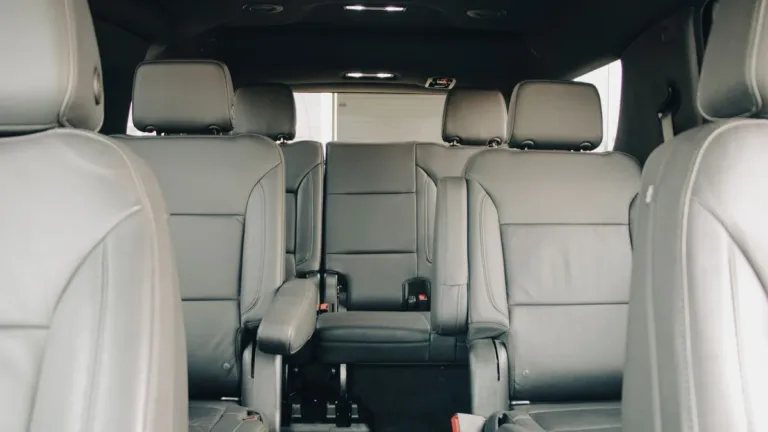
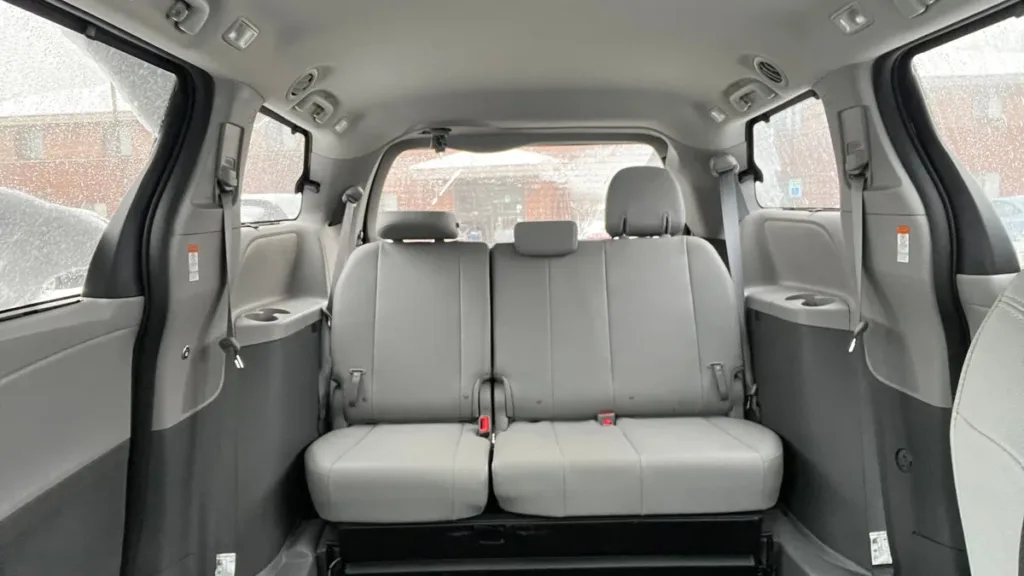
“Can adults sit in the third row?” is the question behind most family-of-six searches. The honest answer: in a compact MPV or seven-seat SUV, adults can sit there for a short run; for a motorway leg of several hours, the third row is children’s territory. In a full-size people carrier, the third row is a proper seat.
Wheelbase, floor height and cabin width decide third-row comfort, and none of them appear in the headline seat count. A longer wheelbase leaves more floor to share between three rows; a high SUV floor leaves adults knees-up.
Here is how the four vehicles most families shortlist compare, using manufacturer figures where they are published and the capacity notes on our own vehicle pages.
| Vehicle | Length / wheelbase | Registered seats | Third row in practice |
|---|---|---|---|
| Changan Karvaan Plus | 3,980 mm / 2,560 mm | 6+1 | Occasional seats; best for children or short hops |
| Honda BR-V | Check current Honda Atlas sheet | 7 | Children, or adults on shorter journeys |
| Toyota Fortuner | 4,795 mm / 2,745 mm | 7 | Children or short legs; high floor |
| Kia Carnival | 5,155 mm / 3,090 mm | 11 | Adult-usable; fourth row is the compromise |
Figures: Karvaan from Master Changan’s Karvaan specification page; Fortuner from the Toyota Indus Fortuner specification sheet; Carnival from Kia Lucky Motor’s Carnival specifications. Honda Atlas publishes BR-V figures on its own site; check the current variant sheet before comparing dimensions.
Changan Karvaan: seven belts in a short body
Master Changan lists the Karvaan Plus as a “6+1” three-row MPV with three-point belts for all passengers, a fold-down second row and a third row that folds and tumbles. The catch is the footprint. At 3,980 mm long and 1,620 mm wide it is shorter than many family saloons, so the third row is short on legroom and the cabin is narrow across the shoulders. Changan also lists ISOFIX anchors in the second row, which is where a fitted child seat belongs. Our Changan Karvaan page puts it plainly: six adults travel comfortably, and the rearmost pair of seats is occasional, for children or short hops.
Honda BR-V: the most car-like of the compact seven-seaters
The BR-V drives like a raised hatchback and is the compact MPV we would pick for a longer journey. Our Honda BR-V page describes it as seating five adults in genuine comfort, with the third row suited to children or adults on shorter journeys. That is the whole story for a family of six: two parents up front, two adults or teens in row two, two children in row three, and a boot of about 223 litres behind the third row: one large case or two cabin bags.
Toyota Fortuner: the SUV answer, with an SUV’s third row
The Fortuner is the choice when the road matters more than the rows: gravel approaches, the Kaghan road in season, broken tarmac after rain. Toyota Indus quotes 279 mm of ground clearance. The third row, though, sits on a high floor, and with all seven seats in use the bay behind it is small; our Fortuner listing describes hand baggage only in that configuration. Read luggage claims carefully: the number that matters is the one with every seat you need still upright.
Kia Carnival: the first vehicle where row three is a real seat
Kia Lucky Motor specifies the current Carnival with 11 seats, a 60:40 split third row, a pop-up fourth row that sinks into the floor, power sliding doors and a walk-in device for access to the rear. The 3,090 mm wheelbase is what buys adult legroom behind the second row. Our Kia Carnival page is candid about the other side of that: eleven is a legal seat count, not a touring layout, and the space behind the third row is shallow. For six people with luggage, the Carnival is close to ideal, because you can run it as a seven-seater with the rear area free for cases.
Car seats and boosters in rows two and three
If a child seat is travelling with you, where it goes matters as much as whether it exists. A few rules of placement that hold across most three-row vehicles:
- Never a rear-facing seat in front of an active airbag. This is the one point where UK guidance and physics agree absolutely. Unless you can confirm the passenger airbag is switched off, rear-facing seats go in the back.
- Second row first. Row two usually has better belt geometry and easier access for strapping a child in.
- Keep the third-row access path clear. In MPVs the kerbside second-row seat typically slides or tumbles to let people into row three. Do not fit a child seat on the seat that has to move. Put it on the opposite side, or centre if the belt allows.
- Boosters suit row three. An older child on a booster is light and quick to buckle, and the booster does not block access. That is often the best use of a compact MPV’s third row.
Availability of child seats in hired vehicles varies by city and supplier, so never assume one will be waiting. Tell us the ages and approximate weights of the children when you plan the journey, and say whether you are bringing your own seat. We will confirm in writing what is possible for that vehicle before anything is agreed.
Luggage with all seats up
Families flying in from Manchester, Toronto or Dubai rarely travel light, and luggage is where most seven-seat plans collapse. The table below uses the capacity notes on our vehicle pages, which state luggage in cases rather than litres because cases are what decide whether a party fits.
| Vehicle | All seats in use | Third row folded | Verdict for six with airport luggage |
|---|---|---|---|
| Changan Karvaan | Two cabin bags | About four large cases | Does not fit six plus cases |
| Honda BR-V | One large case or two cabin bags | About four large cases | Does not fit six plus cases |
| Toyota Fortuner | Hand baggage only | Four large cases | Does not fit six plus cases |
| Kia Carnival | Three to four cases (11 seats up) | Eight to ten cases (as a seven-seater) | Fits six with most family luggage |
The arithmetic is unforgiving. With a driver, a family of six fills all seven seats of a compact MPV or seven-seat SUV, so the third row cannot be folded and the luggage allowance is the small “all seats in use” figure. Self-drive changes the picture only slightly: one seat is spare, but folding one half of a split third row still leaves you short of space for six full-size cases.
Two workable fixes, in order of preference:
- Go up a class. A people carrier or van carries the family and the bags in one vehicle, one driver, one pickup.
- Split the load. A compact MPV for the family plus a second car for the luggage. On an airport run it can be the simplest arrangement.
MPV vs SUV vs van for 6
Once you have counted honestly, the choice narrows to three body types. Each one wins in a different situation.
| Factor | Compact MPV (Karvaan, BR-V) | Seven-seat SUV (Fortuner) | People carrier / van (Carnival, Hiace class) |
|---|---|---|---|
| Six adults for 3+ hours | Poor | Poor to fair | Good |
| Four adults, two young children | Good | Good | Good, possibly more than needed |
| Six with airport luggage | No | No | Yes |
| Rough or unsealed roads | Limited | Strongest option | Varies by model; long overhangs are a weakness |
| Access for elderly passengers | Fair | High step-in | Best, especially with sliding doors |
| Narrow old-city lanes | Easiest | Manageable | Hardest |
The Fortuner is the one to watch: book it for the road, not for the headcount, because its third row and seven-up luggage space are no better than a compact MPV’s.
For the full list of vehicles in the compact class, see our family MPV class page, which also explains that you book a class rather than a named model, and that the assigned vehicle is confirmed against your passenger and luggage numbers.
The best car for family of 5 is a different question
Drop one person and the answer moves more than you would expect. Five people with a driver means six occupants, which a seven-seat MPV handles with one seat to spare, and that spare seat is usually half of a split third row. Fold it and the boot grows enough for a couple of extra cases. Five people self-drive means five occupants, and now a large saloon or a five-seat crossover is back in contention, provided the rear bench holds three without a child seat blocking the middle.
The trap for a family of five is the middle rear seat. Three across a saloon’s rear bench rarely works with a child seat fitted. If one of your five needs a fitted seat, count the saloon’s rear bench as two, and the MPV becomes the sensible choice again.
Worked examples: counting six properly
These are illustrative examples, not quotes or real bookings. They show how the counting rule changes the vehicle.
Example 1: grandparents, parents and two small children, Islamabad airport to Rawalpindi
Six passengers plus a driver is seven occupants. The children are aged three and seven, so one needs a child seat and one a booster. Luggage is four large cases and four cabin bags after a long-haul flight. A compact MPV fails on luggage even though the seats add up. The workable choices are a people carrier, or an MPV for the family plus a second car for the cases.
Example 2: two parents and four children aged 6 to 12, a city wedding day in Lahore
Six passengers, short hops between home, salon and venue, and almost no luggage. A compact MPV is exactly right: parents in rows one and two with the youngest, older children in row three on boosters. The narrow body is an advantage in tight residential streets and crowded venue car parks.
What to check before you book a vehicle for six
- Is the passenger figure excluding the driver? When you enter numbers, count passengers only and choose “with a driver” or “self-drive”; the fit is then checked against the vehicle that will actually be assigned.
- How many are adult-sized? Teenagers count as adults for third-row purposes.
- How many large cases and cabin bags? Give real numbers, not “a few”.
- Which children need seats or boosters? Ages and rough weights.
- Anyone with limited mobility? A high SUV step or a third-row climb may rule a vehicle out.
- What roads? City, motorway or mountain changes the class more than the headcount does.
When you plan your journey with iDrive, the form asks for passengers, large bags and small bags separately for this reason. It starts an itinerary enquiry rather than a confirmed booking, and whether the vehicle suits the party, the luggage and the road is confirmed in writing before you commit. If you would rather plan a family arrival through a service that focuses on passengers and families, our sister service Pakistan Taxi, an iDrive brand, has a guide to family journeys and family vehicles.
Many overseas families pair a Pakistan visit with Umrah. The same counting problem applies in Saudi Arabia, often with more luggage. Our sister company Saudi Cab Co has a practical comparison of minivans versus SUVs for family airport transfers in Saudi Arabia.
Questions people ask
Can third row seats take adults?
In compact MPVs and seven-seat SUVs, third row seats suit adults only for short journeys. On a people carrier with a long wheelbase, such as the Kia Carnival, adults can sit in row three for longer trips.
How many passengers in a car is legal in Pakistan?
Treat the vehicle’s registered seating as the ceiling. On national highways and motorways, the National Highways Safety Ordinance treats overloading passengers beyond permissible limits as an offence, with penalty points against the driver.
Are child seats compulsory in Pakistan?
The WHO’s 2023 profile records no national child-restraint law in Pakistan. Using an appropriate seat is still the safe choice, and UK families should plan to their home standard.
Is a seven-seater enough for six people and a driver?
For seats, yes; for luggage, usually not. With all seven seats in use, compact MPVs and seven-seat SUVs take little more than cabin bags, so a family with airport cases needs a larger vehicle.