For most older passengers, the best car for elderly to get in and out of is not the tallest vehicle or the most expensive one. It is the car whose seat sits roughly level with the passenger’s hips when they stand beside it, whose door opens wide, and whose sill is low enough to step over without lifting a stiff knee. In Pakistan’s hire fleet that usually points to a mid-size crossover, or a roomy sedan for shorter passengers, not a low hatchback and not a tall 4×4. A wheelchair-accessible van is the right answer only when the passenger cannot stand and pivot at all, or must travel seated in their own chair.
Below: the choice by vehicle class, the few measurements that decide comfort, and what to put in the booking notes so the driver arrives prepared. It is aimed at families abroad choosing a car for elderly parents in Pakistan, for an airport run or a week of visits in Lahore, Islamabad, Karachi or Mirpur.
Decision summary: the best car for people with mobility issues fits the body, not the budget
Three questions settle most cases before you look at a single model name:
- Can the passenger stand, turn and sit with light support? If yes, a standard car will almost always work. The job is choosing the right seat height.
- Is the main problem knees and hips, or balance and strength? Stiff knees and hips favour a higher seat that removes the deep crouch. Weak legs or poor balance favour a seat the passenger can reach without climbing, plus a grab point.
- Does the passenger need to stay in a wheelchair? Only then is a ramp or lift vehicle a genuine requirement rather than an expensive precaution.
The UK charity RiDC, which measures seat heights, sills and door openings across its vehicle database, puts the core trade-off plainly: an older passenger may need a high seat because bending down is difficult, while a wheelchair user may need a specific seat height for a level transfer. Neither of those people needs the same car, and neither is well served by the default economy booking.
Seat height by class: where the hip point sits
The number that matters most is where the seat cushion sits relative to the passenger’s own hip when they stand next to the open door. Designers call the pivot point of a seated body the hip point. If the cushion is well below the passenger’s hip, they have to lower themselves into a squat. If it is well above, they have to hop or climb up. Level, or slightly below level, lets them simply sit backwards.
RiDC measures seat height from the ground at both the highest and lowest adjustment positions, with the seat set mid-way on its runners, which is a useful reminder that the same car can vary noticeably depending on how the passenger seat has been left (RiDC measurement method). Front passenger seats in many hire cars do not adjust for height at all, so treat the fixed position as the real figure.
In broad terms, economy hatches such as the Alto, Mira and Cultus sit lowest and ask for the deepest bend, although the tall, boxy Wagon R is more upright than its size suggests. Standard and executive sedans sit a little higher, with long front doors and a flat sill. Comfort crossovers bring the cushion closest to adult hip height for many people, which is why they so often remove the painful crouch. Large 4x4s and VIP SUVs can overshoot for a shorter passenger, and MPVs and vans vary so much by model that they get their own section below. These are relative positions, not measurements; the reliable test is the home measurement described later.
Comparing classes for older passengers
Ratings below are relative and describe typical layouts, not any individual vehicle.
| Class | Seat height vs typical adult hip | Door opening | Step or sill | Best suited to | Watch for |
|---|---|---|---|---|---|
| Economy hatch | Well below | Short front doors | Low | Short trips, agile passengers | Deep crouch; tight door frame for the head |
| Standard sedan | Below | Long front doors | Low and flat | Moderate stiffness, motorway comfort | Low roofline at the door edge |
| Executive sedan | Below | Long, often wider opening angle | Low | Long journeys needing rear legroom | Still a bend to sit |
| Comfort crossover | Near level for many adults | Tall and reasonably wide | Moderate | Knee and hip problems | Slightly higher sill to step over |
| Premium 4×4 / VIP SUV | Level to above | Tall | High, often with side step | Taller passengers, rough roads | Climbing up; side steps catch feet |
| Family MPV | Varies by model | Hinged or sliding rear | Low to moderate | Family groups with one older member | Third-row access is hard for anyone |
| Group van | Above, with floor step | Wide sliding door | High floor, step fitted on some | Large groups, luggage-heavy arrivals | Step height from road to floor |
| Wheelchair-accessible van | Travels seated in own chair | Rear or side ramp/lift | Ramp | Non-weight-bearing passengers | Securing the chair; limited fleet |
Door opening and sill height: the forgotten half of the problem
A high seat solves only half the difficulty. The other half is getting the legs in and the head under the frame. Three things decide it.
Door opening angle and width
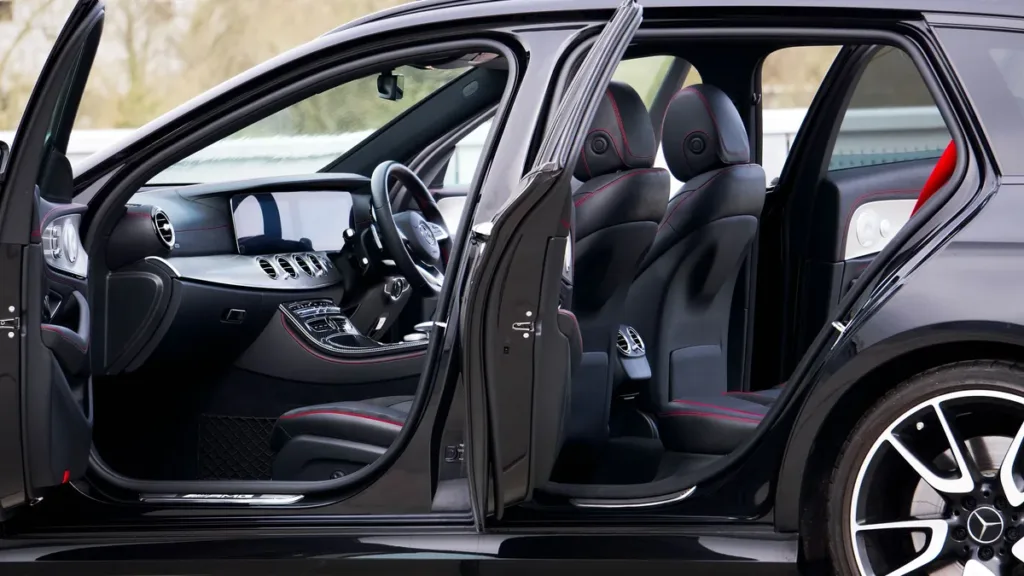
RiDC measures the maximum opening angle of the front passenger door with a protractor, and the width of the opening at half its height. That tells you something practical: a door that swings nearly square to the car gives room to turn a walking frame or stand a companion alongside, while a door that stops at a shallow angle forces the passenger to squeeze past the leading edge. At the kerb, ask the driver to open the door fully before the passenger approaches, and check it will not swing back on a slope.
Sill height
The sill is the lip at the bottom of the door opening. RiDC records it both to the ground and to the cabin floor, because the inside drop matters too: a sill that is low outside but falls to a deep footwell means the foot drops further than expected. Crossovers generally carry a slightly higher sill than sedans; for most people that is a fair trade for not crouching. For someone who shuffles rather than lifts their feet, a lower sill can matter more than seat height.
Crossovers vs sedans for knee problems
For painful knees, the crossover usually wins, for a simple mechanical reason: the higher the seat, the less the knee has to bend under load as the passenger lowers themselves.
A sedan is still the better call in a few cases:
- The passenger is short and a crossover cushion sits above their hip, so they would have to push up and back to sit.
- The main issue is lifting the feet, not bending the knees, and the sedan’s lower sill helps more.
- The journey is a long motorway run, such as the M-2 between Islamabad and Lahore, and the passenger finds a lower, firmer ride less tiring.
If you cannot decide, lean towards the crossover. A seat slightly above the hip is usually easier to manage than one well below it, and nobody can make a high seat lower on the day, whereas a firm cushion can lift a sedan seat a little if that is the car that turns up. Our comfort crossover and SUV class lists the models commonly supplied, and the standard sedan class sets out the alternatives.
Sliding doors and step heights in MPVs and vans
Sliding doors look like the obvious answer for older passengers. They open wide, they do not swing into traffic, and they leave room for a helper to stand beside the passenger. The catch is the floor.
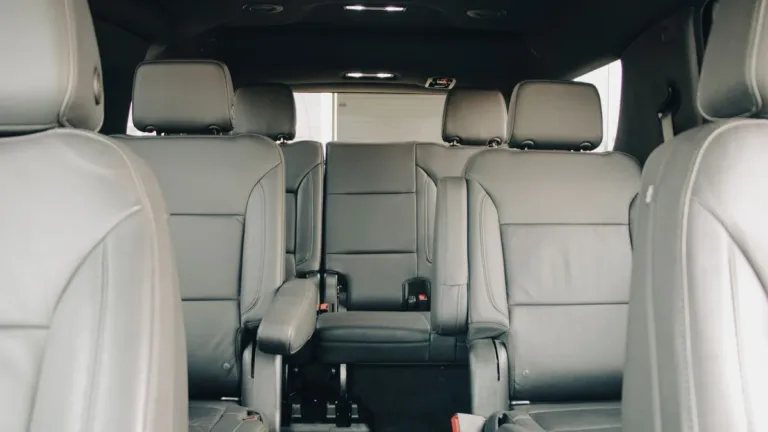
Van-based vehicles such as the Toyota Hiace Grand Cabin have a cabin floor well above the road, and the first step up is the hard part. Some are fitted with an intermediate step; some are not. The passenger then has to walk bent over inside to reach a seat, which is harder than it sounds for someone with back pain. Car-based people carriers, including models in our family MPV class, tend to have lower floors but less room to stand inside.
Practical rules for MPVs and vans:
- Seat the older passenger in the row nearest the sliding door, on the kerb side, never in a third row that requires folding or climbing past a seat.
- Ask whether a portable step is carried if the van floor is high. Do not assume one is.
- Consider a sedan or crossover for the older passenger and a van for everyone else, if the group is large. Two vehicles in convoy are often kinder than one big one.
When a wheelchair vehicle is truly needed
A wheelchair-accessible vehicle with a ramp or lift is a specialist booking, fleet-limited and more expensive. It is the right choice when any of these is true:
- The passenger cannot bear weight on their legs, even briefly, to stand and pivot.
- They have a powered wheelchair or a chair that does not fold, and cannot transfer out of it.
- A clinician has advised they travel seated in their own chair.
- Transfer would require lifting by two people, which is unsafe at a roadside or in an airport car park.
It is usually not needed when the passenger uses a wheelchair only for distance, such as through an airport terminal, but can stand and take a few steps. In that case, a car with the right seat height plus a folded chair in the boot does the job, and the passenger gets a more comfortable seat for the journey.
RiDC’s guidance on accessories for getting into and out of a car describes the middle ground: transfer boards that bridge the gap between a wheelchair and the seat, handles that clip to the door frame, and leg lifters. Its page on swivel seats is useful background too, although fitted swivel seats are an adaptation to a specific car and should not be expected in a hire fleet.
If a ramp vehicle is genuinely required, look at the accessible vehicle class and send the request as early as you can, with the chair’s type and approximate size. Availability varies by city and date and is confirmed only when the operator accepts the request.
A five-minute test to find the high seat car for elderly relatives
You do not need a spec sheet to pick a high seat car for elderly parents. You need a tape measure and one phone call to whoever is at home with them.
- Find the chair they get out of most easily. Not the sofa. Usually a firm dining chair or a particular armchair.
- Measure from the floor to the top of the seat cushion, at the front edge, with nobody sitting on it.
- Note how they stand up. Do they push on armrests? Rock forward? Need a hand?
- Measure the passenger’s own hip height standing in their usual shoes: floor to the bony point at the side of the hip.
- Put both numbers in the booking notes, with a line on how they stand. The operator can then match a class rather than guess.
This is worth doing because kerbs change everything. In many Pakistani cities the car will stop beside a raised pavement, in a narrow gali, or on a gravel forecourt at a marriage hall. A seat that is level with the hip from the road can sit well below it from a kerb, so a sedan pulled up against a high pavement can behave like a crossover, and a crossover at a kerb can feel low. Tell the driver which side the passenger should step out on and whether to pull up close to the kerb or away from it.
How the passenger should get in and out
Technique matters as much as the car. RiDC’s advice on techniques for getting in and out of a car comes down to one sequence: sit first, then swivel the legs in; reverse it to get out. In practice:
- Recline the seat back slightly and slide it fully rearward before the passenger approaches.
- Passenger stands with their back to the seat, calves touching the sill.
- One hand on the door frame or a fixed handle, never on the door itself, which can move.
- Sit down onto the seat edge, head tilted slightly to clear the frame.
- Swing both legs in together, turning the body on the seat rather than twisting at the knees. If a leg will not lift over the sill, RiDC lists a leg lifter among the simple accessories that can take the strain.
- Bring the seat forward and upright only once they are settled, then fasten the belt.
To get out, reverse it: seat back, turn to face the door, both feet on the ground, shuffle forward to the edge, then stand with a push from the seat and the frame. Rushing this at a busy arrivals kerb is how falls happen, so a good driver chooses a stopping place where there is time.
What to tell the driver about assistance
Most mistakes come from vague notes such as “elderly passenger, please help”. Drivers are not carers, and they cannot read what “help” means. Specific notes let them prepare and let the operator assign a suitable car. Include:
- Mobility level in one line: “Walks slowly with a stick; needs an arm to stand”, or “Uses a wheelchair in the terminal, can take three steps to the car”.
- Which side and which seat: front passenger seat usually gives the most legroom and the best door; say so if the passenger prefers the rear.
- Equipment and boot space: folded wheelchair, walking frame, oxygen concentrator, transfer board. A folded chair plus two large suitcases can exceed a sedan boot.
- Physical help that is and is not wanted: “Please steady her arm; do not lift” is clear. Lifting a passenger is not something to expect from a driver.
- Language and contact: the passenger’s language, a local contact number, and who the driver should call if the passenger is confused or unwell.
Our sister service Pakistan Taxi, which runs on the iDrive network, explains how car and driver hire requests work for families. A day with one driver, rather than several separate transfers, is often the most reassuring set-up for an older relative, because the same person learns how they like to be helped.
Linking the car to airport assistance
For diaspora families the car is the last link in a chain that starts at a UK or Gulf departure gate, so plan the handover too.
- Book airline assistance separately, and early. The UK Civil Aviation Authority advises requesting assistance when you book, or at least 48 hours before departure, through the airline or agent, and keeping written confirmation.
- Know the airline’s own process. PIA says passengers can request wheelchair help at booking or afterwards, and that requests are passed to wheelchair service providers 24 to 36 hours before the flight. It also states that cabin crew cannot help with personal care such as eating or medication, so a passenger who needs that should travel with a companion.
- Agree where the wheelchair hands over to the car. The CAA says destination assistance can run through immigration, customs and baggage reclaim to the exit, and only sometimes to car parks or drop-off points, so confirm with the airline where the handover happens. Put the flight number and “arriving with wheelchair assistance” in the booking notes so the driver waits at the exit rather than in the parking.
Our Pakistan airport transfers page sets out how arrivals pickups are requested at the main airports. If the same parents are also travelling on to Umrah, our sister company Saudi Cab Co has a guide to travelling with older passengers in Saudi Arabia, covering vehicle choice and rest stops on the Makkah and Madinah side.
Your next step
The best car for seniors to get in and out of is the one chosen for a specific person on a specific kerb: a crossover for stiff knees, a sedan for shorter passengers with weak legs, a car plus folded chair for airport-only wheelchair users, and a ramp vehicle only for those who cannot transfer. When you are ready, send the journey details through the iDrive booking page with the measurements and assistance notes in the comments. Vehicle class and availability are confirmed by the operator after review; a request is not a guarantee of a particular model.
Questions people ask
Is an SUV always better than a sedan for elderly passengers?
No. A mid-size crossover suits many people with stiff knees, but a large 4×4 can be too high for a shorter passenger, who then has to climb. Compare the seat to the passenger’s hip height.
Do I need a wheelchair-accessible vehicle if my parent uses a wheelchair at the airport?
Not if they can stand and take a few steps. A standard car with the folded chair in the boot is normally enough. A ramp vehicle is for passengers who must stay seated in their chair.
Will the driver lift my parent into the car?
Do not plan on it. Drivers can steady an arm, open doors and handle the wheelchair, but lifting a passenger is unsafe and should not be expected. Bring a companion or an aid such as a transfer board if more help is needed.