A rent a car rate per km in Pakistan is a useful starting number and a poor final answer. Distance drives fuel and wear, but an intercity fare also carries the empty drive home on a one-way trip, motorway tolls, the driver’s time (waiting, traffic, overnight stays) and the road itself, because a kilometre of Murree hill road does not cost what a kilometre of M-2 costs. Two quotes with the same per-km figure can differ by thousands of rupees once those items are counted, and a low per-km quote can end up the dearer of the two. The practical rule: ask any operator to split the price into distance, time, return leg and pass-through costs, then compare line by line. If a quote cannot be split, you cannot compare it.
Decision summary: reading a rent a car rate per km Pakistan quote
Before the detail, the short version for anyone comparing prices this week:
- Per-km rates are only comparable for the same vehicle class. A sedan rate and a seven-seater rate are different products, and the motorway authority charges them differently too.
- On one-way trips, ask whether the return is priced in. If the car has to drive home empty, someone pays for that fuel. It is either in the rate, added as a line, or missing, and a missing return leg tends to reappear later.
- Tolls should appear as their own line. They are set by the National Highway Authority, they change, and there is no reason for them to be buried in a per-km figure.
- Time is priced separately from distance. Waiting at an airport, a lunch stop that becomes three hours, or a night away from base all cost money even when the odometer does not move.
- Hill and mountain routes deserve their own quote. Applying a plains per-km rate to a Murree, Swat or Hunza run understates the job.
The five cost blocks inside an intercity fare
Every serious intercity price in Pakistan can be broken into the same five blocks.
| Cost block | What drives it | Scales with distance? | What to ask |
|---|---|---|---|
| Fuel | Vehicle class, load, speed, air-conditioning, gradients | Yes, roughly | Which vehicle, and is fuel included or charged at actuals? |
| Wear and running cost | Tyres, oil, brakes, servicing, depreciation | Yes, and faster on bad roads | Is the rate the same for motorway and hill sections? |
| Return leg | Whether the car can pick up a return job | Yes, doubles the distance if empty | Is the empty return included, charged, or not mentioned? |
| Pass-through costs | Motorway and expressway tolls, parking, airport access | Partly | Are tolls listed separately at the current NHA rate? |
| Driver time | Hours on duty, waiting, overnight stay, night driving | No | How many hours are included, and what does an extra hour cost? |
A self-drive rental shifts some of these onto you. You buy the fuel, pay the tolls and have no driver-time line, but you may face mileage caps and a daily rate instead. For a fuller treatment of the with-driver side, our guide to what a car with driver includes and what changes its cost goes through duty hours, allowances and the small print.
Fuel and wear per kilometre by vehicle class
Fuel is the one block that behaves like a true per-km cost, so it is worth doing the sum yourself. The formula is simple:
Fuel cost = (distance in km ÷ vehicle’s km per litre) × pump price per litre
The pump price is the volatile part. The Oil and Gas Regulatory Authority publishes notified petroleum prices, and in September 2026 it issued fresh notifications effective 5, 12 and 19 September. A fare built on last month’s price may already be out of date, which is one reason careful operators either quote fuel at the price on the day or state the price their quote assumes.
Worked example: fuel cost Islamabad to Lahore by car
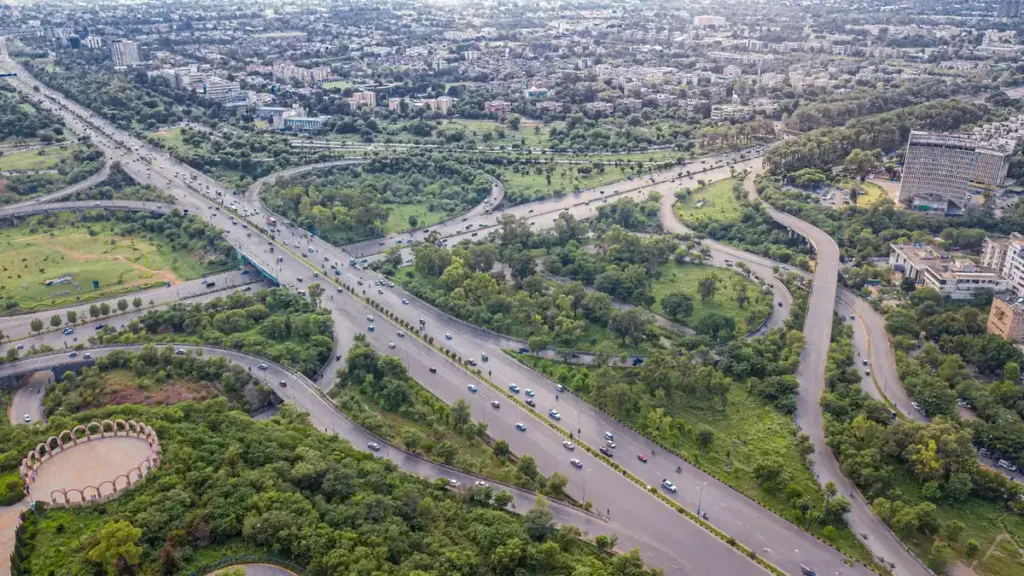
The M-2 motorway runs about 375 km between the Islamabad/Rawalpindi end and Lahore. Door to door, add the city legs at both ends. The figures below are an illustration, not a price: assume 400 km in total, a car returning 12 km per litre, and petrol at Rs 280 a litre as an example figure only (check OGRA for the real number).
- 400 km ÷ 12 km/l = 33.3 litres
- 33.3 litres × Rs 280 = about Rs 9,330 one way
- If the car returns empty, the same again: about Rs 18,670 in fuel for a single paying journey
Swap in a seven-seater that manages, say, 9 km per litre in the same example and the one-way fuel line rises to about Rs 12,440. The distance has not changed. The vehicle has.
Wear is real but lumpy
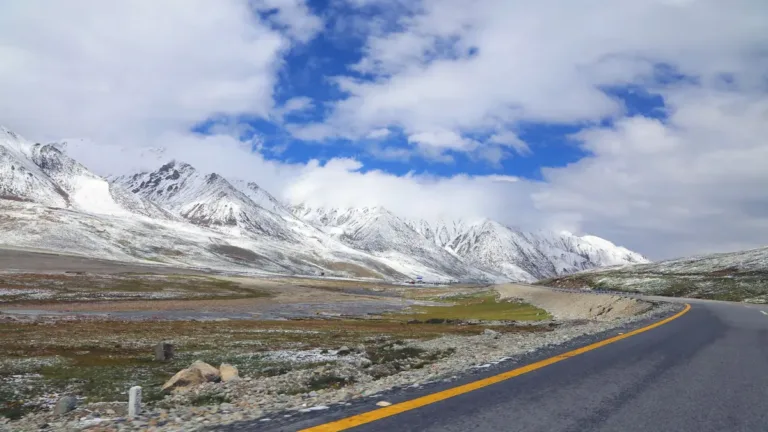
Tyres, brake pads, oil changes, suspension work and depreciation are spread across kilometres, but they do not arrive evenly. A car that spends its week on the M-2 wears differently from one doing the Kaghan valley. Operators usually fold wear into their per-km rate, which is fine, as long as the same rate is not applied to a motorway run and a broken mountain road. The UK Foreign Office puts it bluntly: outside the major motorways, road quality is variable and conditions can be poor, and many northern routes have uneven surfaces and frequent landslides. That shows up in the maintenance bill.
Vehicle class, briefly
| Class | Typical use | Fuel per km | Motorway toll class |
|---|---|---|---|
| Hatchback or sedan | One to three passengers, light luggage | Lowest | Car |
| Crossover or SUV | Families, heavier bags, poorer roads | Higher | Car or jeep |
| Seven-seater or van | Groups, airport runs with many cases | Higher again | Often wagon, depending on the vehicle |
| Coaster | Wedding parties, tour groups | Highest | Coaster |
One-way taxi fare, return empty: the leg you pay for but never ride
This is the single largest reason distance alone cannot set the fare. If you book a car from Islamabad to Lahore and nobody needs a ride back to Islamabad that evening, the car still has to get home. The driver burns the same fuel, pays the same toll, and spends several more hours on the road without a passenger.
There are three honest ways to handle it, and you should know which one a quote uses:
- Return built into the rate. The per-km figure looks high because it quietly covers two legs. Fine, if you know that is what you are paying for.
- Return charged as a line. A lower per-km rate plus a separate “return” or “dead mileage” item, sometimes at a reduced rate because fuel is the main cost and the driver’s time is partly recovered.
- Return waived because the car has a job at the other end. An operator with vehicles based in both cities, or with a booked return passenger, can drop the empty leg. This is where network size genuinely shows up in price.
The problem case is the fourth one: a cheap one-way figure that says nothing about the return, followed by a request for “fuel for the way back” at the destination. When comparing a one-way taxi fare with the return empty, ask the operator to say in writing which of the three models applies.
A round trip changes the arithmetic. If you are going to Lahore and back within a day or two, a return booking with the same car can cost less than two one-way fares, because the empty legs disappear. The trade-off is driver time, which the section below covers.
Tolls and M-Tag: pass-through costs that belong on their own line
Tolls are set by the National Highway Authority and differ by vehicle class. On the M-2, rates were raised by 7 percent from 5 July 2026 under the NHA’s concession agreement with Motorway Operations and Rehabilitation Engineering, a Frontier Works Organization subsidiary. The new schedule, valid until 23 April 2027, charges:
- Cars, jeeps and taxis: Rs 3.98 per km, Rs 1,430 end to end
- Wagons: Rs 6.68 per km, Rs 2,390 end to end
- Coasters: Rs 9.34 per km, Rs 3,350 end to end
So the toll alone for a coaster is more than double a car’s on the same stretch. Send a one-way wedding coaster from Lahore to Islamabad and bring it back empty, and that Rs 3,350 is paid twice.
Other motorways moved on 10 July 2026. The revised schedule put a car at Rs 700 on the M-1, Rs 1,000 on the M-3, Rs 1,350 on the M-4, Rs 1,500 on the M-5 and Rs 300 on the Islamabad-Murree dual carriageway (E-75). These are figures for the dates reported; check the latest NHA notice before relying on them.
The M-Tag wrinkle
The M-2 moved to electronic collection with M-Tag in December 2021. In May 2025 the NHA notified a 50 percent surcharge on vehicles without an M-Tag or without enough balance, but on 3 July 2026 the Islamabad High Court suspended that notification pending further hearings. The position may change again. For a buyer, the point is simple: a professional operator’s vehicles should carry a tagged, funded account, and the quote should state tolls at the tagged rate. If a quote pads tolls, ask why.
Our breakdown of motorway tolls and drive times on the M-1, M-2 and M-4 goes further into timings and interchanges.
Time-based costs: waiting, traffic and night driving
A car with a driver is two assets: the vehicle and a person’s working day. Per-km pricing covers the first reasonably well and the second badly.
Waiting
Airport pickups are the obvious case. A delayed flight, a long immigration queue and a baggage belt that takes its time can add an hour or two before the car moves. Operators handle this with a free waiting window and then an hourly charge. Both numbers should be on the quote.
Traffic and speed
Motorways let a car hold a steady speed, which keeps both fuel use and driver hours predictable. The limit for cars and light vehicles on motorways is 120 km/h, and for public service and heavy vehicles 110 km/h; the government restored those limits on 22 June 2026 after cutting them temporarily to save fuel. City legs are the opposite: a rush-hour crawl out of Rawalpindi or across Lahore adds driver hours out of all proportion to the kilometres, which is why a per-km rate undercharges the start and end of the trip.
Night driving and overnight stays
Expect some operators to charge more for late-night starts or arrivals, and to decline certain routes after dark. The reason is not only the driver’s inconvenience. The UK Foreign Office notes that local driving standards are erratic, especially at night, and a careful operator prices in the extra caution, a second driver on long runs, or an overnight halt instead. If your trip means the driver sleeps away from base, expect a night allowance or accommodation line. It has nothing to do with kilometres and everything to do with the calendar.
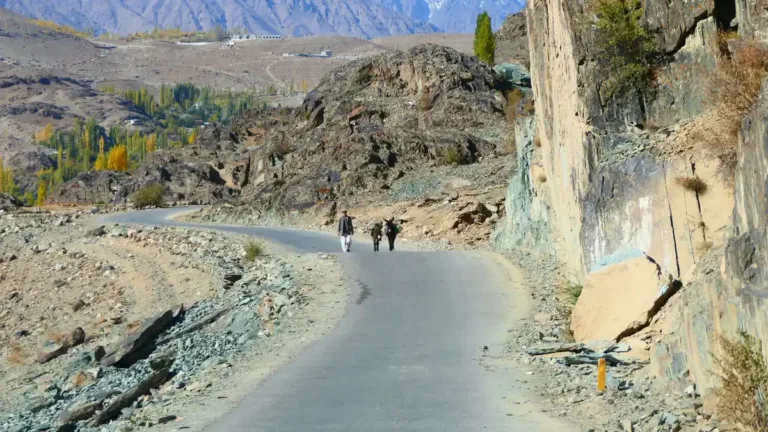
Why hill routes price differently from motorways
Take two trips of similar length. One is a stretch of the M-2 between service areas. The other is the climb from Islamabad towards Murree and on into the Galyat. On paper the kilometres are comparable. In practice almost every cost block moves the wrong way on the hill:
- Fuel per km rises on long climbs, with more low-gear work and more idling in holiday traffic.
- Wear rises: brakes on the descent, tyres on rough patches, suspension on broken surfaces.
- Average speed falls, so the driver-time block grows for the same distance.
- Weather adds risk and delay. Snow season, fog and landslides can hold a car for hours, and the FCDO specifically flags frequent landslides on northern routes.
- Return jobs are scarcer. A car that drops you in a hill town is less likely to find a paying passenger back to the city the same day.
The toll on the E-75 dual carriageway to Murree is modest compared with the M-2, so tolls are not the story here. Time and wear are. For the specific run, see our Islamabad to Murree taxi page, which is set up for hill-road journeys rather than motorway pricing.
Further north, on routes to Swat, Naran or Hunza, a daily rate with a set number of driving hours is usually the fairer basis to ask for, because the distance figure says so little about the job.
Why a taxi fare per km Pakistan calculator can mislead
Search for a taxi fare per km in Pakistan and you will find plenty of calculators that multiply a distance by a rate. They are handy for a rough sense of scale. They are unreliable for three reasons.
First, they rarely know your vehicle. A single per-km figure cannot cover a sedan and a coaster when the NHA itself charges the coaster more than twice as much per km on the M-2.
Second, they almost never model the return. An intercity taxi fare calculator for Pakistan that shows Islamabad to Lahore as a single 375 km sum is quoting one leg of what may be a two-leg cost.
Third, they ignore time. Calculators are distance machines; the waiting, the city crawl and the overnight stop do not register.
A more useful calculation is one you can do on the back of a boarding pass:
- Distance door to door, including city legs, times the vehicle’s fuel use, times the current OGRA price.
- Double it if the return is empty and not otherwise covered.
- Add tolls at the current NHA rate for your vehicle class, once or twice depending on the return.
- Add driver time: hours on duty beyond what the quote includes, waiting, any night allowance.
- Add a margin for wear and the operator’s overheads, which is where honest operators differ.
That will not give you anyone’s exact price, but it will tell you whether a quote is plausible, or suspiciously cheap.
How to compare two quotes like for like
Suppose you have two prices for the same Lahore to Islamabad day. Here is a short method that works whether you are a family booking one trip or a company arranging staff travel every month.
- Fix the vehicle. Same class, same seating, same luggage allowance. If one quote is a sedan and the other a crossover, you are comparing different things.
- Fix the timing. Pickup time, expected finish, and how many duty hours each quote covers.
- Ask for the split. Distance or fuel, tolls, return leg, driver time, extras. A professional operator can give this in a few lines.
- Check the return model. Included, charged, or waived because of a return job. Write it down.
- Check what is excluded. Parking, airport access fees, meals for the driver, overnight costs.
- Check the variables. Which fuel price was assumed, and what happens to the price if tolls or fuel change before the date.
- Check the extras rate. Cost per extra hour, per extra kilometre, and per extra stop.
Our sister service Pakistan Taxi publishes a plain checklist of what a city-to-city travel quote should include, which is a good companion to this list if you are planning a family journey rather than a business one.
Where iDrive fits, and what it does not promise
iDrive prices intercity work as a whole journey rather than a bare per-km number: the vehicle class you choose, the route, the return question, tolls and the time on duty. When you send a request through the city-to-city taxi service, the aim is a quote you can read line by line and compare with anyone else’s.
Two constraints are worth stating plainly. A quote is an offer based on the details you give and the costs known at the time; it is not a guarantee of a particular vehicle or of availability on your date until the booking is confirmed. And pass-through costs such as tolls and fuel are set by other people, so a trip booked weeks ahead can move if the NHA or OGRA changes the numbers.
If you already know your route, date and vehicle size, the quickest next step is to start a journey request on the booking page and ask for the split described above.
Questions people ask
Is there a standard rent a car rate per km in Pakistan?
Not in any useful sense. Operators set their own rates, and those rates vary by vehicle class, route type, whether a driver is included, and how the operator handles the return leg, so treat any single published figure as a rough guide only.
Are motorway tolls included in a car hire quote?
It depends on the operator. Ask for tolls as a separate line at the current NHA rate for the vehicle class, and check whether the return leg’s tolls are counted too.
How do I estimate the fuel cost from Islamabad to Lahore by car?
Divide the door-to-door distance (the M-2 alone is about 375 km) by the car’s kilometres per litre, then multiply by the current OGRA petrol price. Double it if the car returns empty.