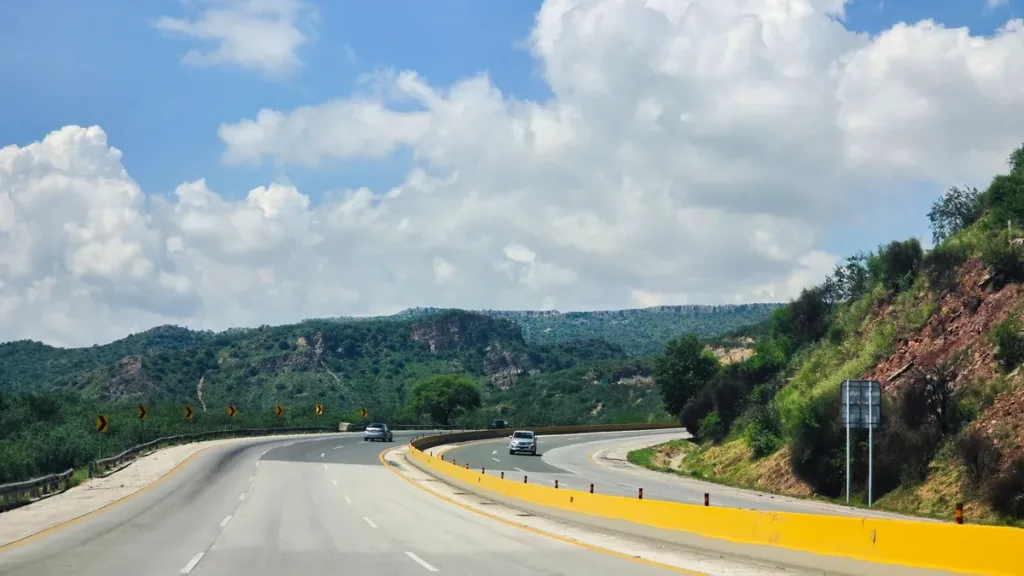
The Lahore airport to Islamabad airport distance by road is roughly 400 km: the M-2 motorway itself runs about 375 km between Lahore and the Islamabad end, and you add the run out of Allama Iqbal International (LHE) on the Lahore Ring Road plus the final approach to Islamabad International (ISB) near Fateh Jang. At the 120 km/h motorway limit for cars, the M-2 section alone is just over three hours of wheel time before a single stop, so plan on four to five hours terminal to terminal once you allow for the city exit, a rest-area break and the airport approach. That makes the road a real alternative to waiting for a later flight after a missed connection, but only in specific conditions, and only after the airline has told you what it will and will not do with the ticket you already hold.
The short version: when the car wins
Send a car up the M-2 when three things are true at once:
- The next seat to ISB is more than about five to six hours away, or the airline cannot confirm a seat at all, and the traveller must be in Islamabad or Rawalpindi for something fixed, such as a morning meeting, an embassy appointment or an onward international departure from ISB.
- The airline has confirmed in writing what happens to the unused sector, and in particular whether skipping it cancels any later flight on the same ticket.
- The road is open and the timing is sane, meaning no fog closure on the M-2 and no expectation that a driver who has already worked a full shift will cover 400 km through the small hours.
If any one of those fails, waiting is usually the better decision, even when it feels slower. A traveller asleep in an airline-provided hotel with a confirmed morning seat is in a stronger position than one in a car at 2am with an onward ticket that may have been cancelled for a no-show.
Lahore airport to Islamabad airport by road: the legs that make up the journey
Distance pages tend to quote one number. For a contingency decision you need the legs, because the unpredictable time sits at the ends, not in the middle.
| Leg | What it involves | Why it matters for timing |
|---|---|---|
| LHE terminal to the M-2 | Out of the airport and onto the Lahore Ring Road, an 85 km orbital that passes the airport and links to the M-2 | City traffic, the pickup itself and luggage loading are the biggest variables |
| M-2 motorway | About 375 km, six lanes, from the Lahore end at Thokar Niaz Baig to the Islamabad end, where it meets the Islamabad link road and the M-1 | Steady speeds; the Salt Range descent and rest stops are the main slowers |
| M-2 to ISB | ISB sits in the Fateh Jang area of Attock district, about 25 km from Zero Point in Islamabad, with road links to the M-2 and, via the Srinagar Highway, the M-1 | Short leg, but allow time for airport entry and drop-off checks |
Two practical notes. First, the exact kilometre figure depends on which LHE exit and which Islamabad interchange the driver uses, so treat 400 km as a working number and let the driver’s navigation give the final figure. Second, the M-2 interchanges nearest the capital include Thalian, Chakri and Islamabad, and the right exit for the airport is not the same as the right exit for a Blue Area hotel. Confirm the destination as “ISB departures” rather than “Islamabad” when you brief the driver.
Next flight or the M-2: a timing comparison
The mistake most people make at a transfer desk is comparing the drive time with the flight time. The flight between the two cities is short; the real comparison is time until you are standing at ISB by each route. Build it like this.
- Flight route: time until the next confirmed departure, plus check-in and security buffer, plus flight time, plus taxi and deplaning at ISB. If the next seat is only on standby, do not count it as confirmed.
- Road route: time for the car to reach the LHE pickup point, plus loading, plus four to five hours on the road, plus any stop you already know you will need.
Here is a worked example, labelled as a hypothetical so nobody mistakes it for a schedule. A traveller lands at LHE at 18:00 from the Gulf, misses the 19:30 domestic sector, and the transfer desk offers the first confirmed seat at 07:00 the next day.
| Hypothetical scenario | Wait for 07:00 flight | Car from LHE at about 19:30 |
|---|---|---|
| Standing at ISB | Around mid-morning, after the flight and arrival formalities | Around midnight, if the M-2 is clear |
| Night spent | In a hotel, possibly airline-provided | Mostly on the road, arriving late |
| Ticket risk | Low: the airline has rebooked the sector | Depends on what the airline says about the unused sector |
| Best fit | Traveller needed in Islamabad by midday or later | Traveller needed at an early-morning fixed appointment, or an onward ISB departure before the rebooked flight lands |
The pattern holds beyond this example. The car tends to win when the rebooked flight lands after the thing the traveller is travelling for. It tends to lose when it only saves a few hours and costs a night’s sleep. If the traveller has an onward international flight from ISB that the rebooked domestic seat would miss, the calculation shifts decisively towards the road, provided the airline has confirmed that the onward booking survives.
Missed connecting flight in Pakistan: settle the ticket before you leave the airport
A missed connecting flight in Pakistan is first an airline problem and only second a transport problem. Before anyone books a car, the traveller or the travel manager needs answers to four questions from the airline’s transfer or ticketing desk, ideally in writing on the booking record or by email.
1. Was this a single booking?
If the international flight and the domestic sector were on one ticket or one reservation, the airline that sold it generally owns the problem of getting the passenger to the final destination. If the domestic flight was bought separately, the second airline usually treats a missed check-in as the passenger’s own no-show. For journeys that fall under European rules, the EU’s air passenger rights guidance is explicit that connection protections apply to flights “booked as part of a single reservation”, and that the airline must offer a choice between a refund, rerouting at the earliest opportunity, or rerouting at a later date. Choosing one ends your rights to the other two, which matters if you are about to walk away and take a car.
2. What happens to the unused sector, and to anything after it?
This is the question that catches people out. On many itineraries, not flying one sector can lead the airline to cancel the remaining sectors on the same booking, including a return flight home weeks later. Ask directly: “If the passenger does not fly LHE to ISB, is the return journey still valid?” Get the answer noted on the booking. If the agent cannot confirm it, treat the return as at risk and decide accordingly.
3. Is the airline offering care while you wait?
Where European rules apply, the airline must provide meals, refreshments and, for an overnight wait, a hotel and transport to it, as the EU guidance sets out. Outside that framework, care depends on the airline’s own conditions of carriage and the reason for the missed connection. Ask what is on offer before you decline it; a hotel voucher and a confirmed morning seat is a legitimate option, not a consolation prize.
4. Is there a refund or credit for the unused sector?
If you accept a refund of the unused domestic sector, you may be closing off the rerouting option. That can be the right commercial trade, since the refund partly offsets the car, but make the choice consciously rather than by default.
Rule of thumb for travel managers: no car is booked until someone has written down, from the airline, the status of the unused sector and of every onward sector on the same ticket.
M-2 motorway journey time from Lahore, and where the minutes go
The M-2 motorway journey time from Lahore is governed by three things: the speed limit, the stops and the Salt Range.
Speed limits
Motorway limits have moved this year. The government temporarily cut them as a fuel-saving measure, and on 22 June 2026 the National Highways and Motorway Police announced that 120 km/h for cars and light vehicles, and 110 km/h for public service and heavy vehicles, had been restored, according to Dawn. Those are the numbers behind the three-hour arithmetic for the motorway leg. A van or coaster carrying a family group runs to the lower limit, so add time accordingly.
Service areas
The M-2 has service areas on both carriageways at Sukheki, Sial, Bhera, Kallar Kahar and Chakri, roughly 60 to 80 km apart. For a contingency run, one planned stop is usually enough, and the choice is practical:
- Bhera, one of the middle service areas, suits a traveller who has come straight off a long-haul flight and needs food and a prayer break.
- Kallar Kahar sits in the Salt Range country and is a sensible point for a driver break if the run is late at night.
- Chakri is close to the Islamabad end and is best treated as a fallback, not a plan, because stopping so near the destination adds time exactly when the traveller is watching the clock.
Budget 20 to 30 minutes per stop, including getting back on the carriageway.
The Salt Range section
The M-2 crosses the Salt Range near Khewra, a section that includes one of the highest pillared bridges in Asia. It is well engineered, but gradients and bends mean heavier vehicles slow down, and it is the stretch where a tired driver is most exposed.
For deeper figures on each motorway, including M-1 and M-4 context, our guide to motorway tolls and drive times on the M-1, M-2 and M-4 covers the wider network; this article sticks to the airport-to-airport case.
Tolls, M-Tag and what to put in the budget
Tolls are rarely the deciding cost on a contingency car, but they are a source of delay if the vehicle is not set up properly.
- M-Tag. The M-2 moved to an M-Tag electronic toll system from December 2021. A vehicle without a working tag, or with an insufficient balance, slows down at the plaza.
- The surcharge dispute. The National Highway Authority imposed a 50 percent additional toll on vehicles using motorways without an M-Tag or with insufficient balance. On 3 July 2026 the Islamabad High Court suspended that notification pending further hearings, Dawn reported. The position may have moved since; a professional operator’s vehicles should be tagged and funded regardless.
- Rates change. The NHA issued a revised toll schedule for national highways and several motorways from 10 July 2026, as ProPakistani reported; that report does not list an M-2 rate, and the M-2 itself is managed by the Frontier Works Organization. We do not quote a toll figure here because it is volatile. Ask for the quote to state whether tolls are included.
On a company account, the useful discipline is simple: the quote should be all-in for the route (fuel, tolls, driver) or should list each extra explicitly. Anything else invites a disagreement at midnight at the ISB kerb.
Night runs and the fog season
By the time a missed connection has been diagnosed, the airline consulted and a car arranged, the clock has often moved into the evening. The contingency car is frequently a night car, and night on the M-2 has its own rules of thumb.
Winter fog
Winter fog in Punjab is the single biggest threat to a road fallback. In January 2025, Dawn reported that fog closed the M-2 between Kala Shah Kaku and Kot Sarwar, along with sections of the M-1 and M-3, with visibility down to 50 to 60 metres. When the Lahore end of the M-2 is shut, the car either waits or diverts onto slower roads, and the time advantage over a morning flight can vanish. During fog season, check the motorway police’s travel advisory before committing, and be ready to reverse the decision if closures are announced after the car sets off.
Driver hours
A 400 km run that starts at 21:00 finishes around 01:00 or later. Ask the operator a direct question: has this driver just come on shift, or is he finishing a day’s work with your job? A fresh driver matters more than a newer car. For runs that start very late, a planned break at a service area is a sign of a sensible operator, not a slow one.
Arrival at ISB in the small hours
If the traveller is connecting onto an early international departure from ISB, arriving in the small hours is usually the point of the exercise: the priority is being there before check-in closes, so confirm the departure’s check-in window with the airline. If the destination is actually a home or hotel in Islamabad or Rawalpindi, the question becomes whether a 01:00 arrival beats a mid-morning flight arrival at all, given the lost night. Often it does not.
Monitoring on the road
The National Highways and Motorway Police run a travel advisory service and FM 95 road information radio, which are the sensible places to check conditions before and during a night run. The three-hour motorway figure already assumes driving at the limit, so a driver promising to “make up time” is making the wrong promise.
Who authorises the fallback, and how it is booked
For a corporate traveller, the worst outcome is two people arranging two cars while a third person rebooks the flight. Decide the chain of authority in advance and keep it short.
A simple authority model
| Role | Decides | Needs to know |
|---|---|---|
| Traveller | Whether they are fit to travel overnight, and confirms the airline’s written position | Next confirmed seat, status of unused and onward sectors |
| Travel manager or family coordinator | Car versus wait, using the timing comparison above | Traveller’s fixed commitment in Islamabad, cost ceiling |
| Budget holder | Approves spend above a preset limit | All-in quote, refund value of the unused sector |
A sensible policy is to pre-authorise a road fallback up to a set amount for named routes such as Lahore to Islamabad, so that nobody has to wake a budget holder at midnight. If you do this, write down the conditions: confirmed airline position, no fog closure, driver briefed for the airport rather than the city.
Booking steps that save time
- Get the airline position first. Write down the next confirmed seat and the status of every remaining sector on the ticket.
- Send the request with the right details. Pickup at LHE (terminal and meeting point), destination “ISB departures” or the exact address, number of passengers and bags, and the latest acceptable arrival time.
- Ask for a quote that states inclusions. Fuel, tolls, driver, waiting time at LHE. For the route itself, our Lahore to Islamabad taxi page sets out the service; for the pickup side, see Lahore Airport taxi and transfers.
- Wait for confirmation of the vehicle and driver before the traveller releases the airline’s alternatives. A request is not a booked car, and a quote is not a guarantee of availability at that hour.
- Share live contact details between traveller and driver, and agree the meeting point inside or outside the arrivals hall.
If the traveller’s flight situation is still moving, for example a delayed inbound that may or may not make the connection, our sister service Pakistan Taxi has a practical guide on what to check with the transfer operator when your flight changes, written for families and individual travellers rather than corporate desks.
For wider city-to-city planning beyond this one corridor, iDrive’s intercity taxi service across Pakistan covers the main motorway routes. When you are ready to send a request, use the iDrive booking page with the details above; the operator will confirm what is available for your time and route.
Questions people ask
What is the Lahore airport to Islamabad airport distance by road?
Roughly 400 km. The M-2 motorway accounts for about 375 km of it; the rest is the Ring Road exit from Allama Iqbal International and the approach to Islamabad International near Fateh Jang. The exact figure depends on the route the driver takes at each end.
How long does the drive from Lahore airport to Islamabad airport take?
Plan on four to five hours terminal to terminal. The motorway leg is just over three hours at the 120 km/h car limit, and the city exit, a rest stop and the airport approach add the rest. Fog closures in winter can add much more.
If I miss my connection at Lahore, will the airline put me on the next flight?
If both flights were on one booking, the airline usually has to reroute you, and under EU rules you must be offered a choice of refund or rerouting. On separate tickets, the second airline may treat you as a no-show. Ask the transfer desk before arranging a car.
Will skipping the Lahore to Islamabad sector cancel my return flight?
It can on some itineraries. Ask the airline to confirm, on the booking record, that the remaining sectors stay valid if you do not fly the domestic sector.