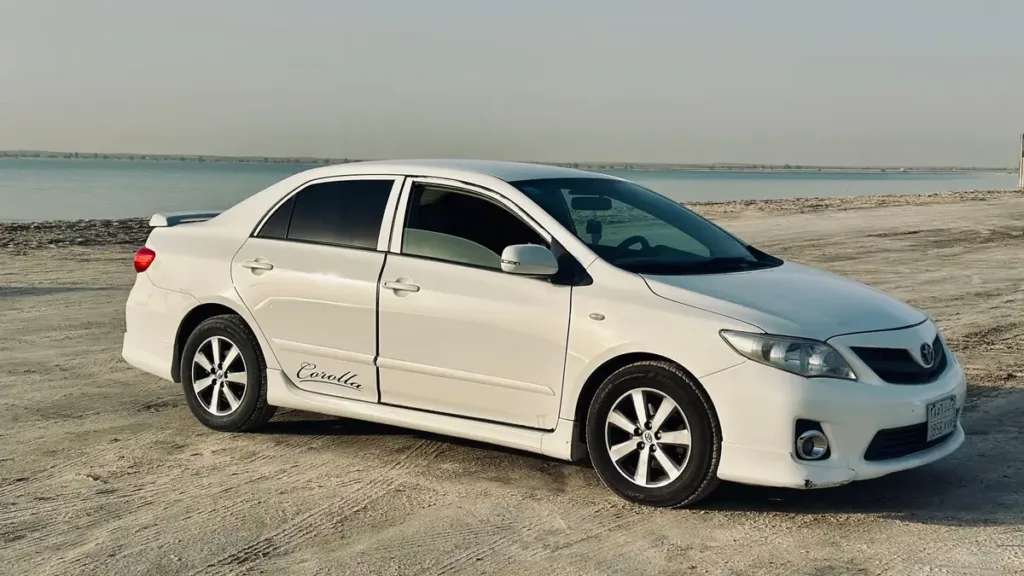
For most executive journeys in Pakistan, the civic vs corolla question has a short answer: a current Toyota Corolla Altis or Altis Grande is a fair substitute for a current Honda Civic, and in two respects it is the better car for the job. It has the larger boot (470 litres against the Civic’s 409) and the taller roof (1,475 mm against 1,432 mm), which matters to a passenger in a suit getting in and out six times a day. What the Corolla gives up is image, a little rear legroom and some composure on the motorway. So the swap is acceptable for airport runs, office-to-office days and anyone travelling with luggage. It is less acceptable when the car itself is part of the message: a visiting chairman, a client who specifically asked for a Civic, a wedding that planned around one.
The real risk is not the car. It is discovering the substitution at the kerb, with no agreed rule for what counts as equivalent. The rest of this guide sets out the measurable differences, the three generations you are likely to meet under the “executive sedan” label, and a substitution clause you can put in writing before the day.
Decision summary: when the swap works and when it does not
The table assumes you asked for a Civic and are being offered something else in the same class.
| Situation | Corolla Altis / Grande instead of Civic FE | Civic X (FC) instead of Civic FE |
|---|---|---|
| Airport pickup with two large cases | Accept. Bigger stated boot. | Accept, if the car is within the age limit and presentable. |
| Full day of meetings in one city | Accept. Taller roof helps repeated entry and exit. | Accept, but check the rear seat and air-conditioning condition. |
| Long motorway leg with a senior passenger in the back | Acceptable. Expect a slightly less settled rear ride at speed. | Acceptable. Same multi-link rear layout as the FE. |
| Client explicitly requested a Civic | Ask the client first. Do not decide for them. | Usually acceptable. It is still a Civic. |
| Wedding, launch or photographed arrival | Only if colour and condition are confirmed in advance. | Only if colour and condition are confirmed in advance. |
What “executive sedan” actually covers in Pakistan
A booking for an executive saloon in Pakistan is a booking for a class, not a named car. On iDrive, the executive sedan class lists four representative models: the current Honda Civic, the previous-generation Civic X, the Toyota Corolla Altis/Grande and the Hyundai Elantra. The page says plainly that the vehicle sent may be the one shown “or a similar one of the same class”, and that cars in this class are accepted up to seven years old. That is the normal industry position, and it is why a travel buyer needs a view on substitution before booking rather than after.
Honda Civic FE (current generation)
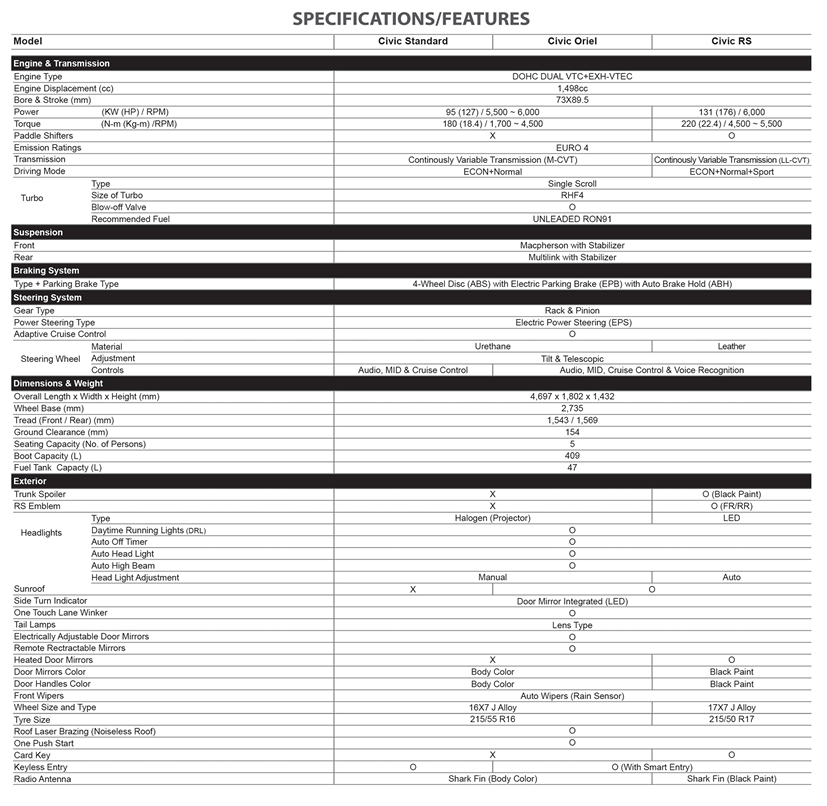
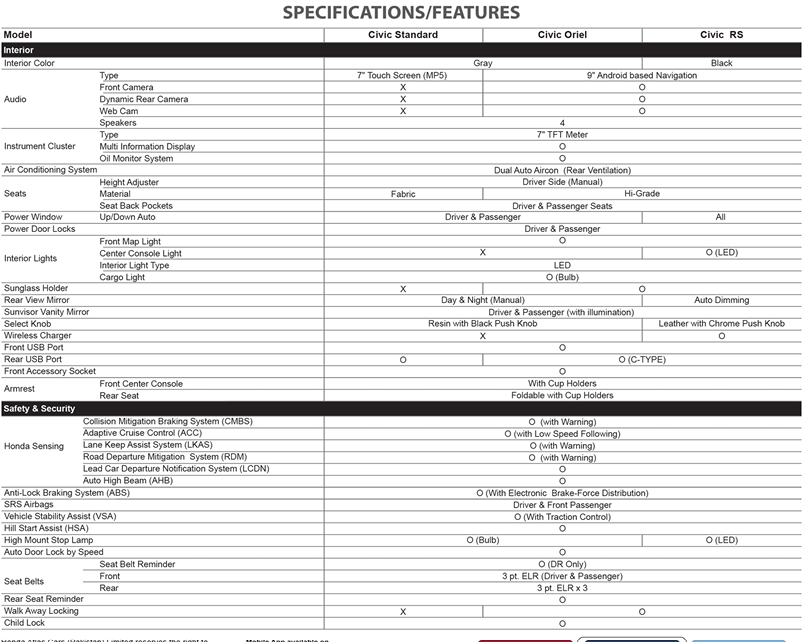
The eleventh-generation Civic went on sale in Pakistan in March 2022. The current line-up, as listed on Honda Atlas’s Civic pages, is Standard, Oriel and RS, all with a 1.5-litre turbo petrol engine and a CVT. Honda’s published specification sheet gives every variant the same body: 4,697 mm long, 1,802 mm wide, 1,432 mm high, on a 2,735 mm wheelbase, with a 409-litre boot and a 47-litre fuel tank. All three variants list dual automatic air-conditioning with rear ventilation and a folding rear armrest with cup holders. The sunroof is listed on Oriel and RS but not on the Standard car, which matters more than it sounds if the client associates “Civic” with the glass roof.
Honda Civic X (FC, previous generation)
Honda Atlas launched the locally assembled tenth-generation Civic in Pakistan on 22 July 2016, and global production ran until 2021, according to its production history. Local cars were offered with a 1.8-litre naturally aspirated engine and, for a period, a 1.5-litre turbo, both with a CVT. Globally published dimensions put it on a 2,700 mm wheelbase with a roof of about 1,416 mm, the lowest of the three cars here. It shares the Civic’s multi-link rear suspension. The practical catch is age: with a seven-year acceptance limit, by 2026 only the final model years of the FC still qualify, and those cars have usually done hard service.
Toyota Corolla Altis X and Altis Grande
Indus Motor sells the current Pakistani Corolla as the Corolla Altis X. Its model page lists 1.6 manual, 1.6 CVT-i, 1.6 CVT-i Special Edition, 1.8 CVT-i and 1.8 CVT-i Grande. The Indus Motor specification sheet gives 4,620 mm length, 1,775 mm width, 1,475 mm height, a 2,700 mm wheelbase, a 470-litre luggage compartment and a 55-litre tank. The 1.6 makes 120 hp and the 1.8 makes 138 hp. The rear suspension is a torsion beam. “Altis” in a booking context usually means the 1.6 CVT or 1.8 CVT; “Grande” is the top 1.8 with the higher trim and partial-leather seats.
Honda Civic vs Toyota Corolla: the numbers that matter to a passenger
Brochure comparisons tend to lead with horsepower. A rear-seat passenger does not care about horsepower. The figures below are the ones that change how the car feels from the back seat or at the boot lid, taken from the manufacturers’ own Pakistani specification sheets.
| Measure | Civic FE (Standard / Oriel / RS) | Corolla Altis X / Grande | What it means for the passenger |
|---|---|---|---|
| Wheelbase | 2,735 mm | 2,700 mm | The Civic has 35 mm more between the axles, most of which goes to the cabin. |
| Overall height | 1,432 mm | 1,475 mm | The Corolla is 43 mm taller: easier to get into, more space above a tall passenger’s head. |
| Overall length | 4,697 mm | 4,620 mm | The Civic looks longer and lower, which is much of its kerb appeal. |
| Boot capacity (stated) | 409 litres | 470 litres | The Corolla’s is 61 litres larger, roughly one extra soft bag. |
| Rear suspension | Multi-link | Torsion beam | The multi-link layout generally copes better with mid-corner bumps and high-speed undulations. |
| Tyres | 215/55 R16 (215/50 R17 on RS) | 205/55 R16 on 1.8 variants (195/65 R15 on the 1.6 manual) | Similar on Civic Standard/Oriel and Altis 1.8; the RS’s 17s are firmest. |
| Fuel tank | 47 litres | 55 litres | Fewer fuel stops on a long day for the Corolla, all else equal. |
Neither manufacturer publishes rear legroom or rear headroom in millimetres on its Pakistani specification material, so any site quoting precise figures for the local cars is working from other markets or from a tape measure. Wheelbase and roof height are the honest proxies. They point in opposite directions, which is why the civic vs corolla debate never quite settles.
Rear legroom and headroom compared
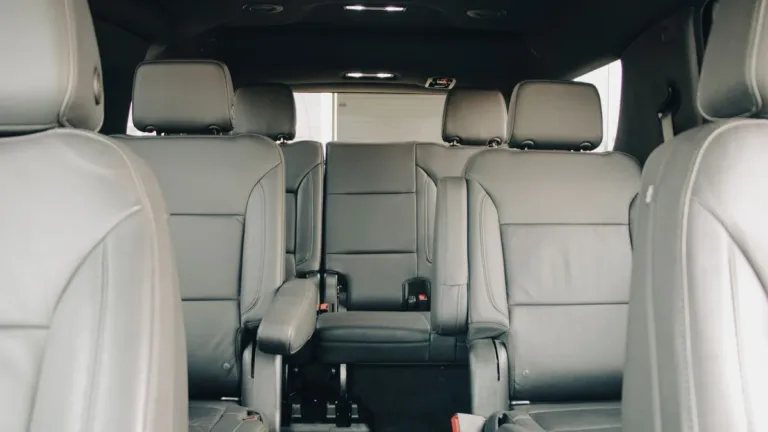
On paper the Civic FE offers slightly more room for knees and the Corolla slightly more room for heads. In practice, that splits the passengers you are likely to be moving into two groups.
- Tall passengers, or anyone in a turban or a hat. The Civic’s fastback roofline drops towards the rear window. The Corolla’s roof is 43 mm higher overall and more upright over the rear bench. For a passenger of above-average height, the Corolla is usually the more comfortable seat and the less awkward exit.
- Passengers who want to stretch out. The Civic’s longer wheelbase, combined with its lower seating position, gives a more reclined, legs-forward posture. Some executives like that on a long leg; others find it harder to climb out of.
For a regular corporate account, record each frequent passenger’s height and preference once; it settles this question for good.
Boot capacity with real cases
This is where the Corolla wins cleanly. Toyota states 470 litres; Honda states 409. The iDrive class page puts the realistic load for any of these saloons at two large suitcases plus a cabin bag, with four passengers at most because the driver takes the fifth seat. That is a sensible ceiling for both cars, but the margin inside it is different.
- Two large checked cases plus a cabin bag. That is the published ceiling for the class, and both cars are rated for it. The Corolla’s extra 61 litres is what gives you slack for a suit carrier or a laptop bag you would rather not hold on your knees.
- Returning diaspora family luggage. Arrivals at Islamabad, Lahore or Karachi from the UK or the Gulf can easily carry more than two large cases between them. Neither saloon is the right class for that; our guide to how many people and suitcases actually fit in Pakistani fleet vehicles shows where the saloon class stops.
The consequence for substitution is clear: if a Civic was requested and a Corolla arrives, luggage will never be the complaint. If a Corolla was requested because of luggage and a Civic arrives, it might be. That asymmetry belongs in the substitution rule.
Ride comfort on the motorway and in the city
Ride quality is the hardest thing to judge from a spec sheet and the easiest thing for a passenger to notice. Two hardware differences do most of the work.
On the motorway
The Civic FE and the older FC both use a multi-link rear suspension; the Corolla Altis X uses a torsion beam. On long, fast stretches such as the M-2 between Islamabad and Lahore or the M-9 out of Karachi, a multi-link rear end generally keeps the car flatter over expansion joints and long undulations, so a rear passenger reading a document is jostled less. The turbo engine helps too: Honda quotes peak torque of 180 Nm from 1,700 rpm on the Standard and Oriel, so the car gathers speed for an overtake without much fuss.
None of that makes the Corolla uncomfortable. The difference is modest and shows mainly on patched sections: on a two-hour leg it rarely matters, on a six-hour intercity run it can.
In the city
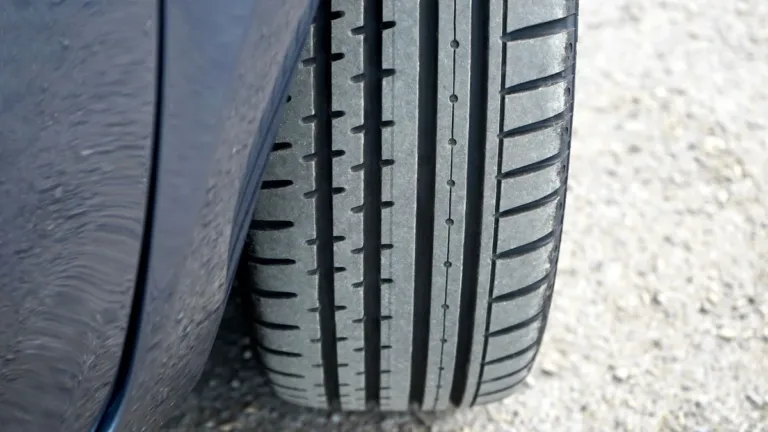
City driving flips some of the advantage. Pakistani streets are full of speed breakers, broken service lanes and sharp-edged potholes. The Corolla’s taller body helps here, and the base 1.6 manual’s 15-inch tyres have taller sidewalls that take some sting out of sharp impacts; the 1.8 Altis and Grande run the same 16-inch size as a Civic Standard. The Civic sits lower, with 154 mm of stated ground clearance and lower-profile tyres, so a careless driver over a steep breaker is more likely to scrape and more likely to jolt the rear seat. The RS, on 17-inch wheels, is the firmest of the lot.
Civic FE vs Civic X FC vs Corolla Altis Grande
A buyer who says “Civic” may mean either generation, and a supplier who offers “Corolla” may mean anything from a 1.6 manual to a Grande. Being precise closes most of the gap between what was expected and what arrives.
| Factor | Civic FE (2022 onwards) | Civic X FC (2016 to 2021) | Corolla Altis Grande (1.8 CVT-i) |
|---|---|---|---|
| Kerb image | Strongest. Current shape, widely recognised. | Still reads as a Civic; older styling. | Conservative, respectable, very familiar. |
| Rear room | Longest wheelbase of the three. | Shorter wheelbase and lowest roof. | Tallest roof; wheelbase equal to FC. |
| Boot (stated) | 409 litres | Varies by source; check the car. | 470 litres |
| Rear suspension | Multi-link | Multi-link | Torsion beam |
| Age exposure | Low | High. Only late cars fit a seven-year limit. | Depends on model year; check it. |
| Best use | VIP arrivals, client-facing days | Budget-conscious business travel with a condition check | Luggage-heavy trips, senior passengers, long city days |
Framed as corolla altis vs civic, the neat conclusion for many travel managers is that a late Corolla Altis Grande is a closer match to a Civic FE, in the ways passengers notice, than a tired Civic X is. The badge says otherwise, which is exactly why the rule needs to be agreed before either car is sent.
Client-facing image: is a Corolla a fair executive sedan substitute?
In Pakistan both cars are status saloons in their own right. A white Corolla Altis or Civic is the conventional Pakistani saloon for weddings and formal arrivals, and neither will embarrass a passenger. The difference is in what each signals.
- The Civic signals choice. It is the car a younger executive or a returning professional is likely to have asked for by name. The current FE shape is recognisably new, and the sunroof on Oriel and RS variants is part of its appeal.
- The Corolla signals safety. It is the establishment car: understated, familiar to every driver and mechanic in the country, and entirely proper for a bank, a ministry meeting or a family elder.
- Colour and condition outweigh the badge. A clean, recent Corolla in white, silver or black beats a Civic with scuffed bumpers, tired seats or a non-matching colour in a convoy. For any photographed arrival, confirm colour in writing.
So the honest answer to “civic or corolla for business” is that either suits most business travel. The exception is the named request. When a client, a principal or a family has asked for a Civic, the swap is theirs to approve, not yours.
Writing a substitution clause that prevents the argument
Most substitution disputes come from an unspoken expectation. A one-paragraph rule agreed at booking stage removes it. Treat the text below as an example you can adapt for a travel policy, an event brief or a purchase order; it is not iDrive’s contract wording.
Example clause: “The booking is for an executive sedan. The preferred model is a Honda Civic FE. If the preferred model is unavailable, the supplier may provide a Toyota Corolla Altis 1.8 or Altis Grande, or a Honda Civic FC, no more than seven years old, in white, silver or black, with working rear air-conditioning. A Toyota Corolla 1.6 manual is not an acceptable substitute. Any substitution must be notified in writing at least 12 hours before pickup, with the replacement vehicle’s make, model, year and registration. If the passenger has marked the model as essential, no substitution may be made without their written approval.”
The clause does five jobs worth keeping even if you rewrite it:
- It separates class from preference. The contract is for the class; the named model is a preference unless marked essential.
- It lists acceptable swaps by variant, not brand. Naming the 1.8 CVT-i or Grande stops a base 1.6 manual being sent against a Civic booking.
- It sets an age and condition floor. Seven years matches the iDrive class policy; working rear air-conditioning is non-negotiable in a Pakistani summer.
- It fixes a notice window, so the traveller learns of the swap from a message, not at the kerb.
- It gives the passenger a veto for named requests, which resolves most VIP and wedding cases before they arise.
On iDrive, the relevant protection already sits in the booking record. The Terms of Hire say the Booking Confirmation shows the assigned vehicle class and details, and that if the vehicle that arrives does not match it, for example through the wrong class or an unauthorised substitution, iDrive may cancel that booking and the customer is entitled to a full refund and/or a replacement booking, at iDrive’s discretion. Your clause governs what counts as authorised; the confirmation is the evidence.
Practical steps before you book
- Decide whether the model is a preference or a requirement. If it is a requirement, book from the model page rather than the class page. iDrive publishes separate pages for the Honda Civic FE and the Toyota Corolla Altis/Grande, so the request is explicit from the start.
- Note passenger height or mobility needs. These are the factors that make the Corolla the better car, and they are invisible unless someone writes them down.
- Put your substitution rule in the booking notes. Keep it short, in the form above.
- Check the confirmation. Make, model and registration should match what you agreed. If they do not, raise it before the day, not on it.
Constraints worth knowing
- Availability varies by city and date. No supplier can guarantee a specific model in every city on every day. Busy dates such as Eid, peak wedding weeks and large conferences can tighten executive saloon supply, so book those early.
- Fleet mix shifts with sales. The Pakistan Automotive Manufacturers Association publishes monthly production and sales figures, which is the place to look if you want to know which saloons are entering fleets in volume.
For simpler trips where the model matters less than a calm arrival, our sister service Pakistan Taxi, an iDrive brand, can help you plan a journey in a standard taxi. If your travel continues to the Gulf, our sister company Saudi Cab Co arranges business and executive sedan transfers in Saudi Arabia, which is useful when one travel policy needs to cover both legs.
When you are ready, plan your executive journey with iDrive, add your preferred model and substitution rule in the notes, and the team will confirm in writing what can be supplied.
Questions people ask
Is a Corolla Altis a downgrade from a Civic?
Not in practical terms. The current Corolla Altis X has a larger stated boot and a taller roof than the Civic FE. It gives up some rear legroom, image and motorway composure. Whether that counts as a downgrade depends on whether the passenger asked for a Civic by name.
Which has more rear legroom, Civic or Corolla?
Neither maker publishes a rear legroom figure for the Pakistani cars. The Civic FE’s 2,735 mm wheelbase is 35 mm longer than the Corolla’s, which favours the Civic for knee room; the Corolla’s roof is 43 mm higher, which favours it for headroom.
Which boot is bigger?
The Corolla Altis X, at a stated 470 litres against the Civic FE’s 409 litres.