Your Pakistan. Your Journey.
An airport transfer SLA for business travel in Pakistan should measure what a supplier actually controls: the car and driver being in the agreed meeting position before the passenger could reasonably walk out, a fixed free-waiting window that starts from the flight’s real landing time, a response time for changes and incidents, and a short list of exclusions for events nobody can drive around. It should not promise that a director is in the back seat twenty minutes after touchdown. At Islamabad, Lahore or Karachi, immigration queues, baggage belts and customs screening sit between the aircraft door and the kerb, and none of that belongs to the driver.
Copy a 99% on-time template written for London or New York into a Pakistani contract and you get either a supplier who signs and quietly misreports, or one who prices every trip for the worst case. Below is a clause-by-clause alternative that a competent operator can meet and your finance team can audit.
Decision summary: the five numbers an airport transfer SLA needs
If you only have time to negotiate five things, negotiate these. The figures in brackets are illustrative starting points for discussion, not industry standards or iDrive commitments; set your own after a trial month.
- Positioning time. How many minutes before the scheduled or revised landing time the driver must be at the agreed meeting point, checked in with the dispatcher (for example, at landing time or earlier).
- Free waiting. How long the driver waits after actual landing before waiting charges start (for example, 60 minutes for international arrivals, 30 for domestic).
- Change response time. How fast a booking change made in working hours is acknowledged and confirmed, and how that differs out of hours.
- Incident response time. How fast the supplier tells your traveller or travel desk that something has gone wrong, and what the recovery plan is.
- Reporting deadline. The working day of each month by which the supplier sends trip-level data with evidence, and the day credits are settled.
Why imported SLA templates break at Pakistani airports
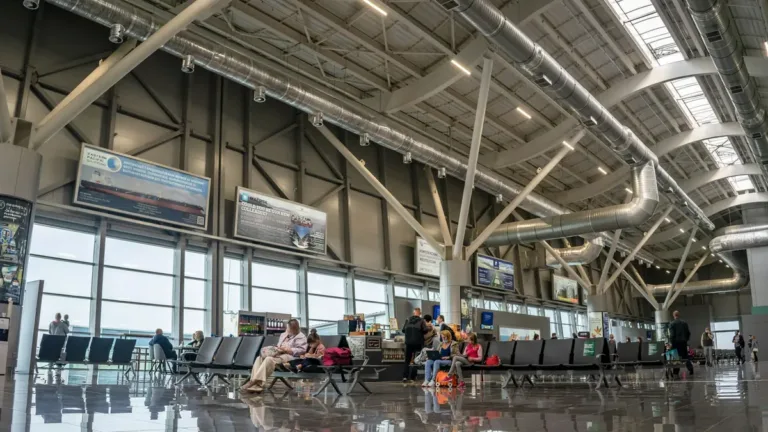
Consider the chain after an international flight lands at Islamabad International Airport: taxi to stand, disembark, immigration, the belt, customs and baggage screening, then the walk out to a meeting area where drivers are waiting for dozens of other flights. The UK Foreign, Commonwealth & Development Office warns travellers that airports in Pakistan can be crowded and that baggage may need to go through screening equipment and checks. That exit time varies from flight to flight and season to season, and it is outside the transfer supplier’s hands.
Three local realities follow from that:
- The passenger’s exit time is variable; the driver’s arrival time is not. Measure the driver against the part of the journey they control.
- Peak arrival banks overlap. When several international flights land close together, the meeting area fills with drivers and families, and a late-running flight can drop your executive into someone else’s peak. Plan for the crowd, not the timetable.
- Disruption is not rare enough to ignore. The FCDO notes that regional tensions in May 2025 led to sustained airspace closures and airlines suspending flights, and it flags protests that have caused road closures. An SLA without a clear exclusions clause invites arguments every time the news turns.
None of this is a reason to accept vague service. It is a reason to measure different things.
Defining on-time for an arrival pickup
The single most useful clause in the whole agreement is a definition of “on time” that names the clock, the place and the evidence. Write it once, precisely, and every later dispute gets shorter.
Pick the right clock
There are four candidate times for an arrival, and they behave very differently:
| Clock | Who controls it | Use it for | Weakness |
|---|---|---|---|
| Scheduled arrival time on the booking | Airline timetable | Initial dispatch planning | Wrong the moment the flight runs early or late |
| Actual landing time | Airline and air traffic control, published by the airport | Starting the free-waiting window | Tells you nothing about how long the passenger takes inside |
| Driver check-in at the meeting point | Supplier | Measuring punctuality | Needs a verifiable record, not a phone call |
| Passenger walks out | Immigration, belts, customs, the passenger | Measuring passenger experience, not supplier performance | Outside the supplier’s control |
The clean pairing is this: punctuality is measured as driver check-in against actual landing time, and waiting is measured from actual landing time. Islamabad International Airport publishes current arrivals with flight status on its official website, and the airline’s own flight status is a second record, so both sides can reference a public record rather than each other’s word.
Write the definition in one sentence
An example wording, which you should adapt with your own counsel rather than paste:
“A pickup is on time when the assigned driver has checked in with the supplier’s dispatch system at the agreed meeting point no later than the actual landing time of the passenger’s flight, as shown by the airport’s published arrivals information, or no later than the booked pickup time for non-flight journeys.”
It deliberately ignores when the passenger sees the driver, and it does not accept “driver on the way” as check-in.
Decide what counts as late, and by how much
Binary on-time or late reporting hides the difference between a driver who was four minutes behind landing and one who arrived after your traveller had given up. Use bands instead:
- On time: checked in at or before actual landing.
- Minor late: checked in after landing but before the passenger reached the meeting point. The traveller probably never noticed. Count it, but do not credit it.
- Material late: passenger waited at the meeting point for the driver beyond a short agreed grace period (for example, 10 minutes).
- Failed pickup: no driver arrived, or the passenger made other arrangements after the supplier was told and could not recover within an agreed time.
Why an on-time pickup guarantee is the wrong ask
An on-time pickup guarantee mostly pushes risk into price. No honest operator can guarantee that an airport road will be open. Ask for a measured target, visible reporting and a remedy when it is missed.
Waiting time and no-show definitions
Waiting is where most airport transfer invoices get disputed, usually because nobody wrote down when the meter started. Fix three things in the contract.
Free waiting starts at actual landing
Not at scheduled arrival, and not at the moment the driver parks. If, for example, a connection via Doha lands forty minutes late, the free window moves with it. That is the supplier’s job to track, which is exactly why they should be given the flight number, not just a time. For departures and non-airport pickups, free waiting starts at the booked pickup time.
Set separate windows for international and domestic arrivals; a domestic passenger skips immigration, so one generous window means paying for idle time.
Chargeable waiting is capped and pre-approved
Once free waiting ends, the supplier needs a rule for what happens next. A sensible structure:
- At the end of free waiting, the driver or dispatcher tries the traveller’s phone and messaging number and notifies your travel desk.
- Waiting continues in agreed blocks (for example, 15 or 30 minutes) at the rate in your rate card.
- Beyond a cap (for example, 60 additional minutes), the supplier needs a named approver’s go-ahead to keep waiting, or the job is released.
A no-show is a sequence, not a feeling
Define a no-show as the end of a documented process: driver checked in on time, free and any approved chargeable waiting has run, contact attempts to the traveller and to your desk have been logged, and the dispatcher has released the job with a timestamp. If any step is missing, it is not a no-show, and it should not be billed as one.
Say, too, what happens when a traveller misses a connection and rebooks. The kindest contract language treats a rebooked flight number sent to the supplier before the original landing time as an amendment, not a cancellation.
Response time for changes and incidents
A chauffeur service level agreement usually says a lot about the car and very little about the people behind it. Response times are what separate a supplier with a dispatch desk from one with a driver’s personal mobile number.
Changes
Separate acknowledgement from confirmation. Acknowledgement means a human or system has seen the request; confirmation means the change is resourced. Set different targets for working hours and nights.
Incidents
Classify incidents by what the traveller experiences, not by what went wrong behind the scenes:
| Severity | Example | What the SLA should require |
|---|---|---|
| Critical | Driver will not reach the airport; vehicle breakdown with passenger aboard; safety concern | Proactive call to traveller and travel desk, recovery plan with an estimated time, escalation to a named duty manager |
| Major | Driver running late but will arrive; wrong vehicle class dispatched | Notification before the traveller notices, choice to wait or accept an alternative |
| Minor | Name board misspelled; water not in the car; route query | Logged and reported monthly; no real-time escalation needed |
Build in a fallback for communications. The FCDO notes that internet and mobile services can be cut during civil unrest in Pakistan. An incident plan that relies entirely on one messaging app will fail exactly when it matters, so give the supplier a second number for your desk and agree a default meeting point the traveller should go to if nobody can be reached.
Service credits for late pickup versus penalties
This is the clause procurement teams fight hardest over, and the one they most often get backwards.
A penalty is a sum the supplier pays for failing, usually fixed in advance and often larger than the value of the trip. In practice penalties encourage suppliers to reclassify failures and load a risk premium onto every fare, and depending on the governing law they can be hard to enforce; ask your lawyer.
A service credit is a reduction in what you pay, tied to the specific failure and settled on the next invoice. Service credits for late pickup work better for three reasons: they are proportionate, they are cheap to administer, and they give the supplier’s operations manager a number to manage rather than a threat to resent.
A workable credit structure
An example schedule, to be calibrated against your own rate card:
- Material late pickup: credit of a set percentage of that trip’s fare.
- Failed pickup: full credit for the trip, plus the documented cost of the replacement journey the traveller had to take, up to a cap.
- Wrong vehicle class: the difference between the booked and delivered class, or a full credit if the traveller refused the car.
- Monthly punctuality below target: a small percentage credit on the month’s total, which rewards consistency rather than single heroics.
Cap total monthly credits at a sensible share of spend, and keep a termination right for persistent failure. Credits are for ordinary misses; termination is for a supplier who is not improving.
Exclusions: airport closures, security events and other events nobody controls
Every airport transfer SLA needs an exclusions clause; in Pakistan it needs a specific one. General force majeure wording written for European contracts tends to name earthquakes and wars and stop there. Write down the events that actually disrupt ground transport around Pakistani airports:
- Airport or airspace closure, and flight suspension. The May 2025 airspace closures cited by the FCDO are the obvious precedent. When flights stop, pickups tied to them are suspended, not failed.
- Security operations and road closures. Checkpoints, VIP movements, route closures and police instructions on airport approach roads.
- Protests and civil unrest. The FCDO says demonstrations can happen with little warning and may block major roads.
- Severe weather. Winter fog around Punjab, monsoon flooding and, for mountain airports, weather that grounds flights altogether.
- Government instructions, including curfews and movement restrictions.
- Communications blackouts that prevent the supplier from contacting a traveller.
Exclusions still come with duties
An exclusion should switch off credits, not effort. Require prompt notice, a revised plan where it is safe, and every excluded job listed in the monthly report with its reason, so “security event” cannot become a polite word for “we ran out of drivers”.
For trips beyond the main business corridors, align the SLA with your travel risk policy. At the time of writing the FCDO advises against all travel to Balochistan and to many districts of Khyber Pakhtunkhwa, including Peshawar, and against all but essential travel to several others; a transfer contract should never oblige a supplier to drive into an area your own duty-of-care policy prohibits.
Monthly reporting and evidence
An SLA you cannot audit is a mood, not a contract.
What each trip line should carry
- Booking reference, traveller name or employee ID, cost centre.
- Flight number, scheduled and actual landing time, and where the actual time came from.
- Driver check-in time at the meeting point, from the dispatch system rather than a manual note.
- Passenger-on-board time and drop-off time.
- Waiting minutes split into free and chargeable, with the approver named for anything over the cap.
- Punctuality band (on time, minor late, material late, failed) and any excluded-event code.
- Incidents raised, severity, and time from supplier awareness to traveller notification.
Evidence standards
Agree in advance what proves a check-in. A GPS-stamped event in a dispatch app is strong evidence. A driver’s WhatsApp photo of a name board is useful supporting evidence. A dispatcher saying “he was there” is not evidence at all. Tell the supplier which of these you accept, and give yourself the right to request the underlying records for a sample of trips each quarter.
Keep the layout stable month to month. One late month is noise; three months of rising minor-late pickups on the same shift is a staffing problem.
What a chauffeur service level agreement should leave out
Airlines and airports have a long tradition of standardised contracts: IATA’s Airport Handling Manual includes a chapter on ground handling agreements, with the Standard Ground Handling Agreement available as a companion product. Resist borrowing that level of detail; a car-and-driver contract with forty metrics will be ignored by month three.
Things that usually belong elsewhere:
- Vehicle specifications, such as class, age limits and seat count, go in a schedule, cross-referenced to the supplier’s named vehicle classes so both sides share a vocabulary.
- Driver conduct and dress go in a briefing note the supplier signs off.
- Rates go in a rate card with its own review date, because fuel and tolls move independently of service quality.
- Liability, insurance and cancellation are governed by the supplier’s booking terms and your master agreement. Read the supplier’s standard terms first; on iDrive that means the Terms of Hire, which govern each booking and which any service schedule you agree should be read alongside.
Putting a corporate ground transportation SLA to work
A sensible sequence for a company moving staff through Pakistan regularly:
- Map your traffic. List the airports, the typical arrival windows, the share of international versus domestic arrivals, and the onward destinations.
- Run a trial month without credits. Collect the trip data in the format above. You will learn what realistic punctuality looks like before you set a target that is either trivial or impossible.
- Set targets from the trial, not from a template. Agree the positioning rule, the waiting windows, the response times and the credit schedule.
- Write the exclusions list in local terms. Name airspace closures, security operations, protests and government instructions explicitly.
- Brief travellers once. Tell them where the meeting point is, which number to call, and what the default plan is if their phone has no signal.
- Review quarterly. Tighten targets when the data supports it; loosen them if a new airport or route is added.
For the service itself, iDrive’s business travel car service in Pakistan page is the starting point for company travel, and the Pakistan airport transfers overview covers the main airports. Quotes and availability are confirmed per journey, not assumed. If your traveller’s trip combines an arrival with a day of meetings, our sister service Pakistan Taxi has a practical guide to combining an airport pickup with business meetings that works well as a traveller briefing. When you are ready to discuss volumes and service levels, contact the iDrive team, or start a single journey through the iDrive booking page to see how the process works before you commit to anything larger.
Questions people ask
Is 99% on-time realistic for airport pickups in Pakistan?
It can be, if on-time means the driver checking in at the meeting point by actual landing time. It is not a fair measure if it means the traveller being in the car within a set time of landing, because immigration, baggage and customs sit outside the supplier’s control. Set your target after a trial month of real data.
Should the SLA use service credits or penalties?
Service credits usually work better: they are proportionate, settle on the next invoice and encourage honest reporting. Keep a termination right for persistent failure. Take legal advice on any fixed penalty sums under your governing law.
When should free waiting time start for an international arrival?
From the flight’s actual landing time, as shown on the airport’s or airline’s published flight information. Give the supplier the flight number so they can track changes, and set a longer free window for international arrivals than for domestic ones.
Do airport closures or security events count as a late pickup?
Not if your exclusions clause names them. List airspace closures, flight suspensions, security operations, road closures, protests and government instructions explicitly, and require the supplier to report every excluded job with the reason.