Your Pakistan. Your Journey.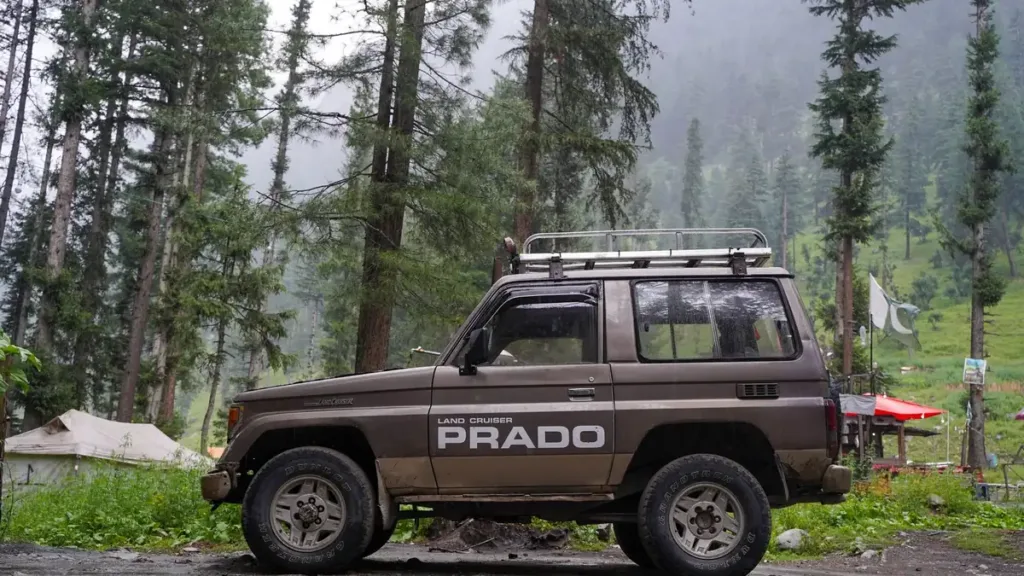
Most people searching prado vs fortuner in Pakistan are deciding what to buy. This page answers a narrower question that matters more to anyone hiring: if you asked for a Prado and a Fortuner turns up, should you accept it? Usually yes, with conditions. Both are Toyota body-on-frame SUVs with seven seats, low-range gearing and, in their current forms, the same 2.8-litre turbo diesel. For city work, airport runs, motorway days and summer trips north with five or fewer adults, a well-kept Fortuner is a fair swap. It stops being fair when all seven seats and a full set of suitcases have to travel together, when long rough-road days are planned with elderly passengers, or when the Prado itself was the point, as it often is for a wedding car or a protocol movement. The trick is to decide which of those applies before the booking is confirmed, and to write it down.
Decision summary: accept, negotiate or refuse
- Accept a Fortuner for Islamabad, Lahore and Karachi city days, airport transfers, motorway intercity legs and paved summer routes to Naran, Hunza or Skardu with up to five adults and moderate luggage.
- Negotiate (price, luggage plan or a second vehicle) when you have six or seven passengers, more than four large cases, or several consecutive driving days above about eight hours.
- Refuse when the vehicle is part of the occasion (a baraat convoy lead car, a VIP arrival where the host specified a Prado), when your itinerary includes long unpaved or broken stretches where you specifically wanted full-time four-wheel drive, or when the substitute on a mountain route is a Fortuner without low-range four-wheel drive. Ask for a diesel: the class description on iDrive notes that low-range 4WD comes on the diesel variants.
One rule sits above all three: a substitute is only acceptable if it was agreed in advance. A switch announced at the kerb, with the family already outside Arrivals, is a negotiation you have already lost.
What the two Toyotas actually share, and where they split
The shared foundations
Both use a separate ladder frame with the body mounted on top, rather than the monocoque construction of crossovers such as the Sportage or Tucson. Toyota Indus describes the Fortuner as built “on a body-on-frame basis” with part-time four-wheel drive in its Fortuner Legender brochure, and the Land Cruiser Prado has been a ladder-frame vehicle through every generation you will meet on a Pakistani hire fleet. The suspension layouts rhyme as well: double wishbones at the front and a four-link rear on the Fortuner, and double wishbones with a four-link rigid rear axle on the current Prado.
The engine overlap is the surprise for most buyers. Toyota Indus lists the Pakistani Fortuner’s 1GD-FTV diesel at 2,755 cc, 150 kW and 500 Nm. Toyota Australia’s Prado specification sheet gives the 250-series Prado the same engine code, the same displacement and the same headline figures, with a 48V system added. On paper, pulling power up the Kaghan valley is not what separates them.
The genuine differences
- Gearbox: six-speed automatic with paddles in the Fortuner; eight-speed automatic in the Prado 250.
- Four-wheel drive: the Fortuner is part-time, with the driver choosing two-wheel drive, 4WD high or 4WD low. The Prado 250 drives all four wheels through a central differential, a full-time layout, so there is nothing to select.
- Size: the Prado 250 is about 195 mm longer, 125 mm wider and 105 mm longer in wheelbase than the Fortuner, going by the two manufacturers’ published figures.
- Steering: the Fortuner keeps hydraulic power steering with variable flow control; the Prado 250 uses electric power steering.
- Fuel range: 80 litres in the Fortuner against a 110-litre dual tank in the Australian-spec Prado.
One Pakistan-specific point: the Toyota Indus showroom lists the Land Cruiser Prado alongside the Fortuner, but it only publishes full local specifications for the Fortuner. Prados on Pakistani hire fleets come from mixed sources, including private imports, so their specification depends on the market they were built for. The Australian data above describes the 250 series in one market; a Japanese or Gulf import of the same generation may differ in trim, suspension and tank size. Older 150-series Prados are common too, and they are a different generation altogether.
Fortuner vs Prado side by side, as a hire buyer should read it
This toyota fortuner vs prado comparison sets the Pakistani Fortuner, as Toyota Indus publishes it, against the 250-series Prado as Toyota Australia publishes it. Treat the Prado column as indicative for imported cars, and ask the operator which generation and market version they are actually sending.
| Point | Toyota Fortuner (Toyota Indus) | Land Cruiser Prado 250 (Toyota Australia) | What it means on hire |
|---|---|---|---|
| Construction | Body-on-frame | Body-on-frame | Both tolerate broken surfaces far better than a crossover |
| Engine | 2.8 L diesel, 150 kW, 500 Nm | 2.8 L diesel, 150 kW, 500 Nm, 48V system | Same rated output, so the premium is not buying engine |
| Gearbox | 6-speed automatic | 8-speed automatic | Prado slightly calmer at motorway speed |
| 4WD | Part-time: 2WD, 4WD high, 4WD low; rear diff lock | Full-time 4WD with central differential | Fortuner relies on the driver engaging 4WD in time |
| Ground clearance | 279 mm (GR-S spec sheet) | Not stated on the sheet we used | Ask the operator; tyres and load change it |
| Length / wheelbase | 4,795 mm / 2,745 mm | 4,990 mm / 2,850 mm | Prado has more cabin and a longer, steadier stance |
| Width | 1,855 mm | 1,980 mm | Prado shoulder room is better three-abreast; Fortuner is easier in old city lanes |
| Fuel tank | 80 L | 110 L (dual tank, Australian spec) | Plan diesel stops more carefully in a Fortuner beyond Chilas |
The Fortuner figures come from Toyota Indus’s Fortuner GR-S specification sheet.
Third-row seats and the boot with the third row up
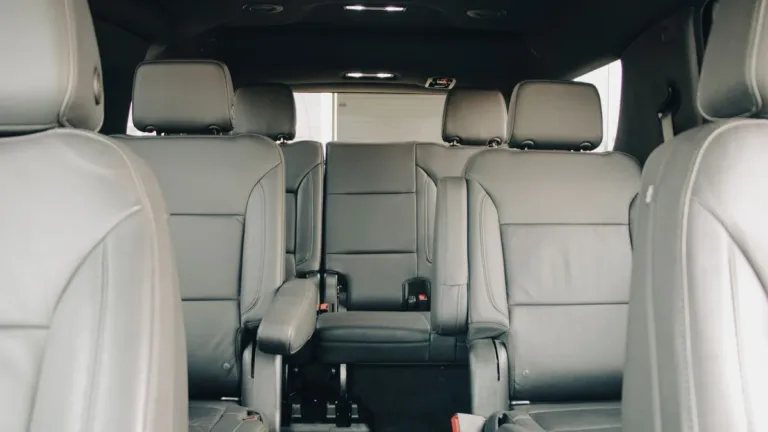
This is where most substitutions go wrong, and it has little to do with badges. Both are sold as seven-seaters; in both, the third row suits children or short adults on short legs, and raising it swallows most of the luggage floor.
Counting bags honestly
Toyota Indus quotes a luggage compartment capacity of 716 litres for the Fortuner, without stating the seat configuration behind that figure, so do not read it as space behind a raised third row. iDrive’s own vehicle pages list the Toyota Fortuner for hire at seven passengers and four large cases, and the Land Cruiser Prado 150 at seven passengers and five large cases. Read the small print on both pages: the case counts assume the third row is folded, and with all seven seats in use you are down to hand baggage and soft bags. The same class page puts the space behind the Fortuner’s raised third row at around 296 litres.
A workable way to think about it:
- Third row folded: four or five adults, and the difference between the two vehicles is roughly one large case. A Fortuner is a fair substitute.
- Third row up: six or seven people, and luggage shrinks to cabin bags and soft holdalls in either vehicle. The substitution question becomes secondary to the luggage question.
- Six adults plus airport luggage: neither vehicle alone is the right answer. Two vehicles, or a van, will be cheaper than the argument.
Two practical checks before you accept either vehicle for a full load: ask whether a roof carrier is fitted and permitted on that car, and ask the operator to confirm in writing how many large cases will fit with the exact seat layout you need. The premium SUV and 4×4 class page is explicit that capacity is not confirmed from the class alone; it asks for your passenger and luggage numbers so they can be checked against the vehicle.
Prado or Fortuner for northern areas: 4×4 systems and ground clearance
The question of prado or fortuner for northern areas is really a question about how the four-wheel drive works and who is driving it.
Part-time versus full-time, in plain terms
The Fortuner’s part-time system spends most of its life in rear-wheel drive. The driver switches to 4WD high on loose gravel, snowmelt or mud, and to 4WD low for steep, slow, rough climbs. Toyota Indus also lists a rear differential lock, downhill assist control and active traction control. Used properly, that is a genuinely capable package; Toyota Indus’s spec sheet quotes 279 mm of ground clearance for the GR-S.
The Prado 250 drives all four wheels all the time and splits torque through a central differential; Toyota Australia’s sheet also lists crawl control and active traction control. The practical advantage is that nobody has to decide when to engage it. On a road that alternates between good tarmac, a wet landslide scar and a gravel diversion every few kilometres, that matters. Part-time systems should not be left in 4WD high on dry, grippy tarmac, so a Fortuner driver on a patchy road is either switching often or compromising.
What the roads actually demand
The UK government’s FCDO travel advice for Pakistan notes that many roads in remote northern areas are of very poor quality, that landslides frequently block or destroy roads, and that the N15 between Chilas and Babusar is inaccessible at some times of year. It advises using experienced local drivers and travelling only in clear weather. Dawn reports that the Babusar Top road, at about 13,700 feet, usually stays closed from November to June because of snow. The FCDO adds that monsoon rains, usually late June to early October, bring flooding and landslides, so the open season and the wet season overlap.
In the summer window, on the main paved routes to Naran, Chilas, Hunza and Skardu, the difference between the two systems is modest and an experienced driver makes it smaller. The case for insisting on a Prado is strongest in the shoulder seasons and on itineraries with repeated mixed surfaces, especially with older passengers who will feel every correction.
Neither vehicle changes a travel advisory, a seasonal closure or a landslide. If you are a UK or dual-national traveller, read the FCDO pages yourself and check what your travel insurance says about areas under an FCDO warning. The National Highways and Motorway Police run a travel advisory service and FM 95 radio worth checking on the morning of a long drive.
Ride comfort on long motorway legs
For overseas families, the longest single leg is often not in the mountains at all. It is a motorway day from the airport to a home town, or a run between two cities for a wedding, and this is where the Prado’s size shows most.
A longer wheelbase and a wider track generally make a vehicle settle faster over expansion joints and feel less busy on a crosswind, and the Prado 250 has about 105 mm more wheelbase and 125 mm more width than the Fortuner on the manufacturers’ figures. Two extra gears should also let it run at lower engine speed at a steady cruise. Toyota Australia fits adaptive variable suspension to two of its Prado grades, though what arrives on a Pakistani import depends on its source market.
The Fortuner’s case is different, not weaker. It is narrower, which helps in the inner lanes of Lahore’s old city or a Rawalpindi mohalla on the way to a family home. For one or two adults in the second row on a single motorway day, few passengers will notice the substitution. For three adults across the second row on consecutive long days, most will.
A fair test: if the heaviest day of your trip is under about six hours of paved road and the second row carries two adults, accept the Fortuner. If it is two or more long days back to back with three adults abreast, ask for a Prado or ask for the difference to be reflected in the price.
The price gap on hire, and what it buys
Expect a Prado to be quoted above a Fortuner, but the gap is not fixed and we are not going to pretend there is a standard number. It moves with the Prado’s generation and age, with season, city, the length of the booking and whether a driver’s overnight allowance is involved.
What the extra money buys:
- Width and wheelbase, which you feel with three adults in the second row on long days.
- Full-time four-wheel drive, which you feel on mixed surfaces, less so on good tarmac.
- Presence, which matters for a wedding, a protocol arrival or a senior guest, and not at all for a family airport run.
It does not buy more engine, if the Prado is a 250 and the Fortuner is the current diesel, because on the published figures they share one. If none of the three points above applies to you, a Fortuner at a lower price is simply the better purchase, not a compromise.
When you request quotes, ask for both vehicles priced on the same itinerary, with the same driver terms and the same inclusions: fuel, tolls, driver’s room and meals, and waiting time. Only then is the difference real. On iDrive you can start from planning your journey on iDrive and add the model preference in the notes; the platform books a vehicle class, so a named model is a request to be confirmed, not a given.
How to pre-approve a Fortuner instead of a Prado, in writing
Almost every hire dispute over vehicles comes from the same gap: the customer thought they booked a model, the operator thought they booked a class. iDrive’s premium SUV class page says it plainly: “You book the class, not a named car.” Both the Fortuner and the Prado sit in that class. So the useful move is not to argue about substitution after the fact but to state your terms for a Fortuner instead of Prado before anyone confirms anything.
- Say which you prefer and why. “Prado preferred because three adults will sit in the second row for two long days” is a reason an operator can act on. “Prado only” with no reason tends to get a yes that means maybe.
- State the acceptable alternative. Name the Fortuner explicitly, and specify diesel and four-wheel drive if any leg leaves the motorway network.
- Set minimum conditions. Model year or maximum age, working air conditioning for all three rows, a full-size spare and tyres suitable for the route. iDrive’s class page publishes a five-year age limit for this class; ask what applies to your booking.
- Tie luggage to the seat plan. Write the passenger count and the number of large cases, and ask for confirmation that the substitute carries both together.
- Agree the price consequence. If a Fortuner arrives where a Prado was priced, what changes? Get that answer before travel, not at the kerb.
- Set the refusal line. For wedding and protocol work, say plainly that a substitute is not acceptable and ask what the operator will do if no Prado is available.
An example of wording you might send, which you should adapt to your own trip:
Example: “Premium SUV / 4×4 for 12 to 18 June, Islamabad airport to Hunza and back. Land Cruiser Prado preferred for second-row comfort. A Toyota Fortuner diesel 4×4 is acceptable for this trip provided it is no more than five years old, carries five adults and four large cases with the third row folded, and the price reflects the change. Please confirm in writing which vehicle is assigned before 10 June.”
Substitutes that are not like-for-like
A Land Cruiser 200 or 300 offered in place of a Prado is an upgrade that sits in iDrive’s VIP SUV class; accept it if the price has not moved, and treat any charge added afterwards as a new booking you can decline. A crossover such as a Sportage or Tucson is monocoque with less clearance, so it is no stand-in for either Toyota on a northern route. And a 150-series Prado sent where a Land Cruiser Prado 250 was discussed is an older, differently engineered vehicle: if the generation matters, name it.
If your plans also involve Pakistan Taxi or Saudi Arabia
Some families plan the Pakistan leg with a lighter touch, starting from an enquiry rather than a firm booking. Our sister service Pakistan Taxi covers premium SUV journeys on the same network, and the substitution principles above apply there too: state the preferred model, the acceptable alternative and the luggage plan up front.
Diaspora families often route through the Gulf or combine a Pakistan visit with Umrah. For the Saudi leg, our sister company Saudi Cab Co arranges premium SUV transfers, where the typical vehicles are large American SUVs rather than Toyotas, so the substitution questions change with the fleet.
Questions people ask
Is the Fortuner a real 4×4 or just an SUV?
The diesel Fortuner sold by Toyota Indus is a body-on-frame vehicle with part-time four-wheel drive, a low range and a rear differential lock. That is a real 4×4. The main difference from a Prado is that the driver has to engage four-wheel drive.
Which is better for Skardu or Hunza, Prado or Fortuner?
In summer on the main paved routes, both work well with an experienced driver. The Prado earns its premium with three adults in the second row, repeated mixed surfaces or shoulder-season travel.
Do the Prado and Fortuner have the same engine?
The current Pakistani Fortuner diesel and the 250-series Prado published by Toyota Australia both use the 2.8-litre 1GD-FTV rated at 150 kW and 500 Nm. Older Prados on hire fleets may carry different engines, so ask which generation is being sent.
Can I insist on a Prado when I book?
You can state a Prado preference and ask for written confirmation of the assigned vehicle. On iDrive the booking is for a vehicle class, so a named model is only yours once it is confirmed.