Your Pakistan. Your Journey.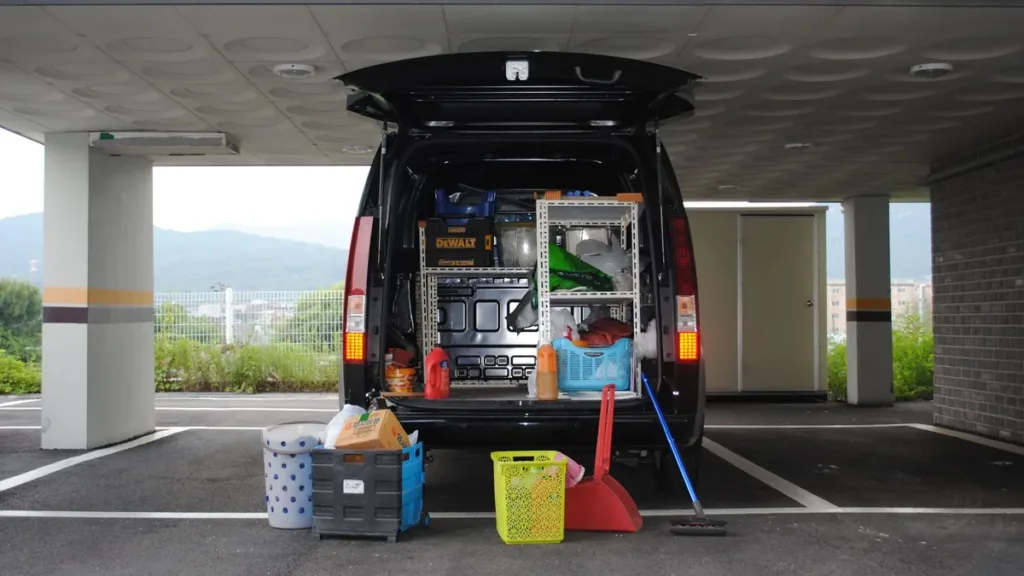
Motorway weight limits in Pakistan are written for goods vehicles, not for the van or double-cab pickup you hire with a driver. The axle and gross-weight tables in the National Highways Safety Ordinance 2000, and the NH&MP dimension rules notified in 2018, govern trucks, trailers, tankers and abnormal loads. A passenger vehicle carrying a camera crew’s cases or a trade-show stand is bound by something simpler and easier to breach: the maximum laden weight on its own registration, the general duty to mark any load that sticks out, and the ban on certain vehicle types entering the motorway at all. If your kit fits inside the vehicle, weighs less than the vehicle is registered to carry with everyone aboard, and nothing overhangs, you are within the rules. If any of those three fails, you need a different vehicle, not a cleverer way of strapping things down.
Motorway weight limits in Pakistan: what the NH&MP rules cover
Two official texts sit behind almost every question about weight on the M-1, M-2, M-4 and the rest of the network. Both are published by the National Highways and Motorway Police on its traffic rules page.
The National Highways Safety Ordinance 2000
The National Highways Safety Ordinance is the parent law. Its Sixth Schedule sets the axle-load limits that people usually mean by “motorway weight limits”: 12 tons on a single axle, 22 tons on a tandem, 31 tons on a tridem and 5.5 tons on the front axle, with gross weights ranging from 17.5 tons for a two-axle truck up to 61.5 tons for the largest articulated combinations listed. Those figures are for trucks. A loaded Hiace or Hilux is nowhere near them.
The clause that does reach passenger vehicles is section 43(4). It forbids driving any motor vehicle on a national highway whose laden weight exceeds the maximum laden weight in its certificate of registration, or whose weight on any axle exceeds the maximum stated for that axle. That is the real ceiling for a hired van: not a motorway-wide number, but the figure attached to that specific vehicle.
Two definitions in the same Ordinance matter for equipment. “Goods” expressly excludes the personal luggage of passengers travelling in the vehicle. And a heavy transport vehicle is one whose registered axle weight exceeds 5,000 kg or whose registered laden weight exceeds 6,500 kg. Your suitcases are luggage; a crate of lighting rigs travelling for a paying client arguably is not. That distinction rarely matters at a checkpoint, but it frames how an officer, an operator and an insurer will look at the load.
The Dimension of Goods Transport Vehicles Rules 2017
The NH&MP dimension rules were notified by the Ministry of Communications as S.R.O. 308(I)/2018 and published in the Gazette on 8 March 2018. They apply to all goods transport vehicles using national highways and motorways, and a goods vehicle that breaches the dimensions in the First Schedule is not allowed on them. The schedule starts small:
| Code in the rules | Vehicle | Key limits |
|---|---|---|
| G1 | Pickup (two-axle, single row of seats) | Length 3.50 m, width 2.50 m, height 3.00 m; registered laden weight under 2,500 kg |
| G2 | Mini truck (single row of seats) | Length 3.5-5.3 m, width 2.50 m, height 3.50 m, effective rear overhang 1.30 m; registered laden weight under 6,000 kg |
| G10 | Two-axle rigid truck | Length 12.00 m, width 2.55 m, height 4.30 m |
| Abnormal load | Indivisible single piece | Over 65.5 tons laden, or over 19.8 m long, 2.9 m wide or 4.9 m high including the vehicle |
Notice that vehicle height and width in these rules include the load. A pickup is measured to the top of whatever is stacked in it. Notice too that the pickup and mini-truck categories are defined around a single row of seats. A double-cab pickup booked with a driver to carry people is not the vehicle those codes describe, which is why the registration figure under section 43(4) is the number to ask about.
The same rules set out the abnormal-load procedure: an application to NH&MP on Form-A, a fee of thirty rupees per kilometre of national highway or motorway, daytime movement only, and a lead car, rear vehicle and mobile workshop escorting the load. No event or film production should be anywhere near that category with passenger vehicles, but it is useful to know the line exists and how far away it is.
Vehicles prohibited from using motorway lanes, and the ones that must keep left
Before weight comes access. The Highway Code printed in the Ordinance’s schedules is blunt about the motorway: entry of animal-drawn vehicles, farm machinery including tractors and harvesters, and construction machinery including rollers and bulldozers is prohibited on any part of it, slip roads and shoulders included. The 2017 dimension rules add a restricted category for agricultural tractors towing trolleys or tankers, which cannot use national highways and motorways except under the abnormal-load permission route.
For equipment moves, the practical consequences are these:
- A tractor-drawn generator or a self-propelled lift cannot simply follow your convoy onto the M-2. It needs its own transport on a proper goods vehicle.
- Transport vehicles and any vehicle drawing a trailer must use the extreme left lane except when overtaking or when safety requires otherwise. A van towing a box trailer of kit will be slower and in a fixed lane; plan the timing around that.
- You may not stop on a slip road or any part of the motorway, shoulder included, to pick up or set down anyone. A crew cannot be collected at an interchange ramp because it is closer to the venue. Use the service areas or leave the motorway.
If the kit needs a towed trailer at all, say so at the start. It changes the vehicle, the lane, the journey time and whether a given driver is licensed for it.
Roof carriers and overhanging loads on hired vehicles
This is where most equipment trips go wrong, because a roof rack looks like free space. Searches for a luggage carrier on car Pakistan routes mostly come from families with too many suitcases, but the logic is the same for kit, and it is less forgiving.
What the rules say
We found no clause in the Ordinance that bans a roof carrier outright. What the Highway Code does require of every driver is to observe the prescribed limits while hauling wide and protruding loads, and to mark the ends of the load with a red flag by day and a red light by night. It also requires that a vehicle is not driven unless it is in fit mechanical and technical condition and meets body-building requirements. Under the dimension rules, where a load protrudes from one of the conditional-access vehicles, NH&MP permission is needed and the vehicle must travel with lead and rear escorts.
What that means in practice
- Weight on the roof counts twice. It counts towards the laden weight under section 43(4), and it raises the centre of gravity. The vehicle and the rack each carry their own roof-load rating, and the lower of the two is the one that counts; ask the operator what the handbook allows rather than guessing.
- Nothing should overhang the windscreen or tailgate. A lighting truss or banner pole sticking out behind a pickup is a protruding load and needs marking, and at motorway speed it is a hazard to the car behind.
- Wet and wind are the other risks. Flight cases on a roof in monsoon rain or on an exposed, windy stretch of motorway take a beating even if the straps hold.
- A canopy beats a rack. For a pickup, a fitted canopy or hard tonneau keeps the load inside the vehicle’s footprint, which is the simplest way to stay on the right side of every rule above.
Our own vehicle pages say it plainly: on the Toyota Hilux Revo page the open bed is treated as exposed and unsecured unless a canopy or tonneau is fitted. That is the default assumption you should make for any hired pickup.
Van, pickup with driver for equipment, or a separate goods vehicle
The comparison is less about horsepower than about where the load sits, who is responsible for it, and which rulebook applies.
| Factor | High-roof van | Double-cab pickup with driver | Separate goods vehicle plus car |
|---|---|---|---|
| Where the kit rides | Inside, enclosed, behind or instead of rear seats | Open bed; enclosed only with a canopy | In a dedicated cargo body |
| Weather protection | Good | Poor without a canopy | Depends on body type |
| Crew seats | Trade-off: every seat removed is space for cases | Four realistic, plus the driver | Crew travel separately in comfort |
| Length limit | Interior length of the van | Bed length; nothing past the tailgate | Set by the goods-vehicle category |
| Which rules bite | Registered laden weight | Registered laden weight, protruding-load marking | Dimension rules and Sixth Schedule axle limits |
| Best fit | Film and photo crews, exhibition stands in cases, AV kit | Rough or rural destinations, dirty or bulky kit, small teams | Staging, long items, heavy or pallet-scale loads |
When the van wins
For most event and production kit, a high-roof van is the right answer, because it keeps everything inside a single enclosed vehicle. Our group van class covers the Hiace variants and similar people-carriers; the high-roof versions are the ones with the internal height to stack flight cases behind the last row. The honest trade-off is seats. A van that carries thirteen people with hand luggage does not also carry a dozen hard cases, so count the people and the pieces together. Our guide to how many people and suitcases actually fit in each fleet vehicle is the best starting point for that arithmetic.
When the pickup wins
A pickup earns its place when the destination is rough, the kit is heavy or grubby, or you need ground clearance after the motorway ends. Think a survey team heading off the M-4 towards a rural site, or a location shoot that finishes on an unmade track. Book a pickup with driver for equipment only if the kit fits entirely within the bed, and ask for a canopy or tonneau if anything in the load would suffer from dust, rain or theft at a rest stop.
When you need a goods vehicle
Split the move once any item is longer than the bed or cabin, once the total starts to look like a pallet rather than a pile of cases, or once anything needs forklift or tail-lift handling. A small goods vehicle for the load and a car for the people is often cheaper than trying to force one vehicle to do both, and it puts the load under the rules actually written for it. The driver’s licence matters here too: under the NH&MP Drivers Licensing Authority Rules 2014, an LTV licence has a minimum age of 21 and an HTV licence 24, and an HTV Category-B applicant must already hold an LTV licence that is at least three years old. A driver licensed for a car or van is not automatically licensed for a truck.
Declaring equipment size and weight when booking
Every rule above turns on facts only you have. An operator cannot match a vehicle to a load it has never been told about, and a driver who arrives to find three extra road cases is being asked to take a legal and physical risk on the spot. Before you ask for a quote, put together a short load list.
- Count the pieces. Number of cases, bags and loose items, separately.
- Measure the largest three. Length, width and height in centimetres. The longest item decides the vehicle more often than the total volume does.
- Estimate total weight. Weigh a few representative cases on a luggage scale and multiply. State it as an estimate.
- Flag anything unusual. Batteries, fuel for generators, fragile glass, items that must stay upright, or anything needing two people to lift.
- List the people. Crew numbers and who travels with the kit, because passengers and their luggage count towards the same laden weight.
- Describe both ends. Loading access, stairs, lifts, parking restrictions and whether anyone will help the driver load.
- Name the route and stops. Motorway, highway or mountain road, and whether the vehicle will wait at a venue with the kit inside.
Put that list in the notes when you enter the journey on the iDrive booking page. The vehicle and fare you see are only as good as the information behind them, and a load that turns out larger than declared can mean a different vehicle, a revised price, or a journey that cannot go ahead as planned. If you are also sending relatives or guests to the same event with their own suitcases, our sister service Pakistan Taxi has a practical guide to what to tell the booking team about family luggage on an intercity journey.
Insurance and damage responsibility
Weight and dimensions are the rules the police enforce. Responsibility for damage is the question that actually costs money, and it is the one people most often leave until something breaks. There are three separate exposures, and they are usually covered, or not covered, by different parties.
Damage to the vehicle
If a case slides forward under braking and cracks a windscreen, or a strap buckle scores the paintwork, that is damage to the operator’s vehicle caused by your load. Ask before travel how the operator handles it, whether a deposit or excess applies, and whether it matters who did the loading. Get the answer in writing, even if only in a message thread.
Damage to your equipment
Do not assume that a passenger transport operator’s insurance extends to the value of what you are carrying. Cover for the vehicle and third parties is a different thing from cover for a client’s cameras, screens or exhibition graphics. If the kit is valuable, the right place to insure it is usually your own equipment or goods-in-transit policy. Check with your insurer that it applies in Pakistan, on the roads you are using, and in a vehicle you do not own.
Fines and roadside consequences
The Ordinance places the laden-weight duty on whoever drives or allows the vehicle to be driven, and section 43(5) lets a court presume the owner knew of an offence the driver committed. Section 75 makes carrying more than fifteen per cent over a goods vehicle’s permissible load, or more than thirty per cent over a passenger carrier’s prescribed number of passengers, an offence, and the officer who stops the vehicle is directed to order the excess goods or passengers off before it proceeds. The penalty amounts printed in the 2000 text may since have been revised; check the current figures with NH&MP rather than relying on old ones. The practical point is simpler than the legal one: an overloaded vehicle can be halted until the excess is removed, which on a motorway means your crew and kit stranded at the roadside while you arrange a second vehicle.
Three questions settle most of this before travel:
- Who loads and secures the kit, and who checks it at each stop?
- If the load is refused or has to be split at pickup because it was under-declared, who pays for the extra vehicle?
- If something is damaged, what is the process and time limit for reporting it?
Constraints worth planning around
- Tolls follow vehicle class, not weight. A goods vehicle running alongside your car pays a different toll. Our page on motorway tolls and drive times on the M-1, M-2 and M-4 explains the classes and where to check current rates.
- The left-lane rule may reach your van. The Ordinance counts most hire-and-reward passenger vehicles other than motor cabs as light transport vehicles, so assume a hired van may be kept in the left lane with the trucks, and build that into call times at the venue.
Questions people ask
What are the motorway weight limits in Pakistan for a car or van?
There is no single motorway-wide figure for passenger vehicles. The axle limits in the Ordinance’s Sixth Schedule apply to trucks. A car or van must not exceed the maximum laden weight and axle weights stated for that vehicle in its registration, which includes passengers, luggage and any equipment.
Which vehicles are prohibited from using the motorway?
The Highway Code in the Ordinance bans animal-drawn vehicles, farm machinery such as tractors and harvesters, and construction machinery such as rollers and bulldozers from every part of the motorway, including slip roads and shoulders. Tractor-trolley combinations are also restricted under the 2017 dimension rules.
Can I put equipment on a roof rack on the motorway?
No rule we found bans a roof carrier outright, but the load counts towards the vehicle’s laden weight, and anything wide or protruding must be marked with a red flag by day and a red light by night. For valuable or bulky kit, an enclosed van or a pickup with a canopy is the safer choice.
Do the NH&MP dimension rules apply to a hired pickup with driver?
The 2017 rules apply to goods transport vehicles, and their pickup category is defined around a single row of seats and a registered laden weight under 2,500 kg. A double-cab pickup carrying passengers is judged mainly on its own registered laden weight and the general protruding-load duties.