Is the motorway open or closed today? Go to the source that closes it. The National Highways and Motorway Police (NHMP) runs a live travel advisory that lists every motorway and many highway sectors, what is shut, between which kilometre markers, on which carriageway, for what reason, and when the entry was last updated. If the page will not load, ring the NHMP helpline on 130, which the force lists on its contact page. NHMP also posts on its official Facebook and X accounts and runs FM 95 road radio. Check the night before, check again an hour or two before departure, and ask your driver to check from the road. News reports and WhatsApp forwards come after these sources, not before them.
Is the motorway open today? The three-minute check
There is no single perfect channel. Each one has a job, and each has a weakness worth knowing before you rely on it.
| Source | What it tells you | Where it falls short |
|---|---|---|
| NHMP travel advisory page | Sector-by-sector closures, lane closures, diversions and weather notes, each with kilometre markers and a “last updated” stamp | Needs a working mobile data connection; entries are only as fresh as the last update from each sector |
| Helpline 130 | A person who can tell you about a specific stretch, interchange or diversion | Can be hard to get through at peak times; you get one stretch at a time, not the whole picture |
| Sector office phone numbers | Local detail from the sector that covers your road (the advisory prints a number for each sector) | You need to know which sector covers your route |
| NHMP official Facebook and X | Announcements of planned or sudden closures, fog alerts, reopening notices | Posts scroll away fast, and a reopening notice is easy to miss |
| FM 95 | Road information while you are already driving | Coverage and timing are not something you can plan around |
| Pakistan Meteorological Department forecasts | Whether fog is likely tonight or tomorrow morning; the NHMP advisory links to PMD’s daily and three-day forecasts | Forecasts risk, not closures; the police decide closures on the day |
A sensible order: advisory first, then 130 for the one stretch you are unsure about, then social accounts for anything announced in the last hour. If you are travelling with a driver, ask him to repeat the check from the road. Conditions on the Salt Range or at Kala Shah Kaku at 6am are not the conditions you saw in Islamabad at 10pm.
How to read the NHMP travel advisory without misreading it
The advisory is a plain text page grouped by zone and then by sector. The motorway sectors include M-1 (Peshawar to Islamabad), M-2 North (Islamabad to Kot Momin), M-2 South (Kot Momin to Lahore), M-3, M-4, M-11 (Lahore to Sialkot), M-14 (Hakla to D.I. Khan) and the Swat Expressway. Below them sit highway sectors, including three that together cover the GT Road from Peshawar to Lahore. Each sector carries its own phone numbers. At the top there is a legend that colour-codes entries as public protest, road and weather, clear, or other information.
Four details decide whether an entry affects you.
- “Lane Closed” versus “Road Closed”. A lane closure for road work usually means slower traffic past a cone line. A road closure means that carriageway is shut between the stated points. Read the whole line: some entries labelled “Road Closed” in the advisory describe a closure of one lane over a few hundred metres.
- The road side. Entries say North Bound, South Bound, or both. A southbound closure on M-2 does nothing to a northbound trip from Lahore.
- The kilometre markers. Motorway kilometre posts let you place a closure against your own entry and exit. A closure between two interchanges you never use is not your problem; a closure that includes your exit is.
- The “last updated” stamp. Each sector shows when it was last refreshed. An entry updated at 7:30am tells you less about a 3pm departure than you might hope.
What a real morning looked like
As an illustration, the advisory checked on the morning of 25 September 2026 showed, among other entries: M-1 closed in both directions from the Swabi area (KM 420) to the Islamabad toll plaza (KM 351) for a law and order situation, with southbound traffic diverted at Swabi Interchange; M-14 listed as closed on both carriageways from Hakla (KM 0) to Yarik (KM 290) for the same reason; heavy vehicles barred from entering M-2 northbound at Kot Momin, with HTVs and cargo vehicles also diverted off M-2 South for security reasons; and a scatter of one-lane road-work closures on M-2 near Capital Smart City, Neela Dulha, Balkasar and Kallar Kahar. For a family car heading from Lahore to Islamabad that morning, the practical reading was “M-2 usable, expect cone lines”, while anyone planning Peshawar to Islamabad by M-1 needed a different plan. That snapshot will be out of date by the time you read this, which is exactly the point: check on the day.
Why a motorway is closed today: the four usual causes
Closures in Pakistan fall into four families. They behave differently, and the right response to each is different.
Fog: the winter pattern on the plains
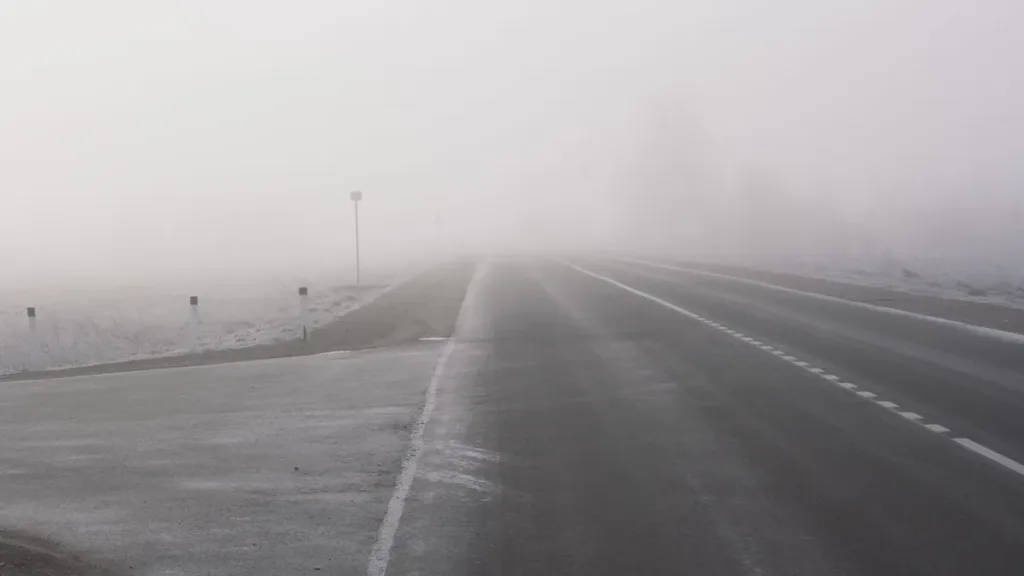
Fog is the classic reason for a motorway being closed today in December and January, and it concentrates on the Punjab and upper Sindh plains rather than the hills. In January 2025, Dawn reported that NHMP closed sections of M-1, M-2 and M-3, including M-2 from Kala Shah Kaku to Kot Sarwar, with visibility down to 50 to 60 metres. A year later, on 11 January 2026, The Nation reported fog closures across M-2, M-3, M-4, M-5 and M-11, with the Motorway Police advising people to avoid unnecessary travel and to plan journeys in daylight. Fog closures are not always a full shutdown: in November 2023, Business Recorder reported that entry to M-5 from the Rahim Yar Khan toll plaza was restricted and traffic diverted, with NHMP pointing motorists to helpline 130.
Fog closures tend to reopen as visibility improves, but nobody can promise you a time. The practical rule for winter is simple: if the forecast shows dense fog overnight, do not plan a pre-dawn departure across the plains and then hope. Move the departure into daylight or accept that you may wait at an interchange.
Protests, marches and security closures
Political marches and security operations close roads deliberately, often in advance, and often several routes at once. In late September 2026, ahead of a planned PTI march on 27 September, Dawn reported that the Punjab government had sought Rangers deployment in Rawalpindi, Attock, Jhelum and Mianwali and asked for mobile networks to be jammed at locations in Rawalpindi and across Attock district. Two consequences follow for anyone travelling. First, the obvious alternative road may be shut too, because a security plan is designed to block every approach, not just the motorway. Second, if mobile data is down, the online advisory will not load on your phone, so keep 130 and the sector numbers written down.
Maintenance and road work
Planned work usually shows up as lane closures at stated kilometre markers, sometimes with a contraflow where one carriageway carries both directions. These rarely stop a journey. They slow it, and the delay grows with traffic, so a road-work entry matters more on a Friday evening than on a Tuesday morning.
Accidents and breakdowns
Crashes produce the shortest-notice closures and the least predictable ones. They are also the least likely to appear on the advisory in time to help you. This is where a driver on the road, calling 130 or the sector office, beats any page you checked at breakfast.
Motorway closed today? What the GT Road alternative really costs
The fallback on the Lahore to Islamabad corridor is the N-5, the Grand Trunk Road. On paper it looks attractive. The M-2 is 375 kilometres long, while the N-5 kilometre markers put Lahore and Rawalpindi roughly 270 kilometres apart. Shorter, then. It is not faster. The GT Road runs through Gujranwala, Gujrat, Lalamusa, Kharian and Jhelum rather than around them, with town traffic, signals, markets, heavy goods vehicles and slow-moving local traffic sharing the carriageway. The motorway’s advantage is controlled access and a steady cruising speed; the GT Road’s is that it exists when the motorway does not.
So treat the GT Road as slower, not as a shortcut. The real time cost depends on the hour, the day, and where you join and leave it; a driver who runs the corridor regularly will estimate it better on the morning than any fixed figure can.
Three caveats matter more than the headline trade-off:
- Fog does not respect road classes. When fog closes the motorway, the GT Road is still under the same fog. It usually stays open because it is not a closed-access road, not because it is safer. Slower is the correct speed on it.
- Security closures can take both. On the same 25 September 2026 morning that M-1 was shut, the NHMP advisory also listed a law-and-order closure on the GT Road at Attock Khurd, with a diversion further along. A reroute plan that assumes the N-5 will be open is only half a plan on such days.
- Partial closures often need no reroute at all. If one M-2 section is closed, traffic is usually diverted off and back on at nearby interchanges. That is a delay, not a new route.
For drive times, toll plazas and distances on the M-1, M-2 and M-4 under normal conditions, see our guide to motorway tolls and drive times, and for how the current speed limits affect those times, the note on motorway speed limits and realistic drive times.
Decision table: wait, reroute or reschedule
| What the advisory shows | Usually the better call | Why |
|---|---|---|
| Lane closures for road work | Go as planned, allow extra time | Slower, not blocked |
| Short section closed with a diversion listed | Go, follow the diversion | You lose minutes at interchanges, not hours |
| Fog closure across a long stretch overnight | Move the departure into daylight | The alternate road has the same fog and more hazards |
| Motorway shut for a security reason, alternates open | Reroute by GT Road if timing matters | Security closures can last until the event is over |
| Motorway and alternates shut for a march or operation | Reschedule | There may be no legal way through on the day |
| Crash reported ahead, no estimate | Let the driver decide on the road | He has the live picture and the local options |
Motorway status and a booked transfer: reschedule or reroute?
If you have booked a car with driver for an intercity run, the closure is no longer only your problem, and it helps to know who decides what. On iDrive, city-to-city journeys are carried out by vetted partner operators and their drivers. The driver is the person holding the live picture; the booking team is the person who can change the booking. Use both.
A workable sequence when you see a closure that touches your route:
- Screenshot the advisory entry. Include the sector, the kilometre markers and the “last updated” time. It turns a vague “the motorway is closed” into something both sides can act on.
- Contact the driver or operator before the pick-up time, not at the kerb. Ask one question: does this change the route, the time, or both?
- Decide what cannot move. A flight out of Islamabad, a hospital appointment, a nikah at a fixed hour. If the arrival time is fixed, the departure time is what moves, usually earlier.
- Choose between an earlier departure, a reroute, or a new date. Use the table above. For fog, an earlier departure is often wrong; a later one, in daylight, is usually right.
- Put any change in writing. A new pick-up time, a different road, a changed price: all of it should be confirmed in a message you can find later.
One point people get wrong: the driver has a say that a passenger cannot override. iDrive’s draft cancellation policy, published for legal review and not yet in force, says the driver makes the final call on which road to use, when to stop and when to wait, and may decline a road or diversion he judges unsafe. It also says that where conditions make the booked journey impossible rather than merely slower, it is treated as a cancellation by iDrive. That is the right instinct in fog or during unrest, and it is worth accepting rather than arguing with at 5am on a slip road.
Who pays for extra time or distance after a motorway closure?
This is the question that sours journeys, so settle it before the car moves. A price for an intercity journey is built around a planned route and a planned duration. A long detour, several hours of waiting for fog to lift, or an overnight stop change the job the operator agreed to do. There is no automatic answer that covers every booking; what applies to yours is what is written in your Booking Confirmation and what you agree in writing on the day.
What you can reasonably expect, and what to ask for:
- If the operator cannot do the journey safely, iDrive’s draft cancellation policy lists weather, flooding, road closure, protest, security incidents and civil disturbance among the circumstances in which iDrive may cancel, and says no cancellation charge applies when iDrive cancels. The document is marked as a draft under legal review and not yet in force, so read it as the direction of travel rather than a guarantee, and check your confirmation.
- If you choose to move the date, ask for the change as an amendment rather than cancelling and rebooking. In the draft policy, cancelling more than 48 hours before pick-up is free and a 10% fee applies inside that window, and closures often appear inside it.
- If a reroute adds real distance, ask the operator to say, before departure, whether the price changes and by how much. Silence at that moment tends to become a dispute at the destination.
- If you are stuck waiting, agree whether waiting time is charged and at what point. Where no figure has been agreed, agree one.
A short example, labelled as an example: a family booked from Lahore to Islamabad for a 5am start in January sees a fog closure between Kala Shah Kaku and Kot Momin at 11pm the night before. Moving the pick-up to 9am, confirmed by message that evening, costs nobody anything and avoids the question entirely. Leaving at 5am and waiting at the toll plaza for three hours raises the question of who pays for the driver’s time. The first conversation is always cheaper than the second.
A pre-departure checklist for intercity road days
The evening before
- Open the NHMP advisory and read the sectors on your route in both directions of the journey you will make today and the return you will make later.
- Look at the PMD forecast if you are crossing the plains between November and February. Dense fog in the forecast is a reason to change the time now, not at dawn.
- Scan the news for marches, sit-ins or security notices around Islamabad, Rawalpindi, Lahore or Peshawar. These are usually announced in advance.
- Write down 130 and the sector numbers for your route on paper or in a note that works offline.
- Confirm with the operator who will call whom if the plan changes, and on which number.
On the morning
- Recheck the advisory and note the “last updated” time on each relevant sector.
- If anything has changed, message the driver before he sets off to collect you.
- Carry water, snacks and phone chargers for a wait you did not plan. Service areas on M-2 sit at Sukheki, Sial, Bhera, Kallar Kahar and Chakri, but you may be held short of the next one.
- Keep documents and any airport paperwork in the cabin, not the boot, in case you need to switch vehicles or routes.
If you are organising a same-day Lahore to Islamabad trip around a fixed appointment, our sister service Pakistan Taxi has a practical appointment-day travel checklist that pairs well with this one.
Planning the journey around closures
The operator you book with should be comfortable talking about closures before departure. When you plan a trip such as Islamabad to Lahore by car with driver, give the booking team the fixed points in your day, flight times, appointments, a wedding function, so that a closure can be worked around rather than discovered. You can set out the journey and request a vehicle through the iDrive booking page; availability and the final terms are confirmed on your Booking Confirmation, not assumed in advance.
Questions people ask
Is the motorway open today between Lahore and Islamabad?
Check the M-2 North and M-2 South sectors on the NHMP travel advisory, which together cover Islamabad to Lahore via Kot Momin. If the page will not load, call 130.
What does the NHMP travel advisory mean by “diversion”?
Traffic is being taken off the motorway at a stated point, usually an interchange, and brought back on further along. It adds time but normally does not require a completely different route.
Does fog close the GT Road as well?
Fog affects the GT Road too. Because it is not a closed-access road, it tends to stay open when the motorway shuts, which makes it usable, not safer. In dense fog the Motorway Police have advised planning journeys in daylight.