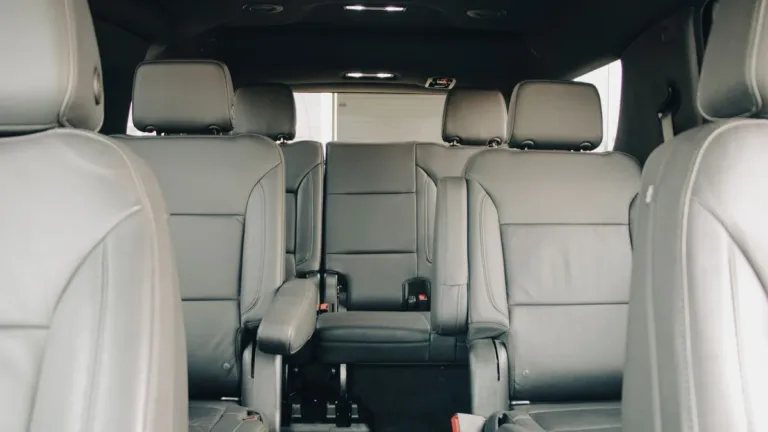
The best car for long drive in Pakistan, when the drive starts at an arrivals hall, is usually not the car you would pick on a fresh morning. After a long-haul flight in an economy seat, the things that matter are rear legroom, a seat that reclines without crushing the case behind it, a boot that swallows long-haul luggage without anything on your lap, and a quiet cabin at motorway speed. For two adults with normal luggage going Islamabad to Lahore or Lahore to Islamabad, an executive sedan is the sensible default. Add a third adult, a child seat or more than two large cases and a crossover SUV or a family MPV becomes the better buy. Six or more travellers, or a family returning with wedding luggage, belong in a van. The cheapest hatchback that “fits on paper” is almost always the wrong answer for anyone who has just crossed time zones.
Why an airport start changes the choice of car
Most advice about the best car for long distance driving assumes a rested driver choosing his own vehicle. An arrival-plus-intercity trip is different on three counts.
You are the passenger, and you are tired. The person in the back may have been travelling since the previous day, has eaten at odd hours and probably wants to sleep. A car that is fine for a two-hour business run can feel cramped by the third hour when your knees are against the front seat and you cannot lean back.
The luggage is at its peak. A trip home for a family visit or a wedding tends to arrive with the cases full: gifts, wedding outfits, sometimes a pram or a folded wheelchair. The baggage allowances quoted further down show how quickly two or three passengers reach a volume that a compact boot cannot take.
The first leg is fixed by the airport, not by you. Islamabad International Airport sits at Fateh Jang, about 25 km south-west of Islamabad, and is connected directly to the M-1 and M-2 motorways. A passenger heading for Lahore or Peshawar does not need to go into the capital at all, so the car joins the motorway within minutes and stays there. Lahore’s Allama Iqbal International Airport is about 15 km from the city centre, which means a Lahore arrival bound for Islamabad spends the first part of the trip in city traffic before reaching the M-2 at Thokar Niaz Baig. The vehicle has to cope with both.
Put those together and the question stops being “which car is best” and becomes “which class gives this group, with this luggage, a genuinely restful few hours”. That is a narrower and more useful question.
Decision summary: best car for long drive in Pakistan, by group and leg length
Use this as a starting point, then adjust for luggage using the section that follows. “Short” here means an airport run to a nearby city of an hour or two; “long” means a full motorway leg such as Islamabad to Lahore, or anything longer.
| Group | Short leg (1-2 hours) | Long leg (full motorway run) | Why |
|---|---|---|---|
| 1 adult, 1-2 cases | Standard sedan | Executive sedan | On a long leg the extra rear space and refinement matter more than the price step. |
| 2 adults, 2-3 cases | Standard or executive sedan | Executive sedan or comfort SUV | Sedan if the cases are soft or medium; SUV if two are large hard-shells. |
| 2 adults, 1 child in a car seat | Comfort SUV | Comfort SUV or family MPV | A fitted child seat takes rear width; the adult beside it needs room to rest. |
| 3-4 adults with long-haul luggage | Family MPV | Premium SUV or family MPV | Four adults plus four full-size cases rarely suit a sedan. |
| 5-8 travellers, or wedding luggage | Group van | Group van | Space to lie back and a separate luggage area beat any two-car split. |
| Principal with a security or protocol brief | Premium or VIP SUV | Premium or VIP SUV | Chosen for presence and route discipline, not only comfort. |
The table is a framework, not a promise that a particular model will be free on your date. Vehicles in each class vary by operator and city, and our booking team confirms what can actually be supplied once your enquiry is in.
Legroom and recline: how each class treats a jet-lagged passenger
Specifications list boot litres and engine sizes. A passenger coming off a long-haul flight cares about four other things: how far the rear seat is from the front seatback, whether the backrest can go back at all, how much road and wind noise reaches the cabin at motorway speed, and how easy it is to get in and out at a service area without unfolding like a deckchair.
Economy hatch
Cars such as the Suzuki Alto, Wagon R or Cultus are efficient city tools. For an intercity leg straight off a flight they fail on nearly every comfort measure: the rear bench is upright, knee room disappears if the front passenger is tall, and the boot is sized for shopping rather than suitcases. Fine for a solo traveller with a cabin bag going across town. Not a long drive sedan or SUV substitute.
Standard sedan
The Honda City, Toyota Yaris sedan and older Corolla GLi/XLi are the workhorses of Pakistani intercity travel for good reason: a proper boot, a rear bench two adults can share and a smooth ride on the motorway. The limit is the backrest, which is fixed, and rear knee room, which is adequate rather than generous. For one or two rested adults this class is perfectly good. For someone planning to sleep through the Salt Range, it is the minimum.
Executive sedan
This is where the executive sedan class, with cars such as the Honda Civic, Toyota Corolla Altis/Grande and Hyundai Elantra, earns its price. The cabin is longer, the rear seat is better shaped for sitting for hours, and the cars are quieter at cruising speed. If your honest answer to “will I want to sleep?” is yes, and there are no more than two of you with normal luggage, this is the most comfortable car for motorway travel per rupee. Boot space is similar to the standard class, so it does not solve a luggage problem on its own.
Comfort crossover and SUV
The Kia Sportage, Hyundai Tucson and Haval H6 sit higher, which makes getting in and out easier for older relatives and anyone stiff from the flight. The boot is deeper and taller than a sedan’s, so upright hard-shell cases stand rather than lie flat. Rear legroom is comparable to a good sedan. The main gain is flexibility: a child seat plus two adults, or two adults with bulky cases, without anyone nursing a bag.
Premium SUV and 4×4
The Toyota Fortuner and Land Cruiser Prado are body-on-frame vehicles with commanding seating and robust suspension. On a smooth motorway they are not necessarily more comfortable than a large sedan, and some versions trade third-row space for boot space. They make most sense when the long drive continues beyond the motorway network, or where presence and a higher driving position are part of the brief.
Family MPV and group van
For three or more adults, MPVs such as the Honda BR-V and vans such as the Kia Carnival, Hyundai Staria and Toyota Hiace change the arithmetic. Individual seats, space between rows and a genuine luggage area mean nobody has to trade comfort for cases. In a van, a tired passenger can often recline properly, which no sedan allows. The trade-off is that larger vehicles are slower through city streets and at the airport kerb, and some older van variants are noisier at motorway speed than a modern sedan.
Luggage from long-haul allowances: turning kilos into boot space
A good way to choose an airport to intercity car is to start from the baggage allowance on your ticket, because that tells you the worst case the boot must handle. Allowances differ widely by airline, fare and route, and they change, so always check your own booking. As published at the time of writing:
- Emirates uses a weight concept on most routes: 20 kg to 35 kg in Economy depending on fare, 35 kg in Premium Economy and 40 kg in Business, with no single bag over 32 kg.
- Qatar Airways also uses weight outside Africa and the Americas: Economy ranges from 20 kg to 35 kg by fare family, again capped at 32 kg per piece.
- British Airways uses a piece concept: one 23 kg bag in Economy and two 32 kg bags in Business, each up to 90 x 75 x 43 cm.
PIA and other carriers publish their own rules; check the airline’s official baggage page for your route and fare.
Worked examples
These are illustrative examples, not quotes or capacity guarantees.
- Example A: a couple on a Qatar Airways Economy Classic fare, 25 kg each, travel with two medium cases and two cabin bags. A standard or executive sedan usually works, with the cabin bags on the floor or in the boot.
- Example B: the same couple on an Emirates Flex Plus fare, 35 kg each, bring four cases including two large hard-shells. The boot is now the constraint. A comfort SUV is the safer choice.
- Example C: a family of four from London, each with one 23 kg BA bag plus cabin bags and a pushchair. Four full-size cases and a pushchair point to a family MPV or a van rather than a sedan.
Weight is only half the story; shape decides whether things fit. Two soft 23 kg holdalls pack more easily than two rigid 32 kg cases. When you send an enquiry, tell the booking team the number of cases, which are large hard-shells, and any awkward items such as a wheelchair, pram, golf bag or boxed gift. Our sister service Pakistan Taxi has a useful checklist on what to tell the booking team about family luggage on an intercity journey, and the same details help us choose the right class.
Rest stops on the M-1, M-2 and M-4
Choosing a comfortable car does not remove the need to stop. A passenger who has been sitting since check-in several time zones away will be glad of a walk, a toilet and something that is not airline food. The motorways make this easy if you plan it.
M-2: Islamabad to Lahore
The M-2 runs about 375 km from its junction with the M-1 west of Islamabad and Rawalpindi to Thokar Niaz Baig at Lahore. It has five service areas on each side, Sukheki, Sial, Bhera, Kallar Kahar and Chakri, typically 60 to 80 km apart. Bhera is roughly mid-route and the obvious single break. Kallar Kahar sits where the motorway enters the Salt Range; this hilly section, with its long bridges, is the least restful stretch for a sleepy passenger, so a stop before or after it is sensible if anyone is prone to travel sickness.
M-1: Islamabad to Peshawar
The M-1 is about 155 km with ten service areas, five in each direction. On a leg this length, a break is optional for a rested traveller but worth considering after a long-haul flight, particularly with children.
M-4: Pindi Bhattian to Faisalabad and Multan
The M-4 runs about 309 km from Pindi Bhattian, where it meets the M-2, through Faisalabad to Multan. An Islamabad arrival heading to Faisalabad or Multan therefore uses the M-2 first and then turns south, so the M-2 service areas still serve the first half of the trip. Agree the second break with your driver before you set off rather than assuming a particular facility will be open.
For typical drive times and the toll structure on each motorway, see our guide to motorway tolls and drive times on the M-1, M-2 and M-4.
Planning the breaks
- Decide before departure whether you want one stop or two, and tell the driver.
- If a child needs feeding or changing, say so at booking so the timing allows it.
- Keep medication, a charger, water and a warm layer in a cabin bag inside the car, not buried in the boot.
- For evening journeys, prefer an earlier stop while service areas are busy and well lit.
Night arrivals: what changes and what to check
If your flight from the UK, the Gulf or North America lands late at night or in the small hours, the vehicle choice does not change much. The arrangements around it do.
Official advice is consistent. The UK Foreign Office says that outside the major motorways road quality is variable, and local driving standards are erratic, especially at night. The US State Department notes that many vehicles have no working headlights and many roads are neither lit nor signed, and recommends travelling with experienced local drivers. Neither is a reason to avoid a night transfer; both are reasons to be deliberate about it.
A practical checklist for a night arrival followed by a long drive:
- Driver hours. Ask whether the driver meeting a 2 a.m. arrival has rested beforehand. A long drive in the small hours is a fatigue question for the driver as much as for you.
- Split the journey if needed. For a very late landing with a long onward leg, an airport-area hotel for a few hours and a morning departure can be the safer and more comfortable plan.
- Stay on the motorway. The motorway network is the better environment for night driving; routes that leave it for smaller roads deserve more thought after dark.
- Meeting point. Agree exactly where the driver will wait. At Islamabad, the airport’s published guidance is that you collect baggage after Customs, ANF and ASF screening, so allow for that before you expect to see the driver. Confirm whether the driver will wait in the car park or meet you inside arrivals: the airport publishes its parking charges and lifts vehicles from no-parking areas with a fine, so drivers do not idle at the kerb.
- Communication. Have the driver’s number, a working SIM or roaming, and the booking reference to hand before you leave the aircraft.
How to choose: a five-step check before you book
- Count people honestly. Include children, and note child-seat needs. A child seat uses more rear width than a child.
- List luggage by size, not weight. Large hard-shell, medium, holdall, cabin bag, plus anything awkward.
- Decide whether anyone will sleep. If yes, move up a class from what “fits”. Executive sedan over standard; MPV or van over a full SUV for groups.
- Check the leg. Airport to a city an hour away is forgiving. A full M-2 run, or anything continuing to Faisalabad or Multan, is not.
- Consider the arrival time. For late-night landings, build in a rest plan for yourself and ask about the driver’s.
Our airport transfers in Pakistan cover the collection itself, and city-to-city journeys cover the motorway legs. The two can be combined into one continuous trip from the arrivals hall to the door.
Constraints and trade-offs worth knowing
Model is not guaranteed. A class describes a level of space and comfort. Specific models within it depend on what the operator has on the day, so treat model names in this guide as examples of the class, not a promise.
Bigger is not always calmer. A premium SUV has presence, but for two people on a smooth motorway a good executive sedan can be quieter and just as restful. Pay for the space you will use.
Two cars versus one van. Splitting a group of six across two sedans can look cheaper, but it separates the family, doubles the coordination at the kerb and still leaves luggage tight. One van usually works better.
Prices vary. Fares depend on class, distance, time of day, waiting time and tolls. Our quotes are not binding until the booking team confirms them.
Questions people ask
Is a sedan or SUV better for an Islamabad to Lahore drive after a flight?
For one or two adults with normal luggage, an executive sedan is usually the more restful choice. Choose an SUV when you have large hard-shell cases, a child seat or older passengers who find a low seat awkward.
How many suitcases fit in a standard sedan?
It depends on the model and the shape of the cases. Tell us the number and size of each bag at booking and we will suggest the class that fits it without cases in the cabin.
Where should we stop on the M-2?
Bhera is the natural mid-route break. The M-2 has five service areas in each direction, and your driver can plan stops around children, prayer times or meals.
Is it safe to drive straight to another city after a night arrival?
It can be done, ideally staying on the motorway network. Official advice highlights the risks of night driving on other roads, so consider a short rest near the airport for very late landings and confirm your driver’s rest in advance.
Next step
If you know your flight, group size and luggage, send us your journey details and our team will suggest a class and send a quote for you to review before anything is confirmed.