Your Pakistan. Your Journey.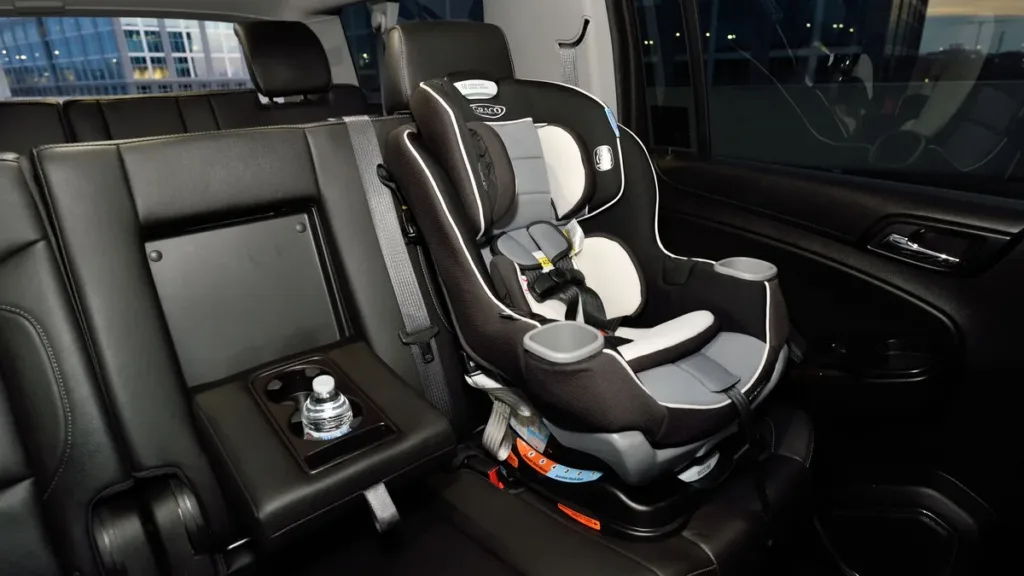
The best car for car seats in Pakistan is not the biggest car you can afford. It is the one whose rear bench has enough usable belt positions, enough width between the doors, and, ideally, ISOFIX anchor points in the places your children will actually sit. For one child seat, almost any standard sedan works. For two, a sedan works if one child is in a slim booster and the other in a compact seat; a family MPV is the safer choice. For three seats across one row, rule out most sedans and compact crossovers and plan on a three-row MPV or a van, where you can spread the seats over two rows instead of forcing them side by side.
Decision summary: which class fits your seat count
Start with the number of child seats, not the number of people. A family of five with two toddlers is a different vehicle problem from a family of five with two teenagers, even though the headcount is identical.
| Seat requirement | Economy hatch | Standard sedan | Family MPV (three rows) | Group van |
|---|---|---|---|---|
| One seat, any type | Workable, tight with a rear-facing seat | Comfortable | Comfortable | Comfortable |
| Two seats, both forward-facing or boosters | Possible, little room for an adult between them | Usually fine; middle adult will be squeezed | Comfortable, seats can go in different rows | Comfortable |
| Two seats, one rear-facing | Poor; front passenger loses real legroom | Tight; check front seat can slide forward | Good; put the rear-facing seat in row two | Good |
| Three seats across one row | Not realistic | Rarely works | Avoid across one row; split across rows two and three | Best option, subject to belt type |
| Three seats plus four adults and luggage | No | No | Only with a roof or tail compromise on luggage | The sensible class |
Car seat law in Pakistan: what is actually required
People searching for car seat law Pakistan are often surprised by how little there is. The Pakistan Safety Council’s seat-belt guidance sets out the position plainly: the current law mandates seat-belt wearing by the driver only, under section 89-B of the Provincial Motor Vehicles Ordinance, with a Rs300 fine. The council notes that Pakistan has no requirement for rear passengers to belt up, and that child-restraint rules and limits on children riding in the front are absent from current law.
Two practical consequences follow.
- No one will hand you a seat because the law requires it. With no legal trigger, a seat appears only if you ask for one, and the request has to be specific.
- Legal is not the same as safe. The absence of a rule tells you nothing about crash forces on the Lahore–Islamabad Motorway at motorway speed. Families who would never put a toddler on a lap in Manchester or Dubai should not start doing it on the M-2.
Rules change, and provinces and the motorway police issue their own enforcement drives, so treat the position above as the national baseline described by the Pakistan Safety Council rather than a permanent guarantee. If a newer rule has been announced for the city you are travelling in, follow it.
ISOFIX car rental in Pakistan: what you can and cannot count on
ISOFIX is the international fitting standard that lets a child seat clip into metal anchor bars built into the car’s seat frame instead of relying on the seat belt to hold it. It reduces fitting errors, which is why many UK and Gulf parents now own ISOFIX-only bases for infant carriers.
Here is the honest picture for anyone looking for ISOFIX car rental Pakistan:
- Some locally assembled cars list it. Honda Pakistan’s own specification list for the City 1.2LS states “ISO Fix Compatible Rear Seats”, alongside dual front airbags and five seat belts. That is the kind of manufacturer statement you want to see.
- Many spec sheets simply do not mention it. Toyota Indus’s published Hiace specification sheet sets out seat-belt types row by row but does not list ISOFIX. Silence on a spec sheet is not proof of absence, but it is not proof of presence either.
- Trim and model year matter. A current-generation car and a five-year-old example of the same badge can differ. Hire fleets in Pakistan run a mix of years, and imported vehicles such as some vans and Japanese-market MPVs follow whatever their original market specified.
The decision rule is simple. If your seat can only be installed with ISOFIX, you need the specific vehicle confirmed, ideally with a photo of the anchor points between the seat base and backrest, before you rely on it. If your seat can also be fitted with a three-point belt, you have far more choice, and that flexibility is worth more in Pakistan than any single feature.
Belt type matters as much as ISOFIX
Most forward-facing seats and all high-back boosters need a three-point belt (lap and diagonal). A lap-only belt is not enough for a booster, because the booster’s job is to route the diagonal strap across the child’s shoulder. The Hiace sheet mentioned above shows why this matters: on several variants it lists two-point (lap) belts for some passenger positions alongside three-point belts elsewhere. A lap-belt position is where a booster will not work, which quietly reduces a van’s advertised seat count to a smaller number of usable child positions.
Two seats versus three across: which classes cope
Economy hatch
Cars such as the economy hatch class can carry one seat well and two with effort. Three is not a plan. The bigger issue is the boot: a folded pushchair, a car seat you are not using yet and two suitcases will not all go in, and an arrival from Islamabad or Lahore airport with overseas luggage almost always includes at least two large cases.
Standard and executive sedans
A sedan is fine for one seat and workable for two, especially if one child is in a narrow high-back booster. Put the larger seat behind the front passenger, not the driver, so the driver keeps full seat travel. The middle position is the weak spot: on many sedans the centre hump, the fold-down armrest and a raised cushion make a seat there rock, and if the belt at that position is lap-only it is out for a booster anyway.
Family MPV
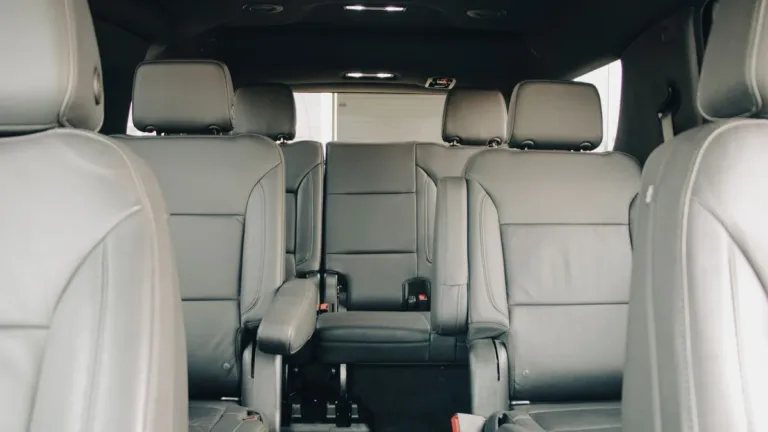
This is the class most families with two or three young children should be looking at. A three-row vehicle such as the Honda BR-V lets you stop fighting for width and start using rows instead. A workable pattern for three children:
- Rear-facing infant seat in row two, behind the front passenger.
- Forward-facing toddler seat in row two, behind the driver.
- Booster for the oldest child in row three, where a three-point belt is available.
The trade-off is luggage. Use the third row for people and the boot shrinks sharply. If you are coming off a long-haul flight with a full allowance, check the family MPV class against your luggage, not just your seats.
Group van and larger people carriers
When the brief is three seats across plus grandparents plus luggage, a van is the answer, and a well-specified people carrier such as the Kia Carnival is the comfortable end of that class. Individual seats in the middle row, where fitted, make installation easier because each seat sits on its own cushion rather than straddling a join. Commercial vans are a different matter: check the belt type at every position you intend to use, for the reason set out above.
Rear-facing seats and front-row legroom
This is the part most guides skip. A rear-facing seat for a baby or young toddler is long from front to back. Its shell, and in many cases a support leg or a rebound bar, extends forward until it contacts or nearly contacts the back of the seat in front. The UK government’s child car seat rules require height-based R129 seats to stay rear-facing until the child is over 15 months, so for many families with a baby this is not optional.
What that means in a hire car:
- The front passenger seat moves forward. In a compact sedan or hatch, that can leave a tall adult with little legroom for a four-hour motorway run. Swap which adult rides in front, or put the rear-facing seat behind the driver only if the driver is short enough to accept the loss.
- Never fit a rear-facing seat in front of an active airbag. The same UK guidance says front airbags must be deactivated before a rear-facing seat is used in a front seat. Many hire cars in Pakistan have no simple airbag switch, so treat the front passenger seat as unavailable for rear-facing seats.
In practice, one rear-facing seat pushes a family from “a sedan will do” to “a sedan is uncomfortable”, and two rear-facing seats (twins, or a baby and a young toddler) push most families into an MPV.
Booster seat in a taxi: the child most often left out
Parents plan carefully for the baby and then assume the six-year-old will be fine on a belt. A booster seat in a taxi is the cheapest safety step on the whole trip and the easiest to forget. An adult belt on a small child sits across the soft stomach and the neck; the booster lifts the child so the lap strap sits on the hips and the diagonal crosses the collarbone.
Three points to plan for:
- Backless boosters are small enough to pack. A backless cushion fits in a cabin bag or a suitcase, which makes it the realistic option for families moving between several cars across a trip.
- High-back boosters fit better but travel badly. They offer side support and a belt guide at shoulder height, but they are bulky. If your trip is one city with one car and driver, the high-back version is worth the space.
- They need a three-point belt. Confirm before the day that the seat position you plan to use has one. On a van, that often rules out the centre seat of a row.
Bringing your own seat from the UK or the Gulf
For most overseas families the most reliable option is to bring a seat you already know how to fit. You know it is not expired, it has not been in an accident, and it fits your child today.
Check the label before you pack it
UK-sold seats carry either an R129 label (height-based, marked with an E in a circle and “R129”) or an older R44 label (weight-based groups), as explained in the GOV.UK guidance. Knowing which one you own tells you how the seat is meant to be installed and at what height your child moves up.
Choose belt-fit over ISOFIX-only where you can
An ISOFIX-only base is superb in your own car and a liability in an unknown one. If you are buying a travel seat, one that can be fitted with a three-point belt as an alternative is the more useful product for Pakistan, because it widens the range of vehicles that will take it.
Airline rules for carrying car seats
Car seats create two separate airline questions: using the seat on the plane, and carrying it as baggage. Policies differ by carrier and change, so check your airline’s own pages before you fly; the points below are drawn from the sources named.
- Using the seat on board needs its own seat. Emirates’ travelling with infants page says you can bring your own approved car seat if you have booked a separate seat and paid a child’s fare, and that the airline does not provide child restraint devices.
- Approval labels matter. The US Federal Aviation Administration’s guidance on flying with children says a seat used on board must carry the label “This restraint is certified for use in motor vehicles and aircraft” or an equivalent foreign-government approval, that a seat which cannot be secured in the aircraft seat may have to be checked as baggage, and that booster seats and backless restraints may not be used during ground movement, take-off or landing. UK and EU-approved car seats are not automatically aircraft-approved, so ask your airline.
- Baggage allowances for infants vary by route. Emirates’ infant baggage FAQ lists a separate checked allowance for infants and a fully collapsible stroller or carry-cot, which moves to the hold if cabin space runs out. The same page indicates a child seat cannot be added on top of that cabin stroller allowance and points car-seat questions to Emirates’ special assistance information, so confirm how yours will be handled when you book.
The practical takeaway: a seat that fits the plane is not necessarily the seat that fits the hire car, and a booster that is perfect for the car cannot be used for take-off. Many families end up carrying one seat for the flight and a backless booster in the suitcase for the older child.
How a child-seat request changes the viable class
A request that says “family of five, two children” reads like a sedan job. A request that says “two adults, one grandparent, a rear-facing infant seat, a forward-facing toddler seat and a booster, four suitcases” gives whoever reviews it what they need to match a vehicle that can actually carry it. The second request costs thirty seconds more to write and saves an argument on the kerb.
Put these in every request:
- Number and type of each seat: rear-facing infant, forward-facing toddler, high-back booster or backless booster.
- How each seat fits: ISOFIX only, belt only, or either. This is the single detail that most changes which vehicles are suitable.
- Whether you bring the seats or need them sourced. Supply of child seats from Pakistani operators is uneven; if you need one supplied, ask for the type and the approval label to be confirmed, and treat it as a request until someone confirms it in writing.
- Every adult, with the tallest one named. The front passenger’s legroom is the first casualty of a rear-facing seat.
- Luggage by piece, including pushchair and any seat travelling in its bag.
- Journey length. A 20-minute hop across Islamabad tolerates a compromise that a Lahore–Islamabad run on the M-2 does not.
When you send a journey request through iDrive, include the seat details in the notes. The request is then reviewed against available vehicles; seat fit, vehicle and price are only settled when a confirmation comes back to you, not at the moment you submit.
Constraints worth planning around
- Heat. Dark car-seat covers and metal buckles get hot in a parked car in the Punjab summer. Cover the seat or keep it inside until the car is cool, and test buckles on your wrist before strapping a child in.
- Night driving. The UK Foreign, Commonwealth and Development Office’s Pakistan travel advice describes local driving standards as erratic, especially at night, and road conditions outside the major motorways as variable. That is a reason to have every child restrained, not a reason to relax the rule on short trips.
- Multi-car trips. Wedding weeks and family visits often mean several vehicles a day. Assign seats to cars in advance rather than moving them between vehicles at every stop.
- Travelling on to Saudi Arabia. If the same trip continues to Umrah, our sister company Saudi Cab Co has a practical guide to child car seats in a taxi in Saudi Arabia, covering what to check before that leg.
If you would rather plan a family journey through a calmer, passenger-first booking flow, family journeys with our sister service Pakistan Taxi run on the same iDrive network and let you set out seat and luggage needs as part of the planning enquiry.
Questions people ask
What is the best car for car seats if I have three children under seven?
A three-row family MPV or a people carrier. Split the seats across rows two and three instead of trying to fit three across one bench, and check that each position you use has a three-point belt.
Can I fit three car seats across the back of a sedan?
Rarely, and not with seats of unknown width in an unfamiliar hire car. Plan on three seats across only in a van or a large people carrier.
Is there a child car seat law in Pakistan?
According to the Pakistan Safety Council, the national law requires only the driver to wear a seat belt and does not require child restraints. Using a correctly fitted seat is still the safe choice.
Can I use my ISOFIX seat in a Pakistani hire car?
Only if the specific vehicle has ISOFIX anchors. Some models, such as the current Honda City 1.2LS, list ISOFIX-compatible rear seats; many spec sheets do not mention it. Ask for the exact vehicle to be confirmed, or bring a seat that can also be belt-fitted.