The cheapest taxi in Pakistan is almost always the smallest car you can safely fit into, booked for a single fixed trip, at a time of day when the driver is not sitting in traffic on your meter. On paper that means an economy hatchback such as a Suzuki Alto or Wagon R on a short city run. In practice, the lowest quote stops being the lowest the moment something on your side of the booking does not fit the car: four suitcases, a flight that lands two hours late, a motorway toll nobody mentioned, or a second car you have to find at 3am because the first one was too small.
So the honest answer has two halves. If you are one or two people with cabin bags going across town, book the economy car and stop overthinking it. If you are a family landing at Islamabad, Lahore or Karachi with checked luggage, the cheapest fare is usually the one quoted for the right-sized car, with waiting time and tolls written into the price before anyone sets off. The rest of this guide is about telling those two situations apart, and about the handful of questions that stop a low fare turning into an expensive evening.
Decision summary: where the cheapest taxi in Pakistan actually is
Fares are lowest where three conditions line up: a short, predictable distance; a small car; and no waiting. Every step away from those conditions adds cost, whoever you book with. A rough ranking, from genuinely cheapest to where “cheap” usually breaks:
- Short intra-city trips, off-peak, light luggage. An economy hatch is the right tool. The price difference against a sedan is real, and you give up nothing that matters.
- City trips with one or two checked cases. A standard sedan (Honda City, Toyota Yaris, Corolla) often costs little more than a hatch and carries the bags in the boot rather than on someone’s lap.
- Airport pickups. The distance is fixed, but the timing is not. The fare is only cheap if it already allows for flight delays, the walk out of arrivals and any parking charge at the terminal.
- Intercity runs on the motorway. Distance dominates. Tolls, fuel and the driver’s return journey are part of the real price, whether they appear on the quote or not.
- Families and groups with luggage. Here the cheapest option is frequently one larger vehicle, not the cheapest per-car rate multiplied by two.
If you only remember one line: compare the price of the whole journey, for everyone and every bag, not the headline rate of the smallest car.
The market has changed: what “cheap” means in 2026
A lot of older advice about low fares in Pakistan assumes the big ride-hailing apps are always there as a fallback. That picture is out of date. Careem, which had run ride-hailing in Pakistan since 2012, announced in June 2025 that it would end the service, as recorded on Careem’s Wikipedia entry citing Dawn and Reuters reporting. What remains is a mix of app-based services, local dispatch operators, hotel desks and pre-booked cars with a driver.
There is also a safety point that shapes the budget. The UK government’s FCDO safety and security advice for Pakistan tells British visitors to avoid street taxis, e-taxis and online taxi apps, and to use only reputable, licensed companies where you call for a taxi and the operator contacts a driver. Whatever you make of that for your own trip, it means the true “cheapest” option for a foreign visitor or a first-time returning family is rarely a car flagged down outside the terminal. It is the cheapest operator-dispatched car that fits.
The FCDO also advises against all travel to Balochistan, to much of Khyber Pakhtunkhwa and to areas near the Line of Control and the Afghan border, and against all but essential travel to further areas, including parts of Sindh north of Nawabshah and Dera Ghazi Khan district in Punjab. This guide is about ordinary airport and city journeys in places such as Islamabad, Rawalpindi, Lahore and Karachi. If your route touches an area covered by that advice, check the full FCDO Pakistan page before you think about price at all.
Car size versus suitcases: the first place a cheap fare fails
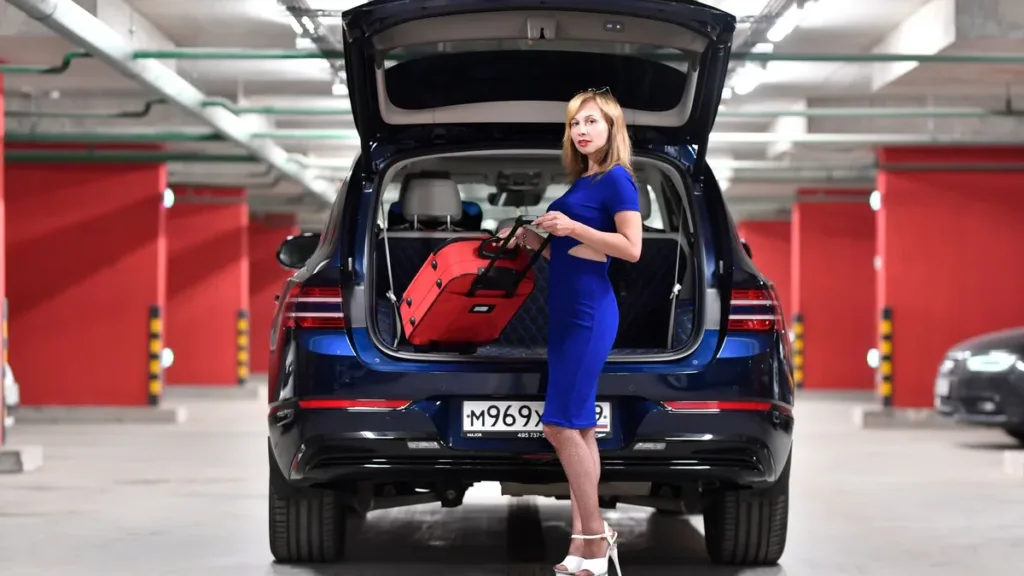
Most budget disappointments start with a boot. A small hatchback is priced for city errands, not for a family coming home from Manchester or Riyadh with two checked cases each. When the bags do not fit, the choices on the kerb are all bad: cases on laps, a case tied to a roof, a second car found in a hurry, or a driver who asks for more money to take the load. None of those is cheap.
A workable rule of thumb, before you look at any price:
- Cabin bags only: an economy hatch is fine for one or two passengers.
- One or two large checked cases: think sedan, so the cases go in the boot and the rear seat stays a seat.
- Three to five large cases, or a family of four or more: this is MPV territory, a Suzuki APV, Honda BR-V or Changan Karvaan class of vehicle, depending on how many seats you need in use.
- Wedding trips, returning with gifts, or six-plus passengers: a group van such as a Hiace-class vehicle, or two cars planned deliberately rather than improvised.
Those bands are a starting point, not a guarantee. Boot space changes a lot between models, and an MPV with every row of seats up carries far less than the brochure picture suggests. Our side-by-side guide to how many people and suitcases fit in Pakistani fleet vehicles goes model by model. The short version is to count bags honestly, including the pushchair, the car seat and the bag of mangoes going the other way.
What to tell whoever quotes the fare
A car for airport luggage in Pakistan is only priced correctly if the person quoting knows the load. Give them four numbers: adults, children (and whether any need a child seat), large checked cases, and awkward items such as a wheelchair, a folded buggy or a cricket kit bag. If you do not give the numbers, you will be quoted for the cheapest car, and the cheapest car is what will turn up.
One larger car or two small ones?
This is the question families get wrong most often, usually because two small cars look cheaper per car. They sometimes are. Often they are not, once you add up the whole journey.
| Factor | Two economy cars | One MPV or van |
|---|---|---|
| Headline fare | Two lower fares, which can add up to more than one larger vehicle | One higher fare, often less than the two combined on longer runs |
| Luggage | Split across two small boots; one car may still overflow | Bags in one place, loaded once |
| Tolls on motorways | Paid twice, once per car | Paid once, at the rate for that vehicle class |
| Waiting at arrivals | Two drivers to find and two sets of waiting time | One meeting point, one driver |
| Family together | Split, often with the elderly passenger in the car without the bags they need | Everyone in one vehicle |
| Where it wins | Short city trips when two groups are heading to different addresses | Airport runs and intercity trips with luggage |
The cleanest way to decide is to ask for both prices, for the same pickup time, with the same luggage list. If two small cars really do come out lower and the bags genuinely fit, fine. If the gap is small, one vehicle is almost always the better low cost taxi for families in Pakistan, simply because it removes the second set of things that can go wrong. Our family MPV range shows the vehicle classes that usually sit in that gap.
Hidden extras: tolls, waiting, parking and fuel
Low quotes are often low because something has been left out. None of these extras is a trick in itself; they are real costs that someone pays. The only question is whether you find out before the journey or at the end of it.
Motorway tolls
Any intercity run on the M-1, M-2 or other motorways passes through toll plazas. On the Lahore to Islamabad M-2, for example, the 375 km motorway has had toll plazas at its interchanges since the 2016 resurfacing, and an M-Tag electronic system was introduced in December 2021. Toll rates are revised from time to time, so treat any figure you see online as a snapshot. Our guide to motorway tolls and drive times on the M-1, M-2 and M-4 explains how they add up on the common routes. The point for your budget is simple: ask whether tolls are included, and if not, who pays them and how.
Waiting time
Waiting is where a cheap airport transfer in Pakistan quietly becomes an ordinary-priced one. International arrivals involve immigration, baggage reclaim and, at busy times, long queues. The FCDO notes that airports can be crowded and that baggage may be screened again. A quote that assumes you walk out the moment the wheels touch down is a quote for a journey that will not happen. Ask how much free waiting is included from the actual landing time, not the scheduled one, and what happens after that.
Airport parking and access
Pakistan’s main airports have large car parks: Karachi’s Jinnah International, reached via Shahrah-e-Faisal, has a heptagonal car park for more than 3,000 vehicles, and Lahore’s Allama Iqbal International, about 15 km from the city centre, added a three-storey car park in its expansion. A driver meeting you inside arrivals usually has to park, and parking is a charge. It may be small, but it belongs in the price you agreed, not in a conversation at the car.
Fuel and distance
Fuel prices in Pakistan are notified by the regulator, and they move. The Oil and Gas Regulatory Authority (OGRA) publishes the notified petroleum prices. A fare quoted weeks ahead for a long intercity journey may be revisited if fuel moves sharply, so ask whether the price you have is held or is an estimate. For airport runs, remember that the airport is not always close: Islamabad International sits about 25 km from both Zero Point in Islamabad and Saddar in Rawalpindi, so “a short airport hop” into the twin cities is a proper drive.
The return leg
For one-way intercity trips, the driver still has to get home. Some quotes build that in; some do not and surprise you with it. If one operator’s one-way price looks far lower than everyone else’s, the return leg is often the reason.
Booking ahead versus finding a car on arrival
There is a persistent belief that turning up and negotiating gets the lowest fare. Sometimes, for a solo traveller with a backpack, it does. For most people landing in Pakistan with luggage, it is the more expensive gamble, for four reasons:
- You negotiate at your weakest. After an overnight flight, with children and trolleys, you are not in a strong position to argue about the price or the car.
- You get what is available, not what fits. The car at the kerb is the car you get, whatever the boot size.
- Safety guidance points the other way. The FCDO’s advice to use operator-dispatched licensed taxis rather than street taxis is hard to follow if you are sourcing a car on the spot.
- Price comparison needs time. Comparing two or three written quotes is easy a week before you fly and nearly impossible in the arrivals hall.
Booking ahead has costs of its own. You commit to a pickup time before you know how late the flight will be, and cancellation terms matter if plans change. The balance still tips towards arranging the car in advance for airport pickups, late-night arrivals and any trip with more than a couple of bags. For a quick city hop in daylight, with cabin luggage, flexibility is worth more than planning.
Arriving from the Gulf or after Umrah
Many families reach Pakistan straight from Saudi Arabia or the UAE, often after Umrah, with more luggage than they left with. The same logic applies at both ends of the trip. If you are sorting ground transport on the Saudi side, our sister company Jeddah Cabs has a guide on comparing Jeddah transfers by price or capacity that uses the same “fit first, then price” thinking.
Getting the price in writing, and what the writing should say
A verbal price is a starting point for a negotiation you will have later. A written one, on a message, email or booking confirmation, is something both sides can point to. It does not need to be long. It does need to cover the things that change the total.
A useful written quote names:
- the pickup point and drop-off address, including the terminal for an airport pickup;
- the date, pickup time and, for arrivals, the flight number;
- the vehicle class, and the passenger and luggage numbers it was quoted for;
- whether tolls, parking and fuel are included or extra;
- how much waiting time is included, and the rate after that;
- whether the price is held or is an estimate that may be revised;
- the cancellation terms, and what happens if the flight is badly delayed or diverted.
If any of those lines are blank, ask. The answer may be perfectly reasonable. What costs money is discovering the answer in a car park at midnight. A request sent through iDrive is exactly that, a request: check what any quote you receive covers, and treat the journey as settled only once you have been told a vehicle and driver are confirmed. It is worth treating every quote from anyone that way.
A worked example, not a real quote
Take a hypothetical family of five flying into Lahore with six large cases, heading to a home in the city. Option one is two economy hatchbacks at the lowest advertised rate. Option two is a single MPV. On paper option one looks cheaper. Then the family discovers the hatchbacks each take perhaps two cases, one driver has to wait while the other loads, a delayed landing adds waiting time to both cars, and one case ends up in the footwell. The MPV quote, which included waiting and parking, turns out to be the lower total. The figures will differ for every trip, and sometimes two cars really do win, but the pattern is common enough to check every time.
A short checklist before you accept the cheapest quote
- Count passengers and large cases honestly, including child seats and buggies.
- Match the car class to the load before comparing any prices.
- For airport pickups, share the flight number so the pickup time can follow the landing.
- Ask what waiting time is included from actual landing.
- Ask whether tolls, parking and fuel are in the price.
- For intercity trips, ask whether the return leg is priced in.
- Compare one larger vehicle against two small ones, with the same details.
- Get the final price and inclusions in writing.
- Check the cancellation terms before you pay anything.
- Read the FCDO advice for every place on your route.
If you are planning a longer family journey between cities with a lot of luggage, iDrive’s passenger brand, our sister service Pakistan Taxi, has a practical guide to what to tell the booking team about family luggage on an intercity journey.
Next step: ask for a quote that fits
The cheapest journey is the one that happens once, in the right car, at the price you agreed. For airport runs, start with our Pakistan airport transfers page. For anything else, send your details through the iDrive booking request form: passengers, bags, flight number and addresses. The team can then quote for the vehicle that fits, subject to availability, and you can compare it with anything else you have been offered.
Questions people ask
What is the cheapest taxi in Pakistan for one person?
For a solo traveller with light luggage on a short city trip, an economy hatchback booked through a licensed operator is usually the lowest-cost option. The saving shrinks quickly once you add checked cases, airport waiting or motorway tolls.
Is it cheaper to book an airport taxi in advance?
Often, once you count waiting time, parking and the risk of getting a car too small for your bags. Booking ahead also makes it easier to compare written quotes and to follow the FCDO advice to use operator-dispatched licensed taxis.
Are motorway tolls included in taxi fares in Pakistan?
It depends on the operator and the quote. Tolls apply on motorways such as the M-2, and rates change, so ask whether they are included and get the answer in writing.
Should a family of five take one car or two?
Ask for both prices with the same passenger and luggage details. On airport and intercity runs, one MPV or van frequently costs less overall than two small cars and keeps the family and the bags together.