Your Pakistan. Your Journey.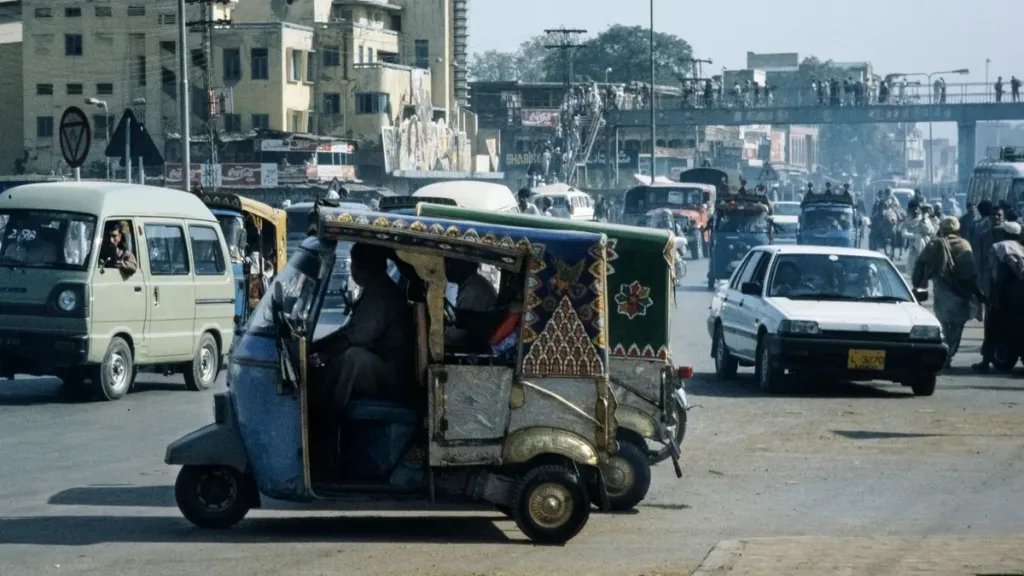
Short answer to “do taxis in Pakistan have meters?”: some older cabs still carry a meter box on the dashboard, but in everyday practice you should not expect one to be switched on, and you should never assume the number it shows is the price. Street taxis and auto rickshaws in Islamabad, Rawalpindi, Lahore and Karachi overwhelmingly work on a price agreed before the car moves. Ride-hailing apps show an estimate that can move with route, traffic and waiting. A pre-booked car from a managed service works on a quoted price for a described job, which is only as good as the description you gave it.
So the useful question is not “is there a meter?” but “which pricing model am I in, and what can change the number?” This guide takes each model in turn, sets out what tends to go wrong, and gives a checklist for agreeing a fare that survives extra stops, a long wait at a relative’s house, or a driver with no change for a 5,000-rupee note.
Decision summary: three ways a fare gets set
Every ride you take in a Pakistani city falls into one of three pricing models. They carry different risks, and the risk is mostly about who owns the uncertainty.
| Model | How the price is set | Who carries the uncertainty | Main risk | Best used for |
|---|---|---|---|---|
| Street taxi or rickshaw | Spoken agreement at the kerb, before departure | You, until the price is agreed; then the driver | Misunderstanding what the price covers; safety advice against street hails | Short hops when you know the area and the going rate |
| Ride-hailing app | Algorithmic estimate shown before booking; final figure calculated at the end | Shared, under the app’s own terms | Final amount differs from the estimate after detours, waiting or traffic | Point-to-point trips with one pickup and one drop |
| Pre-booked managed car | Written quote for a described journey or time block | The operator, provided the job matches the description | Changes to the plan on the day that were not in the quote | Airport arrivals, multi-stop days, family groups, visitors |
None of these is automatically cheaper. The street fare can undercut everything for a two-kilometre hop; it can also be the most expensive ride of your trip if, to take a made-up example, you agree “Blue Area” and later discover the driver thought you meant one end of Jinnah Avenue and you meant the other plus a wait.
Do taxis in Pakistan have meters that anyone uses?
Treat a meter as decoration unless the driver turns it on in front of you and you both agree, out loud, that the reading is what you will pay. Even then, ask what happens at the end: some drivers add a “rounding up” or a return-trip allowance for journeys to the edge of the city, and a meter does nothing to settle that argument.
For a buyer, the reason matters less than the consequence: the number on a dashboard box is not a contract. A negotiated fare also lets a driver price in things a meter ignores, such as the empty run back from an airport or an outer sector, so expect those to surface in the quote.
Rickshaws deserve their own line. Auto rickshaws are, as the Wikipedia entry on auto rickshaws notes, mainly used for short trips within Pakistani cities, alongside the motorcycle rickshaw known as the chingchi. Treat the fare as spoken, not metered. Confirm whether it is per vehicle or per person, and raise luggage beyond a small bag before you sit down.
What a “metered taxi Pakistan” search usually really means
Visitors who search for a metered taxi in Pakistan are usually after one of two things: protection from being overcharged, or a price that follows the actual distance. A meter is one way to get those. In Pakistan, the more reliable ways are a firm price agreed before departure, a written quote from a booking, or an app receipt you can challenge through the app. The rest of this guide is about making those work.
Safety first: what the official advice says about street taxis
Before the money, the part many guides skip. The UK Foreign, Commonwealth & Development Office tells travellers to avoid street taxis, e-taxis and online taxi apps, and to use only reputable, licensed companies where you call for a car and the operator contacts the driver. That is on the FCDO Pakistan safety and security page, which also flags street crime in crowded areas and advises care moving around cities at night.
The US State Department takes a similar line. Its Pakistan country information page tells travellers to remain cautious with taxis and online ride-hailing, and notes that US government staff are not permitted to use them. The overall US advisory for Pakistan sits at Level 3, “Reconsider travel”.
None of the four big cities covered here (Islamabad, Rawalpindi, Lahore and Karachi) is on the FCDO’s list of places it advises against visiting, but that list is long and it changes, so check the FCDO Pakistan travel advice before you travel, especially if your plans extend beyond these cities. The same advice notes that terrorist attacks have taken place in major cities including Karachi, Islamabad and Lahore, and its September 2026 update added information on planned protests and possible disruption, including in Islamabad and Rawalpindi.
This matters to the fare question because the safest option on paper, a car arranged through an operator, is also the one where the price is set in writing before anyone arrives. For a foreign visitor or a family collecting relatives at night, the two considerations point the same way.
Negotiated street fares: how to agree the taxi fare before the ride
If you do take a street taxi or rickshaw, the whole transaction happens in the ten seconds before you get in. Once the door is shut and the car is moving, your leverage is gone. Here is the order that works.
- Name the destination precisely. Sector and street in Islamabad (F-7/2, not “F-7”), a landmark plus block in Lahore (Liberty Market, Gulberg III), a named building in Karachi. Vague destinations are where most fare disputes start.
- Ask the price; do not offer one first. Let the driver name a number. If it feels high, counter once, calmly. A long haggle at the kerb draws attention you do not want.
- Confirm what the price includes. Per vehicle or per person? Luggage included? Any waiting? Say it back: “Seven hundred for the car, to Liberty, with these two bags.” (A hypothetical figure; ask a local for the current going rate.)
- Agree the currency and the note. Rupees only. If you are holding a 1,000 or 5,000 note, say so now: “I have a thousand, do you have change?”
- Do not change the plan mid-ride without a new price. A “quick stop” at a pharmacy is a renegotiation, not a favour.
Before you head to the road, ask a hotel desk, host family or shopkeeper what the trip should cost; a local reference point beats any rule of thumb.
When a fixed fare taxi in Pakistan beats the kerb
A fixed fare is not just a price, it is a price attached to a defined job. That is why it is worth more at some moments than others. It beats street negotiation when:
- you are arriving at an airport tired, with luggage, after dark;
- you have more than one pickup or drop-off;
- you expect to wait somewhere (a wedding hall, a hospital, a bank, a government office);
- you are travelling between cities rather than across one;
- you are booking for someone else, such as a parent landing from Manchester or Dubai, and cannot be there to negotiate.
App estimates versus the final price
The app market in Pakistan has shifted in the last two years, which is worth knowing if you last visited a while ago. Uber stopped ride-hailing in Pakistan in April 2024, and Careem suspended ride-hailing on 18 July 2025, nearly a decade after entering the market, citing macroeconomic conditions and intensifying competition, according to Dawn’s report on the Careem announcement. Other apps still operate, and their pricing models differ from one to the next.
Whatever app you use, read the number on the booking screen for what it is. In most apps it is an estimate built from a predicted route and predicted traffic. The figure that ends up on your receipt can move for reasons that are entirely routine:
- the driver takes a different route because a road is closed, a protest has shut a junction, or peak-hour traffic has jammed the obvious corridor;
- you add a stop or change the destination during the trip;
- the driver waits at the pickup point beyond the app’s free waiting window;
- tolls or parking charges are added on top, depending on the app’s rules.
Some apps work differently again. On inDrive, which has operated in Pakistan since 2021, the passenger proposes a price and drivers can accept or counter-offer: a street negotiation conducted by phone. The practical rule: an app estimate is a good guide for a single, simple A-to-B journey and a weak one for anything with stops, waiting, luggage for five, or a late-night airport run.
Fixed-fare bookings: what a quote does and does not cover
A pre-booked car from a managed service moves the pricing conversation from the kerb to your screen, before the journey. That is the main advantage: you can compare, ask questions and decide without a driver waiting and a queue building behind you.
The trade-off is that a quote is only as accurate as the job description. On iDrive, for instance, you describe the journey through the iDrive booking request form, the request is reviewed, and a price is confirmed for that described journey; submitting the form is a request, not an automatically accepted booking, and availability depends on vehicles and drivers in the area on the day. The quote reflects what you told us. If the plan changes, the price may too.
What a good quote should make explicit:
| Item | What to confirm before you accept |
|---|---|
| Pickup and drop-off | Exact addresses or terminal, not just the city |
| Vehicle type | Seats and boot space for your real luggage, not the ideal version |
| Flight tracking and waiting | How much waiting after landing is included, and the rate beyond it |
| Stops | Each planned stop listed, with rough time at each |
| Tolls and parking | Included or added, and who pays at the booth |
| Changes and cancellation | What happens if a flight is delayed or the plan shortens |
For city work, the relevant pages are taxi and car hire in Islamabad and Rawalpindi and taxi and car hire in Lahore. For a full day with the same driver rather than a string of separate trips, the chauffeur service in Pakistan is usually the cleaner fit, because the price is attached to time rather than to a single route.
Multiple stops and waiting time: where fares quietly grow
Most taxi arguments in Pakistan are not about the base fare. They are about the bit that was never agreed: the stop at a sweet shop in Saddar, the twenty minutes outside an aunt’s house that became fifty, the detour to pick up a cousin in a different sector. This is especially true of family visits, where a plan written as “airport to home” becomes “airport, collect Nani, stop for mithai, home, then the other house” by the time the bags are in the boot.
How each model treats stops and waiting:
- Street taxi or rickshaw: anything not agreed at the start is open for renegotiation. Expect the driver to ask for more.
- App: an added stop is usually recalculated, and waiting beyond any free window may be charged or lead to cancellation, depending on the platform’s own terms.
- Pre-booked car: planned stops and planned waiting can be priced in advance. Unplanned ones are handled under the operator’s change terms, which you should read before accepting.
The fix is boring and effective: write the day down before you book. List every stop, the likely time at each, and who is getting in or out where. If you need a structured way to do this for a family group, our sister service Pakistan Taxi has a practical guide to planning a multi-stop family journey that works as a pre-booking checklist.
When separate one-way rides stop making sense
A rough rule for multiple stops taxi Pakistan journeys: once you have more than two stops or more than an hour of waiting in a single day, the pricing of separate rides turns against you. Each new ride carries its own pickup wait and its own negotiation, and on a busy evening finding the next car can take longer than the stop itself. At that point, pricing the whole day as one job, with one car and one driver, usually gives a clearer total. Whether it is cheaper depends on the day; whether it is more predictable almost never does.
Cash, small notes and change
A fare agreed perfectly can still unravel at the end if you hand over a large note and the driver genuinely has nothing to change it with. Fresh cash from an exchange counter or ATM is the usual culprit, because you rarely control which notes come out.
The State Bank of Pakistan’s banknote pages list the notes in circulation, running from Rs 10 and Rs 20 up to Rs 1,000 and Rs 5,000, and they are the place to check for any denomination being withdrawn or redesigned. For taxi purposes, what matters is the split:
- Carry a working float of Rs 100 and Rs 500 notes, plus some Rs 50 and Rs 20 for tips, parking and toll top-ups.
- Break large notes early at a pharmacy, bakery or supermarket where you are buying something anyway.
- Keep the fare separate from the rest of your money, so you are not counting a thick wad in the back of a car.
- Do not assume card payment. The US State Department warns that credit card payment is not always available and can carry a large surcharge, and that ATMs may be out of service, charge high fees or limit withdrawals.
If you have pre-paid or agreed a fare through a booking, confirm in writing whether anything is still due in cash on the day (tolls, parking, extra waiting) so the driver and you are working from the same sheet.
Airport arrivals: the one ride worth fixing in advance
If you only pre-arrange one journey on a trip to Pakistan, make it the first one. You land with luggage, possibly at night, possibly with children or elderly parents, and with no local reference for what a fare to your destination should be. The arrivals forecourt is exactly the environment where a spoken price is hardest to judge and hardest to hold.
A pre-arranged pickup turns that into a known quantity: a named meeting point, a price set before you board, and someone who knows your flight number. The details differ by airport, so start with the page for your arrival point, such as Islamabad Airport taxi and transfers, and make sure the quote covers realistic waiting time for immigration and baggage.
A note for families who also travel to Saudi Arabia
If your trip pairs a visit home with Umrah, the taxi habits do not transfer neatly. Taxi pricing in Makkah, Madinah and Jeddah works on its own rules, and pilgrims face a different version of the meter-or-fixed-price question. Our sister company Hajj Umrah Taxi has a separate explainer on fixed-price versus metered taxis in Saudi Arabia. The short version for this article: do not carry Saudi assumptions about meters into a Lahore or Rawalpindi taxi.
Before-you-ride checklist
- Know which model you are in: street agreement, app estimate, or booked quote.
- State the destination exactly, with sector, block, landmark or building.
- Agree the price before moving, per vehicle, with luggage mentioned.
- List any stops and expected waiting and include them in the price.
- Clarify tolls and parking: included, or paid separately on the way?
- Check your change: small notes ready, large notes declared up front.
- Check the official advice for the places you are going, and prefer operator-arranged cars at night and on arrival.
- Keep a record: a screenshot of the app estimate or the booking confirmation.
Questions people ask
Do taxis in Pakistan have meters?
Some older cabs have a meter fitted, but it is rarely used as the basis of the fare. Expect to agree the price before departure, use an app estimate, or book a car with a quote.
Is it rude to agree the fare before getting in?
No. It is normal and expected. Drivers generally prefer a clear price at the start to an argument at the end.
Can I pay a Pakistani taxi by card?
Do not rely on it for street taxis or rickshaws. Carry rupees in small notes. Apps and pre-booked services set their own payment options, so check before you travel.
How do extra stops affect a fixed fare?
Stops you list when booking can be priced in. Stops added on the day are treated as changes and may be charged, so write the full plan down first.
Is it safe to hail a taxi on the street in Pakistan?
The UK FCDO advises visitors to avoid street taxis and taxi apps and to use licensed companies where you call the operator. Follow that advice, especially at night and on arrival.