Islamabad to Lahore is the easiest long journey in Pakistan and the one people overthink. There is one motorway, two serious bus companies and a handful of trains. The right answer depends on how much luggage you have, who is travelling with you, and whether anyone needs to be anywhere at a fixed hour.
The road: the M-2, end to end
The M-2 runs 375 kilometres from Islamabad to Thokar Niaz Baig on the western edge of Lahore. It has been open since November 1997, it is six lanes for its whole length, and it has 24 interchanges. For light vehicles the limit is 120 km/h.
Do the arithmetic honestly. At the legal maximum, 375 kilometres is a bit over three hours of running. Nobody does it in three hours: there are the approach roads at both ends, a stop, and the fact that a sensible cruising speed is not the same as the ceiling. Daewoo, who run the route for a living, schedule it at about four hours forty-five minutes to five hours. Plan around that, plus the time from your door to the motorway and from Thokar into Lahore proper.
The natural break is Bhera Interchange, roughly halfway, with fuel, food, prayer areas and clean washrooms. Travelling with children or elderly parents, plan the stop there rather than pulling in wherever tiredness lands you.
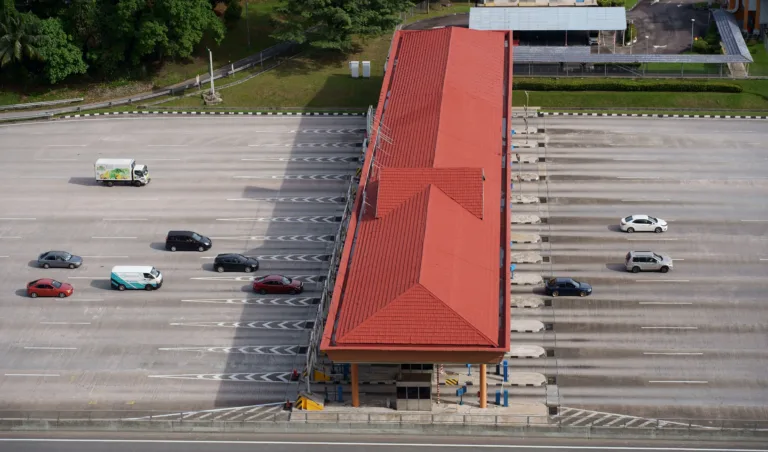
Tolls are real money on this road. The National Highway Authority raised the M-2 car toll by 7 per cent to Rs 1,430 end to end, up from Rs 1,330 the year before. Buses pay considerably more, which is part of why a coach seat costs what it does.
The one thing that reliably breaks this journey is December and January fog. In January 2026 the Motorway Police closed the M-2 from Thokar Niaz Baig to Sial Mor, along with sections of four other motorways, and reopened them later the same day once visibility improved. Fog closures are not rare and are not announced in advance. On a winter morning, whichever option you pick, build in slack.
Daewoo Express and Faisal Movers: what a seat costs
Both operators run tiered services, and the tier you buy changes the seat pitch far more than it changes the journey time. Daewoo’s cheaper product is a 40-seat air-conditioned coach with 2+2 seating, reclining seats and charging points; the premium product is a 30-seat business coach with 2+1 seating, more legroom and WiFi. Faisal Movers is structured the same way: an Executive Class 40-seater and a Business Class 36-seater with 2+1 seating.
| Option | Class | Published fare |
|---|---|---|
| Daewoo Express | Luxury / Super Luxury (2+2) | Rs 2,570 – Rs 2,860 |
| Daewoo Express | Gold / Platinum (2+1) | Rs 3,410 – Rs 3,870 |
| Faisal Movers | Executive Class | Rs 2,200 |
| Faisal Movers | Business Class | Rs 3,000 |
| Train | Economy | Rs 1,000 – Rs 2,050 |
| Train | AC Standard / AC Business | Rs 1,450 – Rs 3,150 |
Two honest caveats. The Daewoo figures come from fare-listing sites rather than one published tariff, and they disagree with each other by a few hundred rupees — the class names differ between listings too. And every source carries its own warning that prices change without notice. Treat the table as the shape of the market, not a quotation.
The fare also does not tell you where the bus leaves from or where it puts you down. Daewoo’s northern terminal for this route is in Rawalpindi, not central Islamabad, and the southern end is Thokar Niaz Baig, on the far western edge of Lahore. If you live in F-7 and you are going to Gulberg, that is two local taxis on top of your ticket and the better part of an hour added to your day. Measure the journey door to door, not terminal to terminal.
The train: cheapest, and the least predictable
Trains between Lahore Junction and Rawalpindi or Islamabad are the cheapest way to make this trip and, when they run to time, a genuinely pleasant one. The Islamabad Express covers roughly 300 kilometres in about four hours fifteen minutes and carries Economy, AC Standard, AC Business and Parlour Car. The Subak Raftar runs Lahore Junction to Rawalpindi, 290 kilometres, timetabled at about four hours thirty-five minutes.
Fares published in April 2025 put Economy on the Subak Raftar at Rs 1,000–1,050, AC Standard at Rs 1,450 and Parlour at Rs 1,900; the Islamabad Express sits a little higher at Rs 1,650 AC Standard and Rs 2,100 Parlour. Pakistan Railways adjusts these with fuel prices, so check before you count on a figure.
Now the honest part. The published timetable and the actual timetable are different documents. Reporting in 2025 described trains on major routes including Rawalpindi being suspended without prior notice, and bookings from several services combined into one train when loads were thin. Track age and maintenance are the underlying problem.
If your trip is flexible — visiting family, nobody waiting on you, an arrival two hours late is an inconvenience rather than a disaster — the train is good value and a comfortable ride. If you have a meeting, a connecting flight, or a wedding to be dressed for, do not put that on a train.
What a private car costs, and what it buys
Be clear about this: a private car with a driver is not the cheapest way to get from Islamabad to Lahore. On price per seat, a bus beats it and a train beats the bus. If cost is the only thing you are optimising for, book a Faisal Movers Executive seat and stop reading.
What a car buys is different from what a bus seat buys. It is worth paying for in five situations:
Door to door. You leave from your address and arrive at theirs. No taxi to Rawalpindi at the start, no taxi from Thokar at the end, no terminal wait. On a route where both terminals sit away from the city centres, that is often an hour saved and two extra fares avoided.
Luggage. Coach hold space is finite and shared. If you are moving a household, a month’s worth of suitcases, or anything you would rather not have loaded and unloaded by strangers, a car with a boot you control solves a problem the bus cannot.
Families of four or more. Once you are buying four or five Business Class seats the gap narrows considerably — and one vehicle with your own family in it is a different journey from five seats scattered through a coach.
Late arrivals and awkward hours. If you need to leave at 04:30 or arrive at 01:00, a private car is often the only thing that will do it at all. We charge a night surcharge for travel between 22:00 and 06:00, so an overnight run costs more than the same run in daylight — but it exists, which the alternatives frequently do not.
Multiple stops. Dropping a relative at Gujranwala, collecting documents at Kharian, calling at an office on the way out — none of that is possible on a coach and all of it is routine in a car. Tell us the stops when you ask for the quote: changes to route or timing after the price is agreed are charged separately.
If you want that, our Islamabad to Lahore taxi page covers the southbound run and the Lahore to Islamabad taxi page the return. A chauffeur fare from us includes fuel, all tolls including the M-2, parking and the driver’s pay. We do not publish live prices; we quote in writing, and once the price is quoted it is fixed.
Which one to pick
Travelling alone with a light bag on a flexible day: train, Economy or AC Standard.
Travelling alone but needing to arrive when you said you would: Daewoo or Faisal Movers, the 2+1 class if the extra thousand rupees is worth arriving unrumpled.
Two people with normal luggage: still the bus — unless the taxis at each end wipe out the saving. Work that out for your actual two addresses before you decide.
Family, heavy luggage, small children or elderly parents, a fixed appointment at the Lahore end, a night departure, or stops on the way: car.
Common questions
How long does the Islamabad to Lahore drive actually take?
The M-2 is 375 kilometres with a 120 km/h limit for cars. Coach operators schedule the run at roughly four hours forty-five minutes to five hours, and that is a realistic planning figure for a private car too, plus the time to reach and leave the motorway at each end. Add margin in December and January, when fog closures on the M-2 are common and are not announced in advance.
What is the Daewoo Islamabad to Lahore ticket price?
Published listings put the standard air-conditioned service in the region of Rs 2,570 to Rs 2,860 and the premium 2+1 business service around Rs 3,410 to Rs 3,870. Listings disagree by a few hundred rupees and all of them warn that fares change without notice, so confirm the current price with Daewoo directly before you travel.
Is the train cheaper than the bus?
Yes. Economy seats on the Lahore–Rawalpindi trains were published at around Rs 1,000 to Rs 2,050 in April 2025, below every coach class on the route, and AC Standard on most services still undercuts a premium bus seat. The trade-off is reliability: services on this corridor have been suspended at short notice, so the saving costs you certainty.
Does a private car cost more than the bus?
Yes, and we would rather say so. Per person a coach seat is cheaper, and a train seat is cheaper still. A car is worth paying for when you need door-to-door travel, when you are carrying real luggage, when you are four or five people, when you are travelling at an hour no coach serves, or when you need to stop somewhere on the way.
What is included in a chauffeur fare for this route?
Fuel, tolls including the M-2, parking, and the driver and his pay. Charged separately: waiting beyond the allowance agreed in your quote, a night surcharge for travel between 22:00 and 06:00, and any change to the route, stops or timing after the price is agreed. We do not publish live fares — we quote in writing, and the quoted price is fixed.
Where do the buses leave from and arrive?
Daewoo’s service on this route runs from its Rawalpindi terminal to Lahore Thokar, on the western edge of the city. Neither is city centre, so factor a local taxi at each end into both cost and travel time when comparing a coach ticket against a private car.